External audience scores · separate television entries
Checked 4 October 2026 · one provider per edition · scores are not averaged across seasons
Begin anime season one, Yen Press light novel volume one or Kodansha main manga volume one. Continue the main TV seasons in order; Visions of Coleus is an optional three-episode story between seasons one and two. The Japanese main novel concludes at volume twenty-three; later screen announcements are separate.
Reviewed 1 October 2026 · Opening reincarnation and third-episode village encounter; later resolutions withheld. Supplement titles can disclose later context. · Licensed access varies by country.

The source and screen branches

Optional branches are not a compulsory chain. Future cour/spinoff broadcasts are announced plans; prose conclusion does not mean every adaptation is complete.
- READ · source and main comic: Light novel volume 1 · Yen Press English edition OR Manga volume 1 · Taiki Kawakami / Kodansha ↓ Follow the chosen medium’s own volume sequence
- WATCH · main TV sequence: Season 1 · original opening → Season 2 · both parts → Season 3 → released Season 4 portions → Season 4 third cour · announced July 2027
- OPTIONAL · separate branches: Visions of Coleus · between seasons 1 and 2 Separate branch Slime Diaries / OADs / films · separate projects Separate branch Clayman Revenge · announced April 2027
Start with Rimuru’s first life change, not the latest branch
That Time I Got Reincarnated as a Slime follows Satoru Mikami, who dies and awakens in a fantasy world as a slime. The English source novel’s opening record presents this transformation as the beginning. Rimuru’s expanding relationships then make the premise useful for our building and fantasy-economics collections: abilities become interesting because other people live with their consequences.
The illustrated prose is by Fuse, with Mitz Vah’s illustrations; Yen Press publishes the English light novels. Taiki Kawakami draws the separate main manga published by Kodansha. For television, begin the original first-season opening. A novel volume, manga volume and numbered anime episode are independent identifiers, even when they present related events.
GC Novels’ Japanese volume twenty-three record explicitly identifies the main prose conclusion and gives 29 November 2025 as its release date. That verifies the Japanese source endpoint; it does not establish identical availability in every language or completion of the manga and television adaptations. Use the English publisher catalog for the English edition you intend to obtain.
Case check: protection becomes a relationship
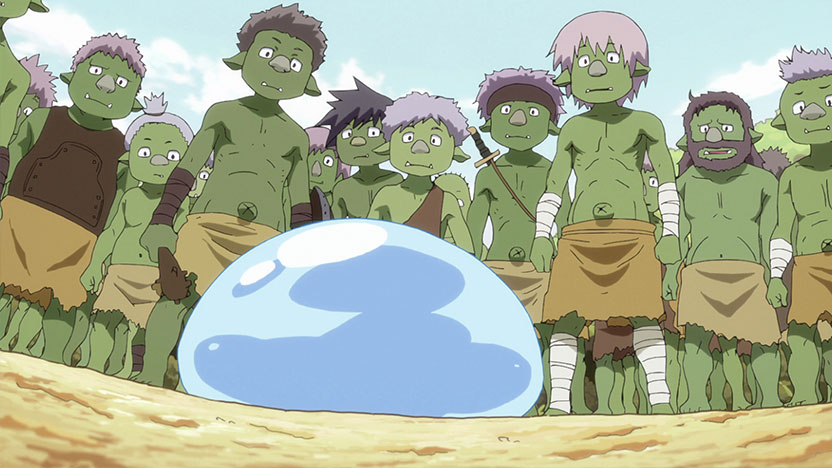
The official third-episode archive describes Rimuru helping a goblin village threatened by direwolves, then naming followers. This is a small, concrete starting point for examining how a powerful newcomer becomes part of a community. It takes place well before the newest season’s promotional setting.
The original episode-three frame below places blue slime-form Rimuru in the foreground, surrounded by goblins. The group’s varied faces and the difference in scale give the encounter a social shape. This is not the later human-form promotional image and should not be captioned as a completed national council or a victory at the end of the series.
Our reading asks what follows protection. An impressive intervention can create trust, dependence or obligation; those are different relationships. Naming likewise marks a bond, but the image alone cannot prove how power is shared. Following that distinction is more rewarding than treating every new follower as a simple addition to a strength total.
Original visual reference
A settlement is a test of what power can maintain
The most useful building lens separates defeating a threat from making life possible afterward. A community needs continuing coordination. Our editorial question is whether a personal ability becomes a resource others can rely on, and how the story handles the responsibility created by that reliance.
This changes the meaning of an encounter. An outsider’s arrival can introduce more than an opponent: it may bring knowledge, work, an expectation of hospitality or a competing claim. Paying attention to those possibilities lets viewers follow a growing society alongside the battles. It also explains why a dialogue about organization can matter even when it does not immediately change combat power.
The premise still offers the pleasure of an unusually capable protagonist. That can reduce uncertainty about some practical obstacles. A critical reading should ask what remains difficult when the leader is powerful: sustaining trust, making commitments and arranging coexistence can carry different stakes. This is a lens for evaluating the story, not a claim that every episode equally develops those subjects.
Exchange depends on more than having something valuable
For the economics collection, our comparison starts with two separate achievements: producing something useful and persuading someone outside the group to exchange for it. A service or object does not become a durable relationship merely because its maker considers it valuable. Access, expectations and confidence in the other party matter.
Rimuru’s community-building premise makes these questions appropriate without supplying a real balance sheet. Ask whether a proposal changes the lives of inhabitants, the settlement’s relations with outsiders, or only its leader’s reputation. Those outcomes can overlap, but evaluating them separately helps identify what a scene actually accomplishes.
Compare this with Realist Hero, where public office is granted early, and Bookworm, where access begins much closer to a household. Slime’s opening approaches organization through encounters with vulnerable groups. The three titles share an interest in useful knowledge while giving their protagonists different starting relationships to authority. That difference is why our thematic shelves explain the selection rather than offering a generic isekai ranking.
Main seasons first; chronological extras are an optional route
The main-screen starting route is season one, followed by both parts of season two, season three and the released portions of season four. The official story archive separates the seasons and their episode records. Use those records when a streaming interface splits a season into several entries or includes recap material beside numbered story episodes.
Visions of Coleus is an optional three-episode adventure. Its own official introduction explicitly locates the story between TV seasons one and two and identifies Fuse’s prose booklet as its source. That verified placement can be used for a chronological detour after season one. A newcomer can also follow the main season sequence and return to it later; chronological placement does not make the detour compulsory.
The Slime Diaries has a distinct anime and manga project record. OADs have a separate portal, and Scarlet Bond and Tears of the Azure Sea have separate movie portals. These pages identify different kinds of supplement; this guide does not draw a false arrow from every supplement to the next as if each were a required main episode.
A September announcement still points to future broadcasts
The official 25 September 2026 notice announces the third cour of season four for July 2027 and the Clayman Revenge TV project for April 2027. Both are future Japanese broadcast plans at this guide’s 1 October review date. The current season-four route should not be described as wholly available just because three cours have been announced.
Clayman Revenge is a separately named adaptation branch, not an alternative label for the next main-season episode. Its title and character context also make it unsuitable as the first entry for someone avoiding later-story spoilers. We keep the branch visible for planning while recommending the original opening to newcomers. Exact days, platforms and regions need their own later announcements.
The manga artist belongs in the anime’s source record
The maintained main-anime portal credits Kawakami, Fuse and Mitz Vah together under its source record. This is a useful correction to describing the screen project as though the manga’s visual authorship were irrelevant. The source novel and main manga can still be separate reading routes while both creator records matter to the franchise.
The current fourth-season staff list names Naokatsu Tsuda as director, Kenji Yasuda as deputy director, Atsushi Nakayama as supervisor, Hitomi Ogawa for series composition and Eight Bit for animation production. These are fourth-season credits, not a staff list retroactively assigned to the original opening. Production-specific labels keep a studio or director page from blending different stages into one inaccurate credit block.
Diaries and Trinity offer other viewpoints
Kodansha’s licensed Slime Diaries catalog describes a comic branch credited to Shiba, with Fuse and Mitz Vah’s source roles. The official portal separately lists Trinity in Tempest and other comic companions. A branch’s own volume one introduces that branch; it need not introduce the entire world to a reader who has never met Rimuru.
The practical choice is what you want to add after establishing the main cast: everyday interactions, another viewpoint or a separate adventure. Treat that purpose as the selection rule. Games, stage material and commemorative projects also appear in the maintained franchise navigation, but a product’s existence alone does not make it mandatory story homework.
A historical circulation figure with a geographical split
The official tenth-anniversary announcement in February 2023 reported that book circulation had exceeded forty million copies: thirty-five million domestically and five million overseas. This is a dated series-book claim, not an estimate of current English novel sales or the number of anime viewers.
The split is informative because it identifies the stated scope rather than collapsing all publishing into one territory. It still does not allocate the figure among novels, manga, individual volumes or actual readers. Nor does it reveal production costs, royalties or profit. We do not multiply the total by one retail price or use it to promise future animation quality.
A title-wide conversation can hide a format mismatch
The inspected title-community discussion of the manga’s 2022 Kodansha award includes a reader emphasizing Kawakami’s name and identifying the manga. That small exchange illustrates a useful navigation problem: readers can discuss the same franchise while referring to different creative work. The publisher licensing page independently lists the award; a Reddit reaction is not the primary award record.
For an introductory conversation, ask what changes when Rimuru’s help creates an ongoing relationship rather than resolving a single encounter. Keep the discussion labeled by season or source volume. The title wiki is valuable for later research but can disclose identities and endings. A precise anime-to-print continuation comparison remains a separate task requiring an inspected endpoint and named edition; this guide supplies the verified beginnings and branches.
Primary sources and useful navigation
- Yen Press: English light novel opening and creator credits
- Kodansha: main manga, creators and publisher award record
- GC Novels: Japanese volume twenty-three and verified main conclusion
- Official TV story archive and separate seasons
- Official episode-three case and original image
- Official fourth-season staff record
- Coleus introduction: three episodes and chronological placement
- Official 25 September 2026 announcement: two future screen branches
- Official tenth-anniversary announcement: historical publishing scale
- Kodansha licensed archive: Slime Diaries comic
- Official franchise navigation: separate anime, films and source products
Community and catalog routes
- Reddit: inspected manga-award conversation
- Reddit: title community; check medium and spoiler labels
- Fandom: title wiki; later-story spoilers
- MyAnimeList: anime catalog lookup
- Wikipedia: secondary format overview
The production and publisher links support project facts. Catalog and community pages are secondary navigation and may reveal later events.
Find this work in our thematic collections
- 5 Building and Crafting Anime Where Progress Takes Work
- Fantasy economics: five anime about trade, access and resources
Original series imagery is reproduced under permission asserted by the site owner; the source and rights credits are retained. The route diagram is Animeteor’s own explanatory graphic.
Games and live-action adaptations
- Slime ISEKAI Chronicles — Game: Side-scrolling action RPG · settlement building
- Slime ISEKAI Memories — Game: Mobile 3D battle RPG · nation building
Future television branches and a separate action game
The existing route already distinguishes Season 4 cour 3, scheduled for July 2027, from the optional Clayman REVENGE television branch scheduled for April 2027. Their missing linked adaptation records now keep those identities separate.
Season 4 third-cour record · Clayman REVENGE record
ISEKAI Chronicles is the separate released ZOC/Bandai Namco action and settlement game in the linked guide. ISEKAI Memories is a different mobile battle/building service; Lord of Tempest is another historical product. The old portal’s promotional availability wording alone does not verify that the latter still operates.