Begin Restaurant to Another World with its first TV series, then the numbered second series, or read the source prose from volume one. The Yen Press manga and separately titled NEW EDITION are distinct comic routes. Match the format before transferring a chapter or volume number.
Reviewed 1 October 2026 · Restaurant and Saturday-visitor premise; guest histories and later outcomes withheld. · Licensed access varies by country.
One provider, one identified television entry. This score is not an average of the franchise, later seasons or games.
Checked 4 October 2026The source and screen branches

The screen projects form a viewing sequence; prose and the two named comics are format branches. A home-video reissue is an edition, not another story season.
- READ · source prose: English light novels · Seven Seas → Begin the selected prose edition at volume 1 → Follow its own book sequence
- READ · choose a comic route: Yen Press manga · Takaaki Kugatsu OR Restaurant to Another World NEW EDITION NOTE Select the named comic; no shared chapter numbering
- WATCH · television sequence: Original television project · SILVER LINK. → Restaurant to Another World 2 · OLM → Exact reading continuation requires edition comparison
The prose and comics are reading routes, not extra seasons
Restaurant to Another World begins from Junpei Inuzuka’s prose, with Katsumi Enami’s illustrations. Seven Seas identifies the English light-novel route under that full format label. Choose it when you want the source presentation, and begin with its first volume. The anime’s episode numbers do not establish equivalent prose-book numbers.
Yen Press separately catalogs the manga adaptation, including Takaaki Kugatsu among its visual contributors. Its volume-one record identifies both paperback and digital editions with different ISBNs. A format selector should therefore show manga for that product even though the author and main title resemble the prose listing. The publisher’s preview contents also organizes the opening by dishes.
Another comic is explicitly titled Restaurant to Another World NEW EDITION. Crunchyroll’s dated launch notice identifies that separate title. We link the announcement for format navigation, rather than treating a historical distribution notice as a guarantee that every chapter remains playable or purchasable today. Select the named comic’s own opening; do not append its chapter one to the earlier manga’s final volume.
Case check: an ordinary doorway inside an extraordinary landscape
The licensed manga’s opening description identifies Western Restaurant Nekoya and its Saturday visitors from another world. Familiar human meals become unfamiliar experiences for those guests. This is the premise used here: a restaurant can be a shared destination for people who would otherwise remain separated by their environments.
The original anime promotional image reproduced below places the proprietor inside a warmly lit doorway while two staff figures occupy a wooded fantasy setting. The doorway’s interior light stands apart from the blue-green surroundings. This is a promotional composition, not an episode still, and it cannot prove when the pictured staff first appear in a novel or television sequence.
Our interpretation is that the visual makes a boundary feel welcoming instead of combative. A door between worlds can be a threshold for service and hospitality rather than invasion. Carry that question into the opening: what has to remain dependable inside the restaurant for guests with different expectations to feel able to return? The question is editorial analysis, not a claim about a later resolved storyline.
Original visual reference
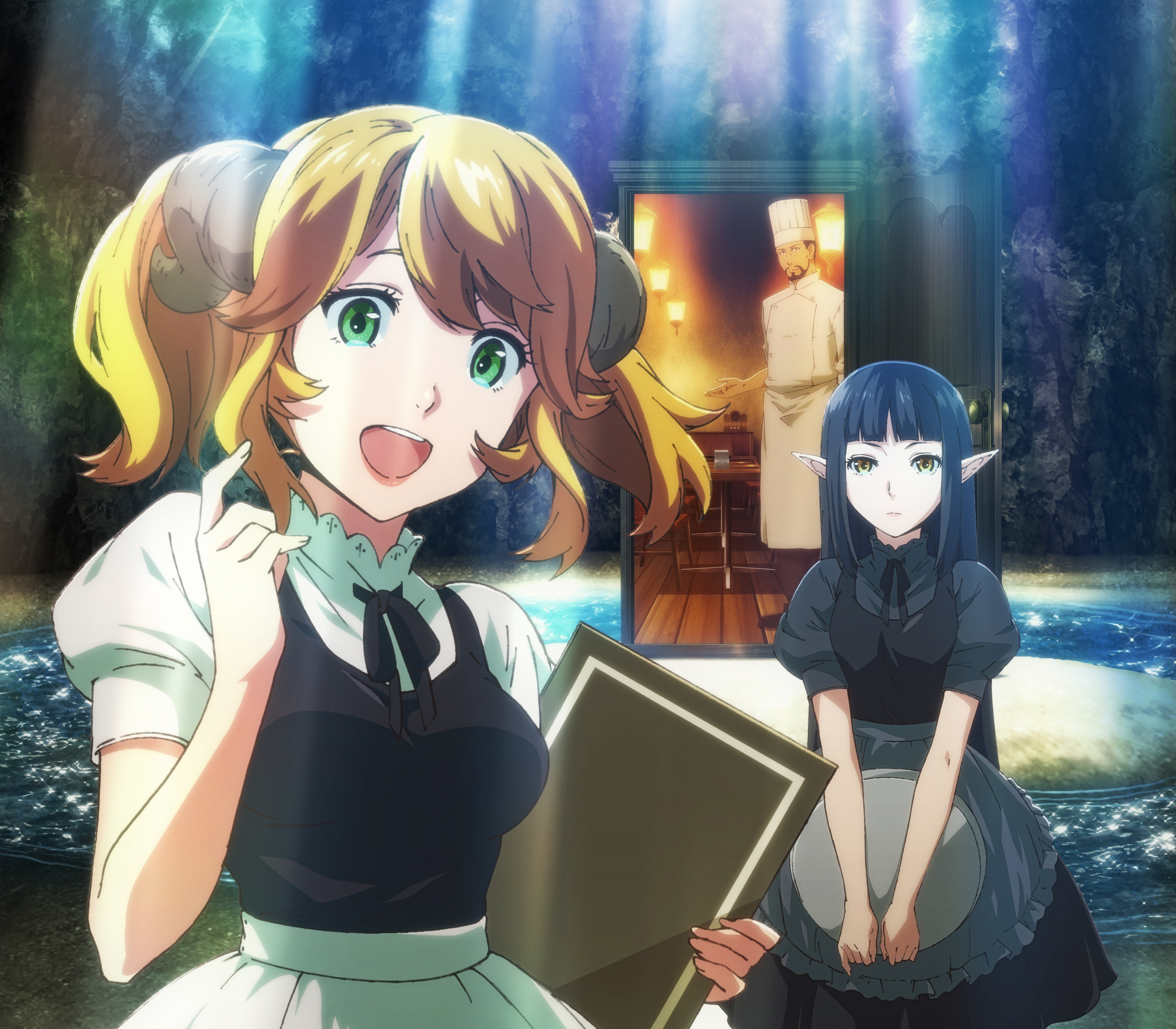
A fixed kitchen allows the guests to carry the journey
A travelling food story moves its central characters from place to place. Here the fixed restaurant lets different customers bring the outside world into one recurring space. That arrangement makes a familiar meal a possible point of contact between otherwise unfamiliar lives. The viewer can return to a stable setting while encountering a changing perspective.
This is the reason to compare it with Campfire Cooking rather than assume both offer the same experience. Mukohda’s premise joins a meal routine to travel and companionship. Nekoya offers hospitality at a destination. Choose the travelling kitchen if movement appeals most; choose the restaurant if you enjoy learning what a visitor brings to a repeated meeting place.
Our preferred reading question is how a food preference becomes a form of recognition. Remembering an order can be practical service, but it can also mean that someone has a place where their wants are understood. That is an interpretive possibility arising from the restaurant premise. It does not require revealing how any later guest’s circumstances change.
Watch the first television project before Restaurant to Another World 2
The original anime portal maintains its first-series material and records the separately numbered second project. TV Tokyo’s maintained second-series pages identify that project’s staff and episode navigation. A newcomer should use the first television opening before continuing into the second, rather than starting with whichever site has the latest copyright or product notice.
The first portal’s twelve-episode story list gives concrete examples of the meal-based presentation, including named dish pairings. Its home-video box notice was posted in 2021; that product date does not mean the first anime originated alongside the second project. Use the project label for the screen branch and the actual product listing for an edition purchase.
Season-specific animation credits matter
The original screen staff page credits Masato Jinbo for direction and series composition and SILVER LINK. for animation production. It separately names the source writer and source illustrator. Those labels identify different contributions; an anime character-design role is not the same as drawing the source books.
TV Tokyo’s second-project staff record again names Jinbo for direction and series composition, but lists OLM for animation production. That change is worth preserving in a studio guide. It does not by itself establish a measured improvement or decline in quality. Compare a specific scene or production contribution before making an aesthetic judgment from a company name.
Choose a route by format, contributor and edition identifier
The first English manga’s catalog names translation by Amanda Haley and lettering by Lys Blakeslee alongside the source and visual credits. That gives a useful checklist when distinguishing a comic edition from the English prose. Format, contributor list and ISBN provide stronger identification than a cover title alone.
If looking at NEW EDITION, retain those words in the purchase or reading link. The historical launch notice is a discovery source for another comic presentation, not proof of a compulsory sequel. This guide deliberately avoids equating three different numbering systems. An exact anime-to-reading continuation would require checking the named source and its actual adaptation coverage.
A meeting place for fantasy visitors rather than a cooking tournament
Choose this for meals, encounters and the idea of returning to a welcoming location. The guest premise includes fantastical beings, so someone seeking an entirely realistic restaurant workplace should account for that setting. Likewise, a food-focused story does not automatically promise a competition, elaborate power ranking or continuous travelling quest.
The recommendation is about narrative mood. It does not guarantee the absence of every difficult guest history, and detailed character biographies can expose more than the opening. When contributing discussion, keep a customer’s later circumstances behind a spoiler label. This guide leaves those individual histories for the viewer to discover.
Hospitality depends on reliability, not only a remarkable dish
Inside the premise, the restaurant’s attraction is repeated access to something visitors value. That gives an editorial economics question: is an establishment memorable because of rarity, dependability or its response to a particular person? These are different forms of value, and a fantasy doorway makes their relationship unusually visible.
This is not a real restaurant profit estimate. The linked project and publisher records identify staff, products and editions, but not the cost of ingredients, licensing terms or an audited production budget. We do not convert a listed book price into franchise earnings or use a fictional service arrangement as proof of real business viability. A commercial update would require properly scoped reporting.
Questions for discussion and further navigation
The title-specific secondary wiki, Reddit search and MyAnimeList lookup lead to further exploration. They may expose later guests and relationships. We have not converted uninspected comments into a claim about what most viewers prefer. The primary sources below establish the named projects and editions; community links support conversation after that orientation.
A useful prompt is whether a returning guest experiences the restaurant as novelty or familiarity. Another is how different media introduce a dish and the person ordering it. The first question invites interpretation; the second requires inspecting an actual chapter or scene. Separating those tasks makes it easier to discuss adaptation choices without pretending every difference is a chronology error.
Before you choose the next branch
Is the English manga the prose source? No: select the format label and credits. Is NEW EDITION automatically the next book? It is a separately named comic presentation. Does a season-two studio credit apply to season one? The official records identify different animation production companies.
Can the guide be expanded later? Yes. Edition availability, verified scene comparisons and precise reading continuations can be added in place. The current route diagram gives a dependable starting structure, while the source links preserve the distinctions needed for those future updates. No chapter jump is guessed from an episode count.
Primary sources and useful navigation
- Seven Seas: English source-prose route
- Yen Press: manga volume-one premise and edition credits
- Original anime portal: story list and project records
- Original anime staff: SILVER LINK.
- Second anime staff: OLM and credited contributors
- Licensed NEW EDITION launch notice (2021 archive)
Community and catalog routes
- Fandom: title-specific anime navigation (secondary, spoilers)
- MyAnimeList: anime lookup
- Reddit: title discussion search (spoilers)
- Wikipedia: secondary format overview
The production and publisher links support project facts. Catalog and community pages are secondary navigation and may reveal later events.
Find this work in our thematic collections
Original series imagery is reproduced under permission asserted by the site owner; the source and rights credits are retained. The route diagram is Animeteor’s own explanatory graphic.
A future English prose volume
Seven Seas schedules English light novel volume 7 for 28 December 2027, ISBN 9798888431351, 352 pages. It remains future at this check; this edition is not a new manga volume or an anime-season announcement.