Watch the standalone Wolf Children film first, or begin the separately labeled manga or prose edition. Ame & Yuki identifies companion reading formats, not a required sequel. A 4K remaster is another presentation of the film, while other Hosoda films are related through their creator.
Reviewed 1 October 2026 · Family inheritance, bereavement and countryside move; the children’s later choices withheld. · Licensed access varies by country.
The source and screen branches

The original film is the screen entry. Its reading versions branch into other formats; the thirteen-year story span is not a season count or a cross-format chapter sequence.
- WATCH · standalone feature: Original feature film · 2012 → Watch in release presentation → Remaster / disc / on-demand: editions, not sequels
- READ · manga adaptation: Wolf Children: Ame & Yuki · manga → Hosoda credited for story; Yuu for art → Select the manga edition; no post-film chapter required
- READ · prose adaptation: Wolf Children: Ame & Yuki · light novel → Mamoru Hosoda’s prose route → Companion telling, not the next screen installment
Begin with the film; the books are companion adaptations
Wolf Children is an original feature-film story credited to Mamoru Hosoda. Studio Chizu identifies Hosoda for direction, original story and screenplay, with Satoko Okudera also credited for screenplay. This makes the film the clearest starting route for the screen experience. You do not need to finish a television season or buy a manga first.
Yen Press offers Wolf Children: Ame & Yuki as a manga and as a separately labeled light novel. The manga credits Hosoda as author and Yuu as artist, with English translation and lettering credits on its edition record. The novel is a prose route to the same family story. These books are not an anime sequel simply because their titles add Ame and Yuki.
For a first encounter, watch the standalone film in release presentation. If you prefer reading, select the named manga or prose edition and begin at its opening. Returning to another format afterward can support comparison of narration and emphasis; it does not require an invented manga chapter at which the film supposedly stops.
Case check: a parent’s embrace and two possible forms
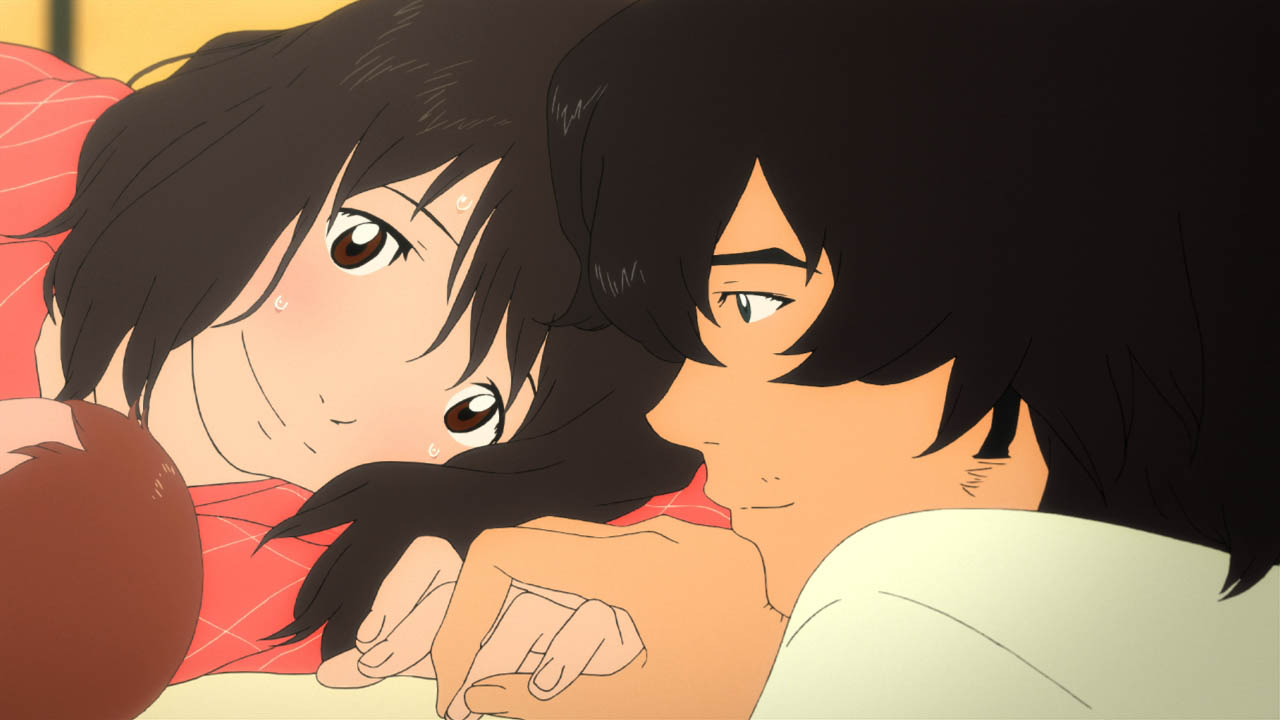
The original film image reproduced here shows Hana closely holding her two young children. The composition keeps the family together inside a small shared space. It is a useful opening visual for a guide about care: the parent’s presence is immediately legible without supplying an image of a later climactic decision.
GKIDS’ licensed introduction identifies the children’s human-and-wolf inheritance, their father’s death and Hana’s move from city life into a countryside home. Those premise facts explain the family’s practical problem without telling us which future either child chooses. The still itself is not evidence of a specific year or a scene’s placement in a novel chapter.
Our interpretation of this reference is that security begins as proximity: one person tries to hold together a household whose members have more than one way of inhabiting the world. That is a starting question for viewing, not a final judgment about Hana’s parenting. Watch how the space needed for care changes as the children become capable of making different choices.
Original visual reference
Making a home is different from choosing a child’s future
The countryside premise has a practical attraction: a different environment might give the children room that their city home cannot. But providing room and deciding what someone should do with it are different acts. Our central reading question is whether a home is successful because its members remain together or because it lets them develop a life beyond its initial arrangements.
That question makes this a strong partner to the settlement stories on our farming shelf. A house is not merely a reward for escape. It needs work, access to surroundings and relationships with other people. In a family drama, those requirements matter because the person maintaining the place cannot make every important decision on everyone else’s behalf.
The wolf inheritance also makes an ordinary parental uncertainty visible. A parent can know a child intimately and still not know what form a satisfying adult life will take for that child. Our analysis does not reduce human and wolf to a simple good-versus-bad choice. The useful distinction is between making possibilities accessible and treating one possibility as the only acceptable outcome.
Story time, release history and edition history
Studio Chizu describes a family story extending across thirteen years. That is a span inside the narrative, not thirteen screen installments. The guide’s route map therefore keeps the original feature and its reading adaptations distinct from the film’s changing family circumstances. It does not reorder scenes into a fan chronology that would reveal the children’s later decisions.
The Japanese film database JFDB records the theatrical release on 21 July 2012 and a running time of 117 minutes. GKIDS’ current licensed film page offers remastered home-entertainment routes. A new 4K presentation is an edition of this film, not a newly numbered sequel. Check the selected product’s language, subtitles and territory rather than substituting its release year for the original production year.
A shared filmmaker connects a filmography, not a canon
The studio credits Yoshiyuki Sadamoto for character design, Takaaki Yamashita for animation direction and Hiroshi Ohno for art. JFDB additionally identifies Masakatsu Takagi for music. Those are concrete contributions to the screen project; the English manga’s visual authorship is separately credited. Following one contributor is a useful discovery route, but the roles should remain attached to the correct format.
Hosoda’s other films include Summer Wars, The Girl Who Leapt Through Time and Mirai, identified in his GKIDS-hosted Reddit introduction. They can be explored as a filmmaker’s related work. They are not required prequels to Hana’s story, and shared interests in family, growth or unusual worlds do not by themselves establish a connected fictional universe.
A reviewed creator discussion adds a second perspective
In the 2022 Reddit AMA, responses were delivered through GKIDSofficial after the introductory post identified Hosoda and provided a verification photograph. In an answer about animals, he explains an interest in taking the side of wolves that people have treated as threatening or exploited. This is a specific attributed creator response, rather than an inferred audience consensus.
That response suggests a useful companion question: does the film let the viewer see wolf identity as a lived possibility rather than only a danger to be suppressed? The question is ours. The AMA does not supply a definitive interpretation of every scene, and a comment about the filmmaker’s broader interests should not be used to assign an unspoken intention to each visual detail.
Family hardship sits beside wonder
The father’s death is included in the licensed opening synopsis, and single-parent responsibility is central to the setup. Viewers seeking a carefree rural fantasy should account for bereavement, financial and practical strain, and the uncertainty of raising children. Our image choice emphasizes care without concealing those premise-level difficulties.
The film’s fantasy element does not turn these subjects into instructions for parenting or a promise that moving to the countryside solves ordinary hardship. We recommend it for viewers who want emotional family stakes joined to an unusual inheritance. Avoid the studio’s full plot summary and detailed fan biographies before watching, as they go beyond the opening information used here.
A remaster is a distribution event, not a profit statement
Original theatrical release, licensed manga, prose adaptation and later remastered editions give the work several ways to reach audiences. The currently linked distributor and publisher catalogs identify those formats. They support an account of edition choices, not a calculation of how much each edition earned for the filmmaker.
We give no unsupported budget, profit margin or box-office total. Retail prices are edition offers, while theatrical gross would require a territory, reporting period and named reporting source. An update can add a properly scoped commercial figure when verified; the visible film and book routes are already useful without making sales claims from their mere existence.
Questions before watching or reading
Is this adapted from an earlier manga? The studio credits the original story to Hosoda; the English books are distinct ways to experience the film’s family story. Must I read Ame & Yuki after watching? No: it is a companion format choice, not an obligatory next episode. Is the 4K remaster a sequel? Its presentation technology does not create another story installment.
Can the guide change as new editions appear? Yes. Edition links, language availability and sourced production context can be updated in place. The original film route remains stable, while later distribution records receive their own date and format label. Reader interpretation can expand with clearly marked scene discussion without exposing the ending in the newcomer’s quick route.
Primary sources and useful navigation
- Studio Chizu: original story and production credits
- Studio Chizu: Japanese project record
- GKIDS: licensed film and remastered editions
- JFDB: original Japanese release and staff
- Yen Press: licensed manga edition and contributors
- Yen Press: licensed prose edition
- Verified Hosoda AMA hosted through GKIDSofficial
Community and catalog routes
- MyAnimeList: film lookup
- Wikipedia: secondary format overview (spoilers)
- Reddit: film discussion search (spoilers)
The production and publisher links support project facts. Catalog and community pages are secondary navigation and may reveal later events.
Find this work in our thematic collections
Original series imagery is reproduced under permission asserted by the site owner; the source and rights credits are retained. The route diagram is Animeteor’s own explanatory graphic.