School Rumble: Neru Ko wa Sodatsu — game guide
GAME GUIDE · Sources checked 05 October 2026 · Opening-premise spoilers; original promotional screenshots can reveal creatures and environments.
School Rumble’s 2005 PS2 adventure links school conversations to keywords and Tenma’s dreams. Its game-original dream stories are a separate interactive product, with their own choices and daily rhythm.
- Original title
- スクールランブル ねる娘は育つ。
- Publisher
- Marvelous Interactive; official archive at Marvelous
- Japanese release
- 21 July 2005
- Platform / product code
- PlayStation 2 / SLPS-25540
- Edition
- Original standard Japanese release
- Mechanics
- Conversations, collected keywords and dream events
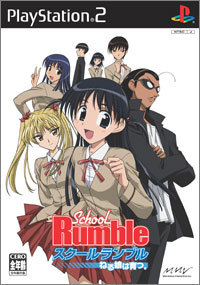
Product and edition
The current Marvelous product archive identifies the original standard PS2 edition and its product code. The preserved official gameplay pages explain how keywords gained in conversations shape Tenma’s dreams. The publisher describes fifty dream stories, including original material absent from the manga. That is a count of advertised game stories, not fifty anime episodes. A separately listed deluxe package and later budget editions should not be mistaken for the product code pictured here. The later Second Semester game is also a distinct product, with its own summer-camp premise.
Gameplay and story
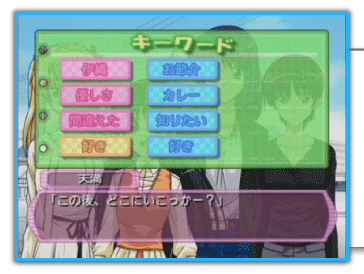
The original interface shows why a conversation has consequences beyond the immediate scene. A keyword selection panel sits over character portraits and a dialogue window, connecting an exchange with information the player can keep. The official explanation gives those keywords a limited period of usefulness, so their value belongs to the game’s daily structure. As an editorial reading, this turns the misunderstandings associated with School Rumble into a system of attention and timing: what the player notices in one conversation can affect a later dream. That does not establish a canonical change to the manga.
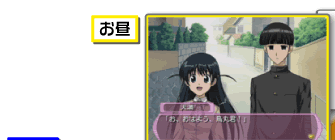
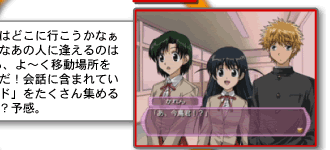
The publisher’s map explanation distinguishes ordinary school days and time away from lessons. Its promotional composites include dialogue screens within a diagram of daily activities. Those are presented in their full original form, including the publisher’s labels; they are not silently cropped into newly invented standalone screenshots. The visual evidence helps separate the choice of a place or conversation from the dream event that follows. The archive’s advertised fifty stories gives a product boundary, while the pacing and success of those stories would require a hands-on review that this guide does not claim to provide.
Choosing this route
Choose this optional route for the relationship between comic school encounters and dream scenarios. For a continuous reading or viewing sequence, use the manga and the named first season, Extra Class and Second Semester productions in the main analysis. The game’s fifty dream stories and a twenty-six-episode television season measure different things. No exact chapter handoff follows from completing this game. Its standard package, interface gallery and source links identify one historical PS2 release, leaving the PSP title and the later summer-camp adventure to their own product checks.
Platforms and access
This guide covers a historical Japanese PS2 disc. The official archive establishes the original release, classification and product identity, without guaranteeing present stock, a current digital version or translation. Check the exact standard edition and hardware compatibility through an authorized listing. Publisher development publicity is evidence of advertised presentation; it is not an independent measurement of finished-game performance.
Sources and credits
- Marvelous — exact standard edition
- Official publisher — daily map and original interface composites
- Official publisher — keyword interface
- Official publisher — dream-story explanation
Facts are drawn from the identified publisher and developer records. The story lens is editorial interpretation, not a hands-on review, performance test or audience rating.