Tengen Toppa Gurren Lagann — Japanese Nintendo DS game guide
GAME GUIDE · Sources checked 04 October 2026 · Opening-premise spoilers; original promotional screenshots can reveal creatures and environments.
KONAMI’s Japanese Nintendo DS game combines robot battles with touch-based special moves. Nintendo’s original catalog distinguishes the interactive product and bundled original animation from the main television route.
- Product
- 天元突破グレンラガン; Japanese Nintendo DS
- Publisher
- KONAMI
- Japanese release
- 25 October 2007
- Catalog genre
- Special-move collecting drill action
- Screens
- Publisher supplied individual DS panels, each 256 × 192
- Source relation
- TV-related game with original material; optional branch
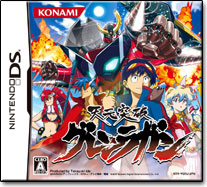
Product and edition
Nintendo’s original catalog identifies a Japanese KONAMI product released on 25 October 2007. Its description connects robot action with touch-based special moves and separately mentions original game material and a bundled animation DVD. Those extras do not turn the game into the television series’ next numbered episode. The catalog supplies each DS display as an individual 256-by-192 file. This article preserves those exact full panels rather than combining, cropping or enlarging them into a simulated hardware screenshot. The battle and cockpit panels are paired examples in the original gallery; the touch-action panel is another distinct file. Their small native size is a property of the preserved source, not evidence that a larger unofficial image would be the same edition.
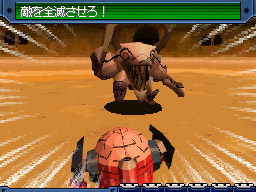
Gameplay and story
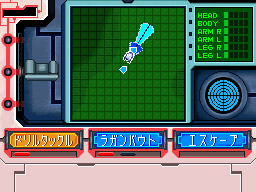
The battle panel shows a robot confrontation beneath a mission instruction. The complete cockpit panel gives a different view of participation through buttons, robot-status indicators and radar. Our editorial reading is that the same fictional machine can be treated as both a dramatic presence and something a player operates through a compact display. The two panels belong to the publisher’s gallery, not an Animeteor reconstruction of a DS screen. They cannot prove response time, control comfort or the outcome of the visible encounter. Keeping them whole allows a reader to see what information the promotional example actually includes. A clean anime still would not communicate those controls, while an enlarged low-resolution panel would add no verified detail.
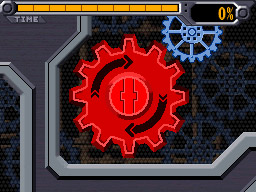
The additional touch-action panel contains gears, a timer and a progress display. We interpret this as an example of how physical input becomes part of the adaptation’s presentation. The comparison is deliberately limited to visible design: it does not certify the gesture needed at that instant, an optimal timing strategy or a complete list of moves. Nintendo’s description supports the broader touch-action identity, but the original image remains a single promotional observation. The small dimensions are retained, and the image is distinct from both the packaging and battle panel. Its controls are not redrawn to match a modern device. That preservation makes the historical product easier to identify while keeping a reader’s expectations separate from a current mobile or console game.
Choosing this route
Choose this optional historical branch for an interactive approach to Gurren Lagann’s machine-action premise. Choose the original twenty-seven television episodes for the main screen story, with the two theatrical retellings treated separately in the parent analysis. The catalog’s mention of original game material does not establish a mandatory bridge between the films, nor does a bundled animation replace the main viewing route. Our editorial question is how a compact player-facing display changes the experience of operating a familiar machine. It is not a claim that gameplay reproduces every relationship or scene from the television work. A reader can recognize the title’s connection and still decide to encounter only the screen original. No invented source chapter or sequel chronology is required.
Platforms and access
The source is a historical Japanese Nintendo DS catalog. Its player-count and wireless descriptions concern that product’s original features; they do not establish present online service, current retail stock or compatibility on other hardware. This guide gives no emulator, unofficial patch or purchase guarantee. The packaging image is 207 by 187 pixels, and the interactive panels are 256 by 192; they are displayed without artificial enlargement. Individual upper and lower panels are labelled accurately rather than presented as a complete physical console view. Japanese interface text is preserved. Promotional material may reveal machines or environments, and these images support a visual interpretation rather than a measured review, personal play record or performance test.
Sources and credits
- Nintendo · exact Japanese product, date and original packaging
- Nintendo · original paired battle and cockpit panels
- Nintendo · original touch-action panel
Facts are drawn from the identified publisher and developer records. The story lens is editorial interpretation, not a hands-on review, performance test or audience rating.