Azumanga Daioh Puzzle Bobble — arcade game guide
GAME GUIDE · Sources checked 04 October 2026 · Opening-premise spoilers; original promotional screenshots can reveal creatures and environments.
A historical MOSS/Taito arcade puzzle product with solo, CPU-versus, competitive and cooperative modes. Original low-resolution developer screenshots are preserved without enlarging or cropping them.
- Exact product
- Azumanga Daioh Puzzle Bobble
- Developer product source
- MOSS official site, archived April 2004
- Distributor
- TAITO Corporation
- Hardware
- Commercial NAOMI GD-ROM arcade system
- Players
- One or two
- Date scope
- Historical product archive; exact launch day not independently verified
Product and edition
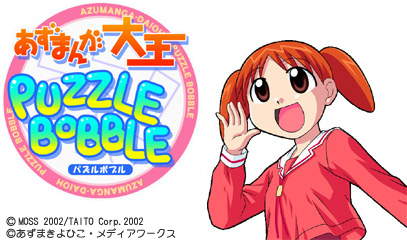
MOSS’s original product page identifies an arcade puzzle game distributed by Taito, with MediaWorks credited for cooperation. It specifies commercial NAOMI GD-ROM hardware. That is not a verified Dreamcast consumer edition, despite the relationship between the hardware families. The product page and its system section were preserved in April 2004 archive captures. Those capture dates document the source, not the game’s launch day. The key art and gameplay images belong to this exact product.
Gameplay and story
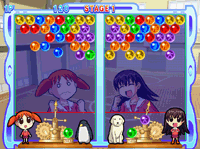
The developer lists puzzle, CPU-versus, competitive and cooperative modes, and describes matching at least three bubbles of the same color. The screenshot beside this paragraph shows the complete two-board CPU-versus composition. Read it as an example of how the character art surrounds a puzzle interface: familiar faces become part of a playfield rather than the center of an episode’s conversation. The interface and the coloured bubbles remain visible, so the image offers more useful product context than a portrait or an isolated logo.
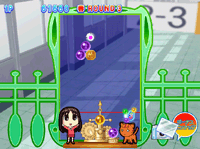
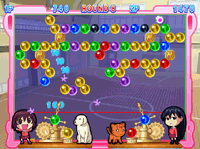
The two supplementary frames contrast a solo puzzle view with a shared cooperative board. That change supplies a useful thematic comparison with the series’ group dynamics: a puzzle can assign several people separate spaces, or place their actions inside one shared task. This is an editorial reading of the displayed composition, not proof of a particular competitive balance, strategy or outcome. The archived system page also mentions bonus pinups, but an unlockable illustration is not evidence of an additional canonical anime installment. The original screenshots are small, so they are displayed at their native size; reconstructing sharper text or cropping parts of the interface would change the historical material.
Choosing this route
Choose this guide to identify the historical arcade product and its documented modes. For the four-panel source manga or the 26-episode television adaptation, return to the linked main analysis. A game using the same characters does not extend the television episode numbering or replace the source’s school-year progression. It can instead be approached as a different use of the cast’s recognizable imagery: the player has a task to complete, while a comic strip or animated scene arranges its own rhythm and punchline. No stage-by-stage correspondence is asserted.
Platforms and access
This is a historical arcade edition guide. The checked developer archive does not establish a current commercial download, English localization or an official Windows port. Hardware names, mode names and the image captions follow that edition. A fan remake, emulated copy or consumer-console game with similar characters should not be relabeled as the original NAOMI GD-ROM release. Consult the actual operator or licensed product source for access; this article makes no present stock, price or hands-on performance claim.
Sources and credits
- Archived original MOSS product identity, distributor and hardware
- Archived MOSS mode descriptions and original full-frame screenshots
- Current MOSS developer site and maintained product archive
Facts are drawn from the identified publisher and developer records. The story lens is editorial interpretation, not a hands-on review, performance test or audience rating.