Watch the standalone 1992 film or read The Age of the Flying Boat’s three short parts. The Japanese reference book and English art book include source material; they are not sequel novels.
Reviewed 3 October 2026 · Opening premise and adaptation relationships. Major endings withheld; linked catalog summaries and discussions may contain spoilers. · Licensed access varies by country.

The source and screen branches

The source is a short three-part manga, not three full volumes. Named art/reference books include it. GKIDS lists 94 minutes for its edition; other Ghibli films are separate stories.
- READ · short manga source: The Age of the Flying Boat · part 1 → Short source · through part 3
- WATCH · animated feature: 1992 film · about 93 minutes · Complete cinematic route
- OPTIONAL · English source + art: The Art of Porco Rosso · Source story + reference images
A flying ace earns a living while trying to remain apart from the world
Porco is an experienced pilot working as a bounty hunter over the Adriatic, with the face of a pig and the manner of a man who has seen more than he wants to explain. Air pirates, a rival pilot, the designer Fio and the singer Gina draw him into relationships he cannot manage simply by flying away. The adventure’s humor sits beside a quieter question about what freedom means after war.
The 1992 animated feature is the direct starting point. Studio Ghibli records an approximately 93-minute film and a July 18 Japanese opening. The licensed GKIDS disc listing uses 94 minutes; those edition descriptions do not identify separate films or a required extra episode. No preceding Ghibli title is necessary.
The short manga The Age of the Flying Boat is the source. It is not a long numbered prose series or a set of chapters that continues after the feature. The English Art of Porco Rosso explicitly includes the original story among its contents, offering a source-and-production comparison after a straightforward first viewing.
A short three-part manga inside books with additional reference material
The Ghibli Museum’s official shop describes a Japanese book organized around The Age of the Flying Boat source and Porco Rosso material. Its contents list source parts one, two and three, followed by aircraft-model research, aviation history and Miyazaki interviews. The checked A4 publication is 72 pages and identifies Dainippon Kaiga as its maker/publisher.
That total page count belongs to the whole mixed-content book. It should not become a claim that the original source manga itself is 72 pages long. Likewise, the three listed parts are short-source divisions, not three full manga volumes. Reading the source means distinguishing its narrative from the technical and historical material packaged with it.
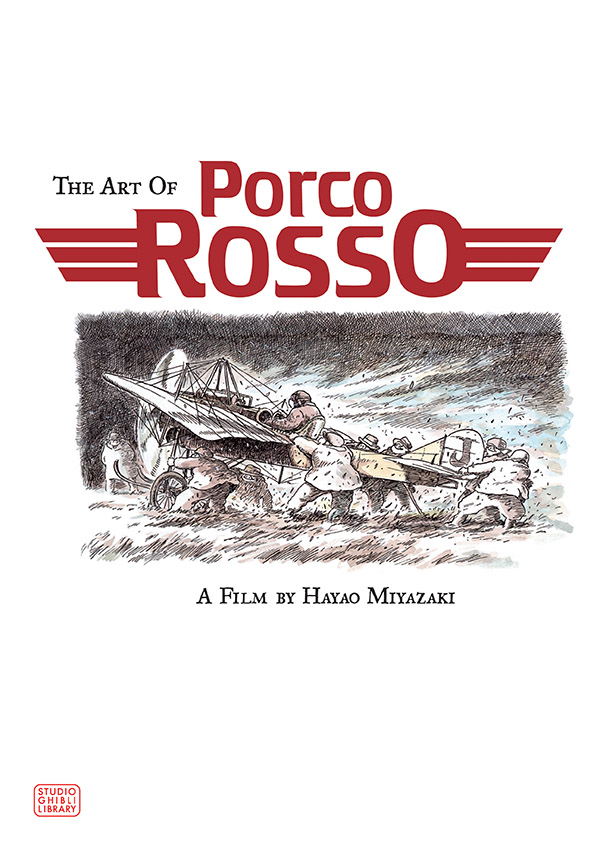
VIZ’s English Art of Porco Rosso lists 208 pages, a March 15, 2005 release and ISBN 9781591167044. Its contents explicitly include The Age of the Flying Boat alongside visual reference sections and ending illustrations. It is an art-book edition with source material, not a prose novel or an automatically equivalent page-for-page version of the Japanese reference collection.
The source explains an origin rather than supplying a post-film continuation
Watch the standalone feature first for animation, performances and Hisaishi’s music. Read the short manga from its opening when comparing the source. Its three parts form the short narrative route; the surrounding aircraft research can then be explored according to interest. There is no verified next-volume handoff after the film to provide.
The English art book is another way to encounter the original story and production imagery. The map places it on a parallel reference lane, with its source inclusion named. Reading both that book and the Japanese reference edition is optional comparison rather than a requirement to complete an extended fictional sequence.
Other Miyazaki films can illuminate the interest in flight, skilled work and technological beauty, but they are separate stories. Nor should fan hopes for a sequel be entered into the watch order. The verified routes here consist of the released feature, the short source and named reference editions; a future confirmed release would need its own evidence and scope.
Original visual reference
Freedom becomes harder when it is defined only as refusing attachment
Our reading focuses on the difference between flight and escape. Porco can choose where to move with impressive skill, but movement does not settle what he owes other people or what he believes about himself. His dry humor makes distance attractive. It can also conceal the effort required to keep concern from becoming commitment.
The aircraft is central because it is both a beautiful means of freedom and a machine that needs other people’s work. Repairs, design judgments and practical cooperation interrupt the fantasy of a completely independent pilot. Fio’s competence matters within that interruption: she is not merely someone present to admire the hero, but someone whose knowledge affects what he can actually do.
Watch how Porco reacts when another person claims expertise he did not initially expect. A skilled adult can recognize talent while still resisting the vulnerability of relying on it. The film makes that tension visible through tasks and negotiation, not only through emotional confession. Being capable of flying alone is therefore different from being able to build and sustain a life alone.
Gina offers another kind of continuity. Her presence links leisure, memory and relationships that cannot be reduced to the next paying job. The spaces around her can look like an invitation to rest, yet rest asks Porco to remain available to feelings he may prefer to leave unspoken. A scene can be outwardly elegant while carrying a question about absence and waiting.
The comic pirates and Curtis prevent that emotional weight from becoming a uniform mood. Vanity, rivalry and spectacle create forms of conflict that are funny without erasing the film’s harder background. The variation matters: if every aerial encounter were treated as equally tragic, the quiet recollections would lose their contrast. If every encounter were merely a joke, the pilot’s refusal of certain loyalties would lose its force.
The film’s interest in machines does not require approval of the purposes to which all machines can be put. An aircraft can embody craft, pleasure, commerce or military demand. Distinguishing those uses is essential to a political reading that respects the movie’s attraction to flight. The relevant question is who asks the pilot to fly, for what purpose and under which claim of authority.
Porco’s appearance also resists an easy equation between looking human and behaving humanely. A face can attract a label while conduct contradicts the assumptions behind that label. This makes the transformation useful beyond a puzzle about mechanics. The source comparison should ask how the short manga and feature establish character, rather than assume the only meaningful answer is a definitive explanation of every ambiguity.
A short-film plan expanded into a feature, according to its producer
The official Ghibli work record credits Hayao Miyazaki for original work, screenplay and direction, Toshio Suzuki as producer and Joe Hisaishi for music. Tokiko Kato is credited for the theme song and appears in the Japanese voice list with Shuichiro Moriyama, Sanshi Katsura, Akemi Okamura and Akio Otsuka. Toho is the Japanese distributor.
In the linked Iwanami interview, Suzuki confirms The Age of the Flying Boat as the basis and describes an initial plan for a roughly fifteen-minute short. The surrounding interview identifies the manga’s three magazine installments beginning in March 1990. These details explain why a relatively compact source should not be measured against the feature as if both were identical in scope.
The interview also addresses production fatigue and the desire to make a smaller aviation project. It is a named participant’s retrospective, valuable for process and intention, but not a complete production ledger. GKIDS lists a separate Suzuki interview and storyboards among licensed disc extras; those offer further production study without adding fictional installments to the viewing route.
Comic adventure and adult weariness can coexist in the same viewing
The linked discussion emphasizes different ways to encounter the movie: aerial comedy and spectacle on one hand, and the pilot’s loneliness, political choices and war memories on the other. Replies describe humor and emotional weight as compatible rather than as reasons to put the film into only one category. That is a useful prompt for comparing scenes with different rhythms.
The post also contains attributed quotations and a strong theory about the transformation. This guide does not promote those quotations to verified interview evidence or make the theory a settled explanation of the ending. The discussion is interpretation with spoilers; the producer’s separately linked primary interview supports the production facts used above.
The named AniList record was checked on October 3, 2026. Its weighted average was 78 out of 100, normalized to 7.8 out of 10 for the original 1992 animated feature. The short manga and reference books are outside that figure. Reader comments are not extra rating votes, and the external score is not a substitute for examining how humor, work and isolation interact.
A longer production does not reveal a budget simply through its running time
The documented change from a short-film idea to a feature establishes a production decision. It does not provide a verified ratio of costs. Multiplying a hypothetical fifteen-minute budget by the released running time would ignore development, staffing, reuse and distribution arrangements, and would manufacture a financial result the interview never supplies.
The verified sources used here do not provide an audited work-specific budget and net-profit statement suitable for a return calculation. Current film and book catalogs show licensed exploitation of the property; they do not reveal what the original production or individual participants earned. The commercial analysis is therefore strongest when it identifies concrete edition contents and the limits of the available financial evidence.
For a purchase, the Japanese source/reference book and English art book differ in language, page count and composition. Neither should be bought under the assumption that it is a new full-length sequel novel. Licensed film access is likewise regional: GKIDS and the Australian distributor provide separate discovery routes, and old retailer or collector information cannot guarantee today’s stock, territory or price.
A short source and substantial reference options support a focused return visit
Begin with the feature or read the source’s three parts from the opening. Choose the English art book when its included source and visual material match your interests; choose the Japanese reference edition for its stated additional aviation and interview contents. These are complementary discoveries rather than an intimidating series order.
The official film page anchors credits, original release, runtime and stills. The museum shop identifies the Japanese source book’s contents, VIZ identifies the English art volume and the Iwanami interview supplies named production recollections. GKIDS and the Australian distributor identify licensed viewing options. Community discussion can deepen interpretation after watching, with major spoilers expected.
The original film still retains the gallery’s attribution and within-common-sense usage instruction; the art-book cover retains its original publisher credit. Future verified editions can update discovery information without turning reference material into fictional continuation. The central guide should keep returning to concrete relationships between skill, collaboration, humor and the freedom Porco is trying to preserve.
Primary sources and useful navigation
- Studio Ghibli · original credits, runtime and official stills
- Ghibli Museum shop · Japanese source and reference-book contents
- VIZ · English art book with original source story and cover
- Iwanami · named producer Suzuki on source and short-film development
- GKIDS · licensed film edition and production supplements
- Madman · Australian licensed film discovery
- AniList · named anime audience score
Community and catalog routes
The production and publisher links support project facts. Catalog and community pages are secondary navigation and may reveal later events.
Explore related story guides
Original series imagery is reproduced under permission asserted by the site owner; the source and rights credits are retained. The route diagram is Animeteor’s own explanatory graphic.
A specifically identified September 2026 disc edition
GKIDS’ limited-edition Blu-ray/DVD Steelbook is dated 29 September 2026, region A/1. Its listed audio, subtitles and extras identify that edition. Blu-ray-only storyboards are distinguished from the DVD. This remains the 1992 film; the listing does not identify a 4K UHD disc or a new story.