Watch the standalone 1989 film or begin Eiko Kadono’s first novel. Six Japanese main novels and the anime’s film-comic retelling are separate reading routes; live-action development stays outside the roadmap.
Reviewed 3 October 2026 · Opening premise and adaptation relationships. Major endings withheld; linked catalog summaries and discussions may contain spoilers. · Licensed access varies by country.

The source and screen branches

Begin source reading from novel 1. Film comics retell the anime. Six Japanese main books do not imply six verified English editions. Live-action development is separate and excluded from these routes.
- READ · original prose: Kadono · main novel 1 → Main novels · through 6
- WATCH · adaptation: 1989 film · 102 minutes · Complete cinematic route
- READ · film retelling: All-in-one film comic · 584-page print retelling
- EDITION · same film: 2026 4K remaster · Revisits the 1989 feature
A useful skill does not remove the difficulty of starting a life
Kiki leaves home with her cat Jiji to begin a young witch’s independent year. Flying gives her a skill she can offer to a coastal town, but it does not immediately give her housing, friends, confidence or a reliable understanding of customers. Her delivery service turns a magical ability into everyday work, with all the uncertainty that comes from being new to a place.
The standalone 1989 animated film is a direct first viewing. Studio Ghibli records approximately 102 minutes and a July 29 Japanese release. Eiko Kadono’s prose novel is its source, so readers can instead begin with the first book. A film comic is a third format, but it retells the animation rather than becoming the prose source.
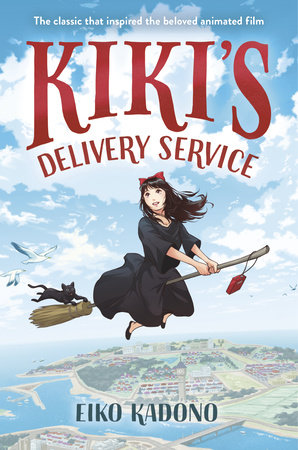
The original arrival scene included here shows Kiki encountering the ordinary authority of a town, broom in hand. Beside it, the licensed English novel cover identifies the source author. That pairing is more informative than using two interchangeable character portraits: one points to the film’s local practical obstacles, while the other opens a different reading route.
Kadono’s six-book main series and Miyazaki’s animated adaptation
Fukuinkan’s official series collection lists the main Japanese books from Kiki’s Delivery Service through numbered book six, alongside other editions and related titles. The collection’s total number of products is therefore not the number of main-story novels. Follow the original first book and its numbered main continuations rather than turning every catalog item into a required chapter.
Penguin Random House identifies an English edition of the first novel by Eiko Kadono with illustrations by Yuta Onoda. The checked paperback is 208 pages, published June 8, 2021, with ISBN 9781984896698; its hardcover and digital formats have their own dates. This English first-book record does not establish English availability for all six Japanese main books.
VIZ’s official shop separately identifies a hardcover Film Comic: All-in-One Edition, with 584 pages and ISBN 9781974749683. Its creator credit relates to the film retelling. Kadono remains the prose source author, and Miyazaki’s role in the film should not be substituted for her authorship simply because a comic product carries his name.
Begin the source at book one rather than force the film into a novel checkpoint
The anime offers a self-contained cinematic experience. The prose series has its own development over several books. A viewer who wants the source should begin with book one, then follow the numbered main novels in an available language. Familiar characters do not prove that every scene, sequence or narrative emphasis is identical across media.
No exact post-film source chapter handoff is established by the verified records used here. Starting at the novel’s opening permits a meaningful comparison of daily tasks, narration and the shape of the adaptation. The film comic instead revisits the animated story, so it cannot fill a gap between the film’s conclusion and a later source novel.
GKIDS documents a 4K-remastered North American IMAX release beginning March 13, 2026. That start date is in the past at this October review and should not be advertised as an upcoming premiere. Separately, BBC Studios confirms a live-action television adaptation in development, planned primarily around the first novel. It has no verified premiere date here and stays outside the anime/prose/comic roadmap.
Original visual reference
Turning flight into work makes confidence depend on more than talent
Our reading begins with the gap between what Kiki can do and what she believes that ability must prove. Flying can solve a transportation problem. It cannot guarantee that a customer is grateful, that a new friend understands her or that she feels comfortable among the town’s other young people. The delivery service exposes those limits in practical situations rather than through a speech about growing up.
The arrival still gives that distinction a specific shape. Kiki carries an unmistakably magical broom, yet faces a uniformed officer writing in a notebook. The town already has routines and expectations. Her special ability does not exempt her from learning them. The image is useful because it places wonder and regulation in the same everyday space, instead of treating independence as a world without constraints.
Osono’s help also changes the meaning of independence. Kiki’s effort matters, but shelter and a place from which to work depend on another person’s generosity. Recognizing that support makes the story more believable. A young person can acquire responsibility without becoming entirely self-sufficient, and receiving help need not erase the courage involved in leaving familiar surroundings.
Delivery work is an especially effective adaptation choice because effort and appreciation can separate. Transporting something requires attention and care, but its recipient may not value it in the way the sender or courier does. Kiki has to encounter that mismatch without making it the final verdict on her usefulness. The scene question is what she learns to distinguish: the task she performed, the response she received and the worth she assigns to herself.
The town’s visual appeal should therefore not flatten it into a permanently comforting setting. Streets, shops and social encounters can be inviting and intimidating at once. The same place that offers opportunity can make a newcomer feel conspicuous. Watching where Kiki hesitates, listens or looks at others is often more revealing than calling the movie simply cozy.
Ursula’s relationship with making images provides a comparison between a practiced ability and the demand to produce reliably. This can support a reading about creative strain, but it remains interpretation rather than a clinical diagnosis of a fictional child. The film’s broader concern is how a person relates to an ability when confidence stops being automatic. In prose, narration can name or develop such concerns differently; the film uses action, performance and pacing to make the difficulty visible.
The source author and the film’s several creative responsibilities
The official Ghibli work page names Eiko Kadono as the original author and Hayao Miyazaki as producer, screenwriter and director. Joe Hisaishi supplies the music, Isao Takahata is credited for music direction and Yumi Arai for the theme songs. These are distinct functions, even where several major names belong to the same studio’s history.
The Japanese cast includes Minami Takayama, Rei Sakuma, Kappei Yamaguchi, Haruko Kato and Keiko Toda. GKIDS separately lists English performers including Kirsten Dunst, Janeane Garofalo, Phil Hartman and Debbie Reynolds. A language performance changes the experience of dialogue and humor, but it does not replace the source author or create an extra position in the watch order.
BBC Studios’ development announcement names Wheel In Motion and KADOKAWA as partners and Irena Brignull as the planned television adaptation’s writer. The proposed format is ten half-hour episodes, primarily centered on the first of the six main novels. These are announced plans for a separate live-action project, not confirmation that those episodes have been completed, screened or incorporated into the animated film’s continuity.
Viewers bring different kinds of starting-over experience to Kiki
The linked discussion includes readers connecting the film to creative blocks, leaving home, overwork and the need for support. One recurring point is that pursuing a livelihood does not make every interaction emotionally rewarding. Another is that help from people such as Osono complicates the idea that independence means doing everything alone.
These are personal responses, not evidence that the film treats a particular medical condition or guarantees recovery through watching it. The same thread includes a viewer who found the buildup and ending less satisfying. Keeping that disagreement visible is useful: a gentle pace and everyday conflicts may resonate with one visitor while leaving another wanting a different narrative emphasis.
The named AniList entry was checked on October 3, 2026. Its weighted audience score was 81 out of 100, displayed as 8.1 out of 10 for the original 1989 animated film. Kadono’s novels, film comics and the developing live-action series are outside that figure. We neither combine personal anecdotes into extra votes nor present the external score as Animeteor’s own rating.
Source publishing, film reissues and development announcements need separate measures
BBC Studios’ announcement places the first source book in 1985 and describes its worldwide sales in the millions. It does not provide a precise current series total suitable for a numerical comparison here. That publishing statement should not become an invented anime revenue figure, a print-sales count for one English edition or a profit estimate for a project still in development.
The announcement also contains company-wide financial information. Those corporate results do not measure the budget or return of Kiki’s television adaptation. The verified sources used here do not supply an audited work-specific profit statement for the original anime. A new 4K exhibition shows continued distribution activity without revealing what each rights participant earns.
For a practical purchase, identify source novel, film comic or film edition first. The 208-page English prose book and 584-page film comic serve different reading purposes. Six Japanese main novels are not automatically six English books in the checked catalog. Territory, language and retailer availability require present checks; a publisher’s collection page also contains alternate formats that should not be counted as additional main-story installments.
Choose the source for wider reading and the film comic for a return to the animation
Begin with the feature or Kadono’s first novel. Follow the numbered main novels when pursuing the prose series in an available language. Choose the film comic if your aim is a print presentation of the animated version. A remastered screening revisits the same film; the separately announced live-action series remains a project to monitor outside the principal reading and viewing map.
The Ghibli work record anchors original authorship, film credits, runtime and stills. Fukuinkan identifies the main source sequence alongside other editions; Penguin Random House identifies the checked English novel. VIZ’s shop establishes the collected film comic, GKIDS the licensed anime and BBC Studios the development status of its separate project. Community links are optional discussion and may reveal later plot events.
The original scene retains the gallery’s within-common-sense usage instruction and attribution, and the source cover retains its publisher and illustrator credit. Later verified translations or release announcements can update this guide without confusing a source author, film creator and new adaptation writer. The lasting value is a clear route into each medium and a specific analysis of how work, help and confidence interact.
Primary sources and useful navigation
- Studio Ghibli · source author, original film credits and official stills
- Fukuinkan · main source novels and separate edition products
- Penguin Random House · English source novel and original cover
- VIZ official shop · collected film comic and edition contents
- GKIDS · licensed film, language performances and 2026 remaster
- BBC Studios · separate live-action series development announcement
- AniList · named anime audience score
Community and catalog routes
The production and publisher links support project facts. Catalog and community pages are secondary navigation and may reveal later events.
Explore related story guides
Original series imagery is reproduced under permission asserted by the site owner; the source and rights credits are retained. The route diagram is Animeteor’s own explanatory graphic.
Games and live-action adaptations
- Kiki's Delivery Service — Live action: Film · 2014