Watch the standalone 1986 film. Read its four film-comic volumes or the 2026 all-in-one retelling; art, picture and cooking books are optional references, not source novels or sequels.
Reviewed 3 October 2026 · Opening premise and adaptation relationships. Major endings withheld; linked catalog summaries and discussions may contain spoilers. · Licensed access varies by country.

The source and screen branches

The film is original; film comics retell it rather than supply its manga source or continue its ending. Nausicaä and other Ghibli films are separate stories.
- WATCH · original feature: 1986 film · 124 minutes · Complete standalone story
- READ · film retelling: Film comic · volume 1 → Film comic · volume 4
- READ · single-book alternative: 2026 all-in-one · 656 pages · Retells the animated film
- OPTIONAL · companions: Art and picture books · Official cookbook
A pendant connects two children to a much larger struggle
Pazu, an apprentice in a mining town, encounters Sheeta as a mysterious crystal brings her down from the sky. Finding the floating city of Laputa becomes their shared adventure, but several pursuing groups want something different from the same discovery. A promise between two children is soon tested by people who approach the unknown as a treasure, an inheritance or a weapon.
The original 1986 animated film is the starting point. Studio Ghibli records an approximately 124-minute running time and an August 2 Japanese opening. No television series or preceding Miyazaki film is required. Its airborne chases work as spectacle, while the slower work of earning trust gives that movement an emotional direction.
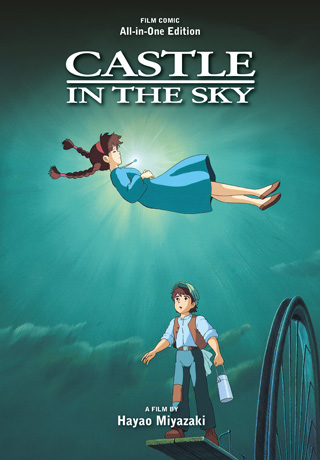
For reading, licensed film comics offer a retelling of the animation. They are useful alternatives for revisiting images and dialogue, but they are not a manga source that the film originally adapted. The film-comic cover included below deliberately accompanies an original film still so that visitors can see both the visual relationship and the difference in publication type.
The manga-category books retell an original animated film
VIZ lists four separate Castle in the Sky film-comic volumes and a Film Comic: All-in-One Edition. The latter has a July 28, 2026 release date, 656 pages and ISBN 9781974754601. As of this guide’s October 3 review, that listed release date has passed; an individual retailer’s stock still needs checking.
The all-in-one catalog uses a manga category, which explains the reading-format badge on this page. Its explicit film-comic designation is the more useful source relationship: the animated feature comes first, and the book presents that story in print. Moving from the film to a film comic is revisiting an adaptation of the same adventure, not continuing beyond its ending.
The 112-page picture book is another film-based presentation. The 194-page art book is a separate visual reference, and the official cookbook connects food to the movie. These publications can deepen a visitor’s engagement without functioning as an original prose novel, a fifth film-comic installment or a sequel to Laputa.
There is one main viewing route and several optional ways to revisit it
Watch the standalone feature for the complete animated experience. A new viewer can select Japanese audio or a licensed dub according to preference. The licensed GKIDS listing identifies English performers including Anna Paquin, James Van Der Beek, Cloris Leachman and Mark Hamill; different performances do not create separate story installments.
For print reading, use the numbered film comics from volume one through four, or choose the single all-in-one edition. The map places those options on parallel lanes. Buying both is a collector’s choice rather than a narrative requirement, and there is no post-film manga chapter handoff to establish for these retellings.
Nausicaä of the Valley of the Wind is relevant to the production history of Miyazaki and Takahata, but it is not a prequel taking place in the same fictional world. Other Ghibli adventures are similarly optional comparisons. A shared creator or a familiar machine design should not be converted into a connected-universe claim without evidence.
Original visual reference
The same machine can be an instrument of care or domination
Our reading focuses on how the adventure changes the meaning of technology through use. Mechanical ability is not reserved for villains: Pazu’s working environment depends on tools, maintenance and practical knowledge. Flight is thrilling partly because someone has learned how to build and operate what carries the characters. The film can admire those abilities while asking what happens when possession becomes the main reason for discovery.
The contrast between working town and distant floating city is especially useful. The mine is a place where equipment, labor and daily needs remain visible. Laputa can instead become an imagined shortcut to power, apparently detached from the people whose work supports ordinary life. Watching who thinks about repair, shelter or another person’s safety reveals a different relationship to machinery from watching who wants command of it.
Sheeta’s pendant makes that problem personal. Its value to pursuers can overshadow the person wearing it, turning a child into access to something they want. Pazu’s most meaningful response is therefore not simply recognizing a magical object. It is learning that her decisions and fears matter independently of the object’s usefulness. Their partnership gives the search an ethical boundary that a treasure hunt alone would lack.
The pirates complicate easy visual categories. Their noisy equipment and aggressive entrance invite a quick judgment, yet cooperation demands attention to behavior rather than a fixed label. Dola’s presence can shift the film’s social arrangement without making every alliance safe or every interest identical. On a rewatch, the question is how a relationship changes through practical acts rather than through one declaration of loyalty.
The original still here catches Pazu and Sheeta facing outward together, with goggles, harnesses and structural lines surrounding them. It is not a detached pair of character portraits: their proximity has a physical purpose within a moving situation. That gives a concrete way to discuss the film’s friendship without replacing scene analysis with a general claim that its characters are lovable.
The garden and robotic imagery invite a further question about care after ownership has disappeared. A machine’s capacity to endure does not automatically tell us what should endure around it. This is a productive comparison with Nausicaä’s attention to living systems, provided the two films retain their separate worlds. The resemblance lies in an ethical question; the plot connection should not be invented.
Miyazaki’s original feature and the studio being built around it
The official film record credits Hayao Miyazaki with original work, screenplay and direction, Isao Takahata as producer and Joe Hisaishi for music. Azumi Inoue is credited for the theme song. The Japanese voice list includes Mayumi Tanaka, Keiko Yokozawa, Kotoe Hatsui and Minori Terada. These roles provide a more precise creator introduction than attaching the Ghibli name to every creative function.
Studio Ghibli’s history places its founding in 1985 while Castle in the Sky was being produced. This makes the film important to the studio’s beginnings. The earlier Nausicaä was animated by Topcraft; treating the two projects as if the organization had already existed in the same form would hide the institutional transition.
GKIDS identifies licensed physical and on-demand discovery options and lists edition extras such as storyboards, producer reflections and a music feature. Such material is valuable when a visitor wants to examine how the film was made. An edition’s disc-release date or supplemental documentary is not an additional fictional installment, and the Japanese original-release year should remain 1986.
A rewatch can change the question a viewer brings to Laputa
The linked Ghibli discussion starts from a rewatch that shifted attention from adventure toward technology, nature and the behavior of robots. Other replies describe childhood memories, attachment to performances and the interaction between human connection and machinery. This is a useful set of interpretive prompts, not a representative survey of everyone who has watched the film.
Try comparing your own first-viewing priorities with the discussion: did you follow the chase, the pendant mystery, the children’s trust or the treatment of powerful machines most closely? Different answers can justify revisiting specific scenes. They cannot by themselves prove an authorial intention, an unannounced production plan or a factual development history.
The named AniList record was checked on October 3, 2026. Its weighted audience score was 80 out of 100, displayed here as 8.0 out of 10 for the original 1986 animated feature. It excludes film comics, reference books and individual Reddit opinions. Animeteor is not collecting local votes or assigning this external figure to the entire publishing property.
Historical admissions and a new book edition answer different questions
Studio Ghibli’s institutional retrospective records 775,000 Japanese admissions for the film’s original release. That dated measure describes cinema attendance in the stated market. It is not a current worldwide audience total, a streaming count, gross revenue or an audited profit result.
The verified sources do not provide a work-specific production budget and profit statement suitable for calculation. A later licensed book edition demonstrates continued publishing activity, but it does not establish how much money the original film earned. Nor can an assumed ticket price turn the historical attendance count into verified box-office revenue.
For a practical purchase, distinguish the feature, four separate film comics, the all-in-one film comic and reference books. The single-volume edition may suit someone wanting a compact collection, while separate volumes offer different handling. Language, territory and current retailer availability matter more than an old collector listing. A cookbook is an optional way to revisit the film’s everyday pleasures, not a requirement for completing its story.
Choose a film experience, then the kind of companion you actually want
Begin with the animated feature. For a print retelling, choose the four numbered film comics or the all-in-one edition. For visual production study, look at the art book and licensed disc supplements. For a shorter illustrated presentation or food-related activity, check the picture book or cookbook’s stated contents rather than assuming every title contains the same material.
The official Ghibli work page anchors credits, running time, release date and still-image discovery. VIZ’s individual publication records keep book types and edition dates distinct. GKIDS supplies a licensed film route, and the community discussion supplies optional viewing perspectives. Catalog descriptions and external discussions can reveal plot developments, so readers avoiding spoilers should open them selectively.
The official gallery permits use within common sense; the original still retains its attribution and source. Future verified editions can be added to the companion lanes without changing the film into an adaptation of its own later books. The useful long-term structure is a clear original feature, clearly named retellings and references, and enough scene-based analysis to make the return visit worthwhile.
Primary sources and useful navigation
- Studio Ghibli · original film credits, release and official stills
- Studio Ghibli · founding history and historical admissions
- GKIDS · licensed film, language performers and edition extras
- VIZ · four numbered film-comic volumes
- VIZ · July 2026 all-in-one film comic and original cover
- VIZ · art-book edition
- VIZ · picture-book edition
- VIZ · official cookbook contents
- AniList · named anime audience score
Community and catalog routes
- MyAnimeList · named anime catalog
- Reddit · rewatch perspectives on technology, nature and performances
The production and publisher links support project facts. Catalog and community pages are secondary navigation and may reveal later events.
Explore related story guides
Original series imagery is reproduced under permission asserted by the site owner; the source and rights credits are retained. The route diagram is Animeteor’s own explanatory graphic.
A historical fortieth-anniversary cinema return
GKIDS and Fathom’s 2026 US program returned the existing film to cinemas on 22–26 August, marking its fortieth anniversary. The event is past; it does not create another movie or change the original-film route.