Watch the single 50-episode TV series from episode 1. Read from volume 1 in your chosen edition: Japanese standard (17 volumes), English VIZ (8 books) or Japanese bunko (11 volumes). Touch is an author comparison.
Reviewed 3 October 2026 · Opening premise and adaptation relationships. Major endings withheld; linked catalog summaries and discussions may contain spoilers. · Licensed access varies by country.

The source and screen branches

Manga entries are alternative editions, not consecutive sequel blocks. Start at volume one of your chosen edition. No exact post-anime chapter jump is asserted. Touch and MIX are further discovery links, not required Cross Game installments.
- WATCH · television: TV · episode 1 → TV · episodes 2–50
- READ · edition choices: Japanese standard · 1–17 · English VIZ · 1–8 · Japanese bunko · 1–11
Begin with episode one or the first manga volume
Cross Game follows Ko Kitamura and the Tsukishima sisters, whose families connect a sports shop with a batting center and cafe. Their shared childhood makes baseball part of ordinary life before it becomes a competitive ambition. The opening also establishes relationships whose significance continues through the later school years. Start with episode one or the manga’s first volume. Knowing another Mitsuru Adachi work is useful for comparison, but is not required to understand these characters.
The verified television route is one 50-episode series. There is no need to alternate with Touch episodes or insert MIX between its arcs. Those titles can supply further viewing after this story, while retaining their own characters and setting relationships. We have not verified a required movie or prose-novel installment that extends the Cross Game screen route in this guide.
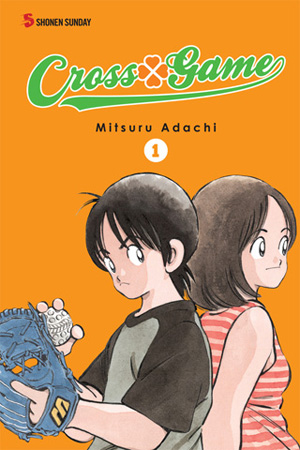
For English readers, VIZ’s first volume supplies an official preview and reading entry. Japanese readers can choose the standard 17-volume manga or its differently packaged bunko edition. Choose one edition and proceed in its numbered order. The main practical complication is matching the correct edition, rather than discovering a hidden franchise viewing sequence. Linked episode and final-volume summaries reveal later events, so use them selectively before finishing.
Seventeen Japanese volumes, eight English books and eleven bunko volumes need separate labels
Shogakukan’s standard manga catalog marks Cross Game complete at 17 volumes. VIZ has its own English collected-book sequence through volume eight. Their numbering refers to different packages of the source material. An English volume eight is therefore not the same object as Japanese standard volume eight. A continuation instruction using only a number, without naming the language and edition, can send a reader to the wrong part of the story.
Shogakukan also documents a bunko manga edition. Its first volume is dated August 8, 2018, and the eleventh volume is explicitly described as the final installment, dated June 14, 2019. The first-volume publisher note identifies extras including messages from notable Adachi readers and his original magazine contents comments. This is a later manga edition with additional publishing context, not an eleven-volume prose novel.
VIZ’s print volume one record gives October 12, 2010 as its release date, while the digital entry lists July 7, 2011. Those dates concern the English publication formats. They do not mark the original Japanese debut or the start of the television broadcast. Our reading map presents the language and edition choices in parallel, keeping the source story separate from the different ways publishers package and distribute it.
A finished television route does not require an invented continuation chapter
TV Tokyo’s official episode archive groups the anime into episodes one through 13, 14 through 26, 27 through 39 and 40 through 50. Its first episode is dated April 5, 2009 and its fiftieth March 28, 2010. These records verify the scope of the production. They offer a dependable endpoint for a newcomer without turning an unofficial list of extras into another season.
The broadcaster’s final-episode summary and the publisher’s final-volume descriptions concern the closing tournament conflict. They support comparing how source and screen approach the story’s concluding stretch. They do not by themselves prove that every manga scene survives unchanged or supply a precise page-by-page continuation boundary. We therefore do not promise an extra post-anime arc beginning at a guessed chapter, and recommend the manga from the beginning for the original presentation.
Cross Game’s author connection to Touch is different from the documented Touch-to-MIX shared-world relationship. Here the useful next step is a comparison of Adachi’s handling of baseball and relationships across separate works. It is not a claim that Ko plays after Tatsuya on one official chronology. Games and live-action adaptations, if future research identifies relevant products, would be documented separately instead of inserted into this source and television route.
Original visual reference
Everyday routines make an ambition emotionally specific
Our reading begins with the ordinary spaces linking the families. A shop, cafe and batting center can hold habits and private associations that a stadium cannot show by itself. The sports goal gains meaning because it grows out of that shared environment. Pay attention to what a person’s familiarity with another family allows them to notice. A simple exchange can carry history that neither character needs to explain aloud.
Ko and Aoba invite a distinction between competence and emotional visibility. Someone can recognize another person’s baseball ability while resisting an admission about the relationship around it. That tension lets practical cooperation and personal hesitation coexist. The story becomes more interesting when a good performance does not automatically produce a clear conversation. Sporting progress is visible; the meaning attached to it can remain contested.
The useful viewing question is how repetition changes a familiar moment. A routine, place or remark can remain outwardly similar while the people involved understand it differently. That is a way to read the measured pacing as accumulation, rather than expecting each episode to introduce a new rival or dramatic confession. This is our interpretation of its storytelling. It does not establish a factual rule that all viewers will find the pace comfortable or that the animated sport supplies real training instructions.
TV Tokyo’s staff archive supplies a clear production identity
The broadcaster credits Mitsuru Adachi’s Weekly Shonen Sunday manga as the source, Osamu Sekita as director and Michihiro Tsuchiya for series composition. Yuji Kondo is credited for character design, Toshiyuki Komaru and Kenji Fujisaki for chief animation direction, Yutaka Mukumoto for art direction and Hiroki Tsubouchi for photography. Synergy SP is the named animation production company. These roles provide concrete paths into investigating adaptation decisions.
The cast list names Miyu Irino as Ko, Haruka Tomatsu as Aoba, Akemi Kanda as Wakaba, Megumi Toyoguchi as Ichiyo, Noriko Shitaya as Momiji and Takahiro Sakurai as Yuhei Azuma. Kotaro Nakagawa is credited for music and Takeshi Takadera for sound direction. A performance comparison with another Adachi adaptation should retain these production-specific credits, rather than assuming shared source authorship also means an identical animation team.
The two original images in this article come from VIZ’s official source-manga presentation: its wide series artwork and English volume one cover. They offer a visually clear connection to Adachi’s work and the English reading edition. They are not labeled as anime episode stills. The broadcaster’s staff archive is the evidence for animation production; a promotional manga image should not be used to support an assertion about a specific animated camera move or match sequence.
A long commitment can feel natural when viewers care about the ensemble
The official AniList entry for the 2009 television adaptation reports 81/100, displayed as 8.1/10 and observed October 3, 2026. The score’s scope is the 50-episode anime. It does not average the original manga, English editions, Touch or MIX. An external score should help discovery while leaving the article’s reading and viewing recommendations grounded in format, pacing and the visitor’s interests.
A selected r/anime recommendation begins with a viewer unfamiliar with baseball who stayed for the characters. Replies discuss whether the 50-episode commitment feels proportionate to the story, and differ over the older visual style. One commenter describes returning after initially rejecting that appearance. Others emphasize the relationship drama or wish for a more definitive sense of closure. This is a useful range of responses, rather than evidence that every reader experiences the same pace.
Our recommendation is strongest for people comfortable with a sustained coming-of-age story in which baseball and relationships develop together. Familiarity with the sport can add interest, but the family and school connections provide another entrance. Readers who want control over how quickly they move through quieter passages can choose the manga. The discussion’s historical MAL rank and access complaints are not reused as current ratings or streaming facts, and its later-story comments are optional spoiler-bearing reading.
Page counts, publication dates and awards have different meanings
VIZ’s first print book lists 576 pages, while the eighth lists 376. This visible difference is a packaging fact: collected books do not all have to contain the same quantity of source material. It is not evidence that a shorter later volume is incomplete, or a reliable basis for calculating exactly which Japanese chapters correspond to an English page. Such a detailed correspondence requires inspection of the actual edition.
Shogakukan’s Adachi profile identifies Cross Game as a recipient of the 54th Shogakukan Manga Award in the boys category. That establishes a named publishing distinction. The same profile’s circulation claim covers the author’s works collectively, so it should not become a Cross Game sales total. We do not supply a budget, franchise profit estimate or adaptation return on investment from an award, author-wide sales or a book’s size.
Print and digital catalog entries also answer different access questions. A publisher’s preview and digital purchase route provide documented English-reading navigation, while a physical-book record does not guarantee local stock. The old TV Tokyo pages document a historical broadcast and production; their continuing existence does not promise a current worldwide stream. We retain those useful links without inventing territory availability, universal prices or reasons behind a distributor’s licensing decisions.
Keep the route simple and use edition details when comparing versions
The immediate screen instruction is to watch the 50-episode television adaptation from its first episode. The reading instruction is to start at volume one in the selected Japanese or English edition and keep that edition name visible. A viewer returning to the manga can use it as a source comparison, rather than assuming that the anime necessarily leaves a new continuation arc unexplored. We do not provide an unsupported exact chapter jump.
VIZ supplies the official English entry point, preview and original images. Shogakukan verifies the standard manga’s completion and the bunko edition’s different scope. TV Tokyo provides the production team and the dated episode archive. AniList and MyAnimeList supply named anime catalog navigation; the selected community discussion explores pacing and visual preferences. The fan wiki is useful for optional navigation but its volume tables and ending summaries need independent verification before becoming editorial route instructions.
Afterward, Touch offers another established Adachi treatment of sport and relationships. MIX can be explored with its own documented Touch-world relationship, without making Cross Game a required bridge. Future updates should check new licensed editions or access announcements, retain separate print and digital dates, and keep the anime score scoped to its actual entry. The core guide can remain simple even when the surrounding publishing and discovery links expand.
Primary sources and useful navigation
- VIZ · official English source page and original series artwork
- VIZ · English print first volume and original cover
- VIZ · English final collected volume record
- VIZ · digital first-volume date and preview
- Shogakukan · standard manga17 and completion
- Shogakukan · first bunko manga and edition extras
- Shogakukan · final bunko manga11
- TV Tokyo · original anime site
- TV Tokyo · animation staff and cast
- TV Tokyo · first episode and April2009 broadcast
- TV Tokyo · final50 and March2010 broadcast
- Shogakukan · author profile, award and author-wide circulation scope
- AniList · named anime audience score
Community and catalog routes
- MyAnimeList · named anime catalog
- Reddit · baseball, characters, visual style and pacing discussion
- Cross Game Wiki · optional fan navigation; edition and spoiler cautions
The production and publisher links support project facts. Catalog and community pages are secondary navigation and may reveal later events.
Explore related story guides
Original series imagery is reproduced under permission asserted by the site owner; the source and rights credits are retained. The route diagram is Animeteor’s own explanatory graphic.