Watch TV episodes 1–26 in numbered order. Starting at episode 2 is an optional fan preference, not a required correction. Anime Manga and Archives are companions; games remain outside the viewing map.
Reviewed 3 October 2026 · Opening premise and adaptation relationships. Major endings withheld; linked catalog summaries and discussions may contain spoilers. · Licensed access varies by country.
The source and screen branches

The original work has a game origin, but games are excluded from this watch/read route. Numbered TV order is the default; fan skip advice is optional.
- WATCH · default: TV · episode 1 → TV · episodes 2–26 → Complete screen story
- READ · companion: Gungrave Anime Manga · Screen-related adaptation
- REFERENCE: Gungrave Archives · Design / art study
Twenty-six television episodes, with a deliberately unusual opening
Gungrave introduces Beyond the Grave, a heavily armed figure whose confrontation with the criminal organization Millennion is tied to an earlier life as Brandon Heat. The series also follows Brandon and Harry as friends moving through that organization. This guide keeps the larger betrayals and final outcome unstated. Even official retailer summaries disclose major turning points, so readers who prefer discovering the relationships gradually should use the route before opening detailed plot references.
Our default recommendation is the complete numbered television order, episodes one through twenty-six. The first episode presents a later situation before the series turns toward the characters’ earlier lives. That framing means numbered order and a strictly chronological reconstruction are different experiences. It is a narrative choice, rather than evidence that a streaming service has accidentally shuffled the files.
Some fans recommend starting at episode two to avoid the opening’s advance information. We identify that as an optional preference, not a mandatory correction or a universal fan agreement. Our default preserves the published presentation and every episode. If you want the earlier-life story before seeing the opening situation, understand what that choice changes rather than assuming episode one is an officially withdrawn installment.
| Entry | Role | Recommendation |
|---|---|---|
| TV episodes 1–26 | Complete screen story | Default numbered order |
| Episode 1 | Opening frame from a later situation | Included by default; advance plot information |
| Anime Manga | Screen-related printed adaptation | Optional companion, not source manga |
| Gungrave Archives | Art and reference book | Optional production / design study |
The origin is a game, but playing it is not part of this viewing route
RED Entertainment’s company history records the original PlayStation 2 Gungrave in July 2002 and Gungrave O.D. in March 2004. FlyingDog’s anime record dates the television broadcast from October 2003 to March 2004 and credits Yasuhiro Nightow and RED Entertainment for the original work. These primary records establish a game origin followed by a television adaptation; the series should not be described as adapting an earlier Nightow narrative manga simply because he also created Trigun.
Under Animeteor’s format rule, the games remain outside the anime and reading map. Their existence explains the production background but does not make a purchase or a playthrough a prerequisite for watching the television story. Nor should a later game title be converted into an announced second television season. A connection between media is not automatically a single interchangeable chronology.
Dark Horse’s official reader guide separately lists Gungrave Anime Manga and Gungrave Archives. The former is a full-color screen-related printed adaptation; the latter is an art and reference publication with character poses and design material illustrated in the catalog. These are companions, not proof of an earlier serialized manga source. A complete independent manga continuation or a prose novelization was not established in the reviewed primary records, so neither is supplied as a missing required branch.
Visual case: a cover places friendship behind the armed present
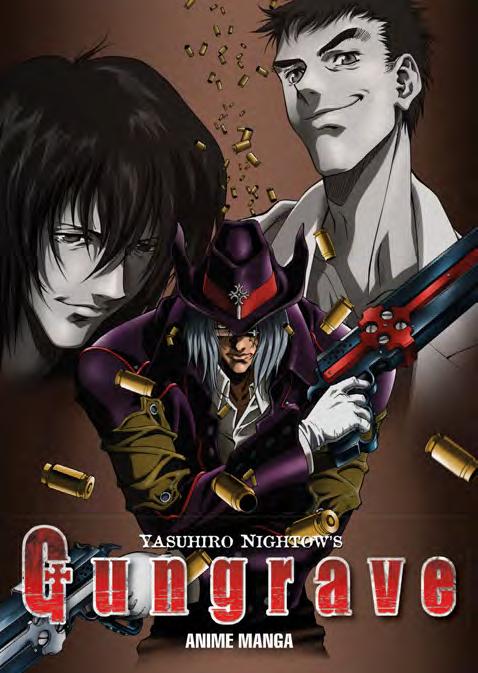
The official Anime Manga cover, reproduced in Dark Horse’s catalog, places an armed Grave in the foreground with two much larger faces behind him. A dark-haired face looks toward the viewer on the left, while the short-haired figure on the right wears a slight smile. Falling cartridge cases occupy the intervening space. The lower title identifies the book as Anime Manga, which keeps the illustration’s publishing function visible.
Our interpretation is that the cover brings an action identity and a relationship history into one composition. The foreground’s weapon and costume announce the violent present, while the enlarged faces encourage attention to people rather than simply a target. This is a reading of promotional framing, not evidence from which to disclose the ending. We retain the complete embedded cover from the publisher’s catalog instead of presenting a newly invented scene as original anime art.
RED Entertainment’s separate franchise illustration places Grave amid exaggerated mechanical equipment and debris against bright yellow and red flames. Chains, large gun forms and a sweeping dark coat create an oversized silhouette. It belongs to the official franchise’s game-origin visual presentation, not an identified television screenshot. Comparing it with the book cover shows how spectacular hardware and interpersonal drama can receive different promotional emphasis without requiring the games to join the watch-order map.
Original visual reference

A friendship can become an institution’s resource
Our analytical starting point is the tension between a private bond and organizational advancement. Brandon and Harry do not enter a neutral workplace: Millennion attaches opportunity to loyalty and coercive power. A friendship may help them move within it, but the organization also supplies incentives and expectations that do not necessarily preserve that bond. Watching their earlier lives gives the later confrontation more than a simple list of enemies.
Ask whose definition of loyalty governs a decision. Keeping faith with a friend, following an authority figure and protecting a wider network may point in different directions. Our reading is that Gungrave becomes compelling when these commitments cease to be compatible. That framework does not require revealing the decisive rupture in advance, and it avoids treating every act as a straightforward expression of a single unchanged personality.
The contrast between an armed supernatural figure and extended criminal-life drama also changes the meaning of action. A spectacular weapon is easy to recognize; the history determining why someone uses it takes time to establish. The opening can make later knowledge available early, while an alternate fan route delays that recognition. Compare those reading experiences as changes in suspense and dramatic irony rather than treating one preference as proof that the creators assembled the story incorrectly.
Nightow’s original designs and Shino’s screen designs belong to separate stages
FlyingDog credits Toshiyuki Tsuru as director, Yosuke Kuroda for series composition, Yasuhiro Nightow for original character concepts and Masanori Shino for animation character design. MADHOUSE produces the animation. These distinctions explain how a recognizable franchise silhouette reaches the screen without assigning every animated drawing or script decision to the originating designer.
Tsuneo Imahori provides music and the opening theme Family, while Scoobie Do performs the ending theme Akaneiro ga Moeru Toki. These are official credit relationships, not a license to redistribute the recordings through this page. Readers interested in sound can use the label’s records to distinguish the television production from other franchise soundtracks that share a composer or title.
Tomokazu Seki voices Brandon and Beyond the Grave. The anime record names Kenji Hamada for Harry’s younger years and Tsutomu Isobe for his later years; Kikuko Inoue voices Maria. The separation of Harry’s performance credits is useful when discussing how a long relationship changes over time. A shared Nightow connection with Trigun may support a creator comparison, but does not make Trigun a prequel or part of a shared required universe.
“Everyone skips episode one” is a community claim to qualify
The displayed AniList audience score is 75/100, normalized to 7.5/10, observed October 3, 2026. Its entry is the 2003 television anime with 26 episodes. It does not rate the original game, later games, Anime Manga or Archives. A franchise’s several media releases should not inherit this score as though one audience ballot measured every product.
A selected recommendation thread contains a viewer asking whether skipping the first episode is necessary. One reply says they had not previously heard the advice, watched it and were comfortable with the experience; the questioner then considers watching it too. That exchange provides a useful counterexample to sweeping claims that all viewers agree on a skip. Other threads promote the alternate opening strongly, but those remain individual recommendations.
Our response is to make the choice understandable. Numbered order preserves the published framing; beginning later postpones certain information. The work combines gun violence and criminal drama with supernatural elements, so an interest in grounded organized-crime stories does not guarantee that every later stylistic turn will appeal. Evaluate the complete adaptation on its own terms, and approach official summaries and fan ending discussions only when the amount of advance information suits your viewing preference.
Separate collection coverage from new production announcements
The official complete-series retailer listing describes episodes one through twenty-six and extras such as conceptual art, previews and clean opening and closing sequences. Those extras do not add another narrative season. Likewise, a packaged collection may place several disc menus around one continuous television run. Check included episode numbers rather than treating the number of cases or discs as the number of story arcs.
The 2013 Dark Horse reader guide places Anime Manga and Archives in different illustrated roles: a graphic adaptation and a design reference. An old catalog proves that a publisher documented these products at that time. It does not guarantee current stock, digital availability or that the Anime Manga covers every television episode. We do not construct an unverified full-volume reading sequence from a single numbered book or a catalog thumbnail.
No audited anime budget or franchise profit was established in the reviewed material. Game release dates and action-oriented promotional language cannot supply those financial figures. RED’s later game announcements likewise concern their named products, rather than a newly commissioned anime continuation. The useful commercial comparison is precise edition coverage and format, with current price and regional availability checked separately when a reader is deciding what to buy.
Finish the screen story before using detailed relationship references
For the simplest complete route, watch episodes one through twenty-six. Keep any alternate first-episode preference labeled as a choice about suspense rather than an official missing-episode repair. The Anime Manga can be explored as screen-related reading, while Archives offers optional design study. Neither book is presented here as a required prose source or an independently verified sequel.
FlyingDog supplies the original television credits, cast and broadcast period; RED’s historical records establish the earlier game origin. Dark Horse’s catalog provides the print-format distinctions and original cover used on this page. MyAnimeList and the Gungrave community wiki can help locate characters and entries, but plot pages reveal central relationship turns. Use them after viewing if preserving that discovery matters to you.
Future updates should check the medium of an announcement before adding a route node. A game, an anime collection and a new television production are distinct items even when they carry the same Gungrave branding. We retain the game-origin explanation while keeping games outside the anime and printed-companion map. That approach allows more adaptation coverage later without making a clean twenty-six-episode recommendation harder to follow.
Primary sources and useful navigation
- FlyingDog · television story, named staff, cast and broadcast period
- RED Entertainment · original game dates and official series record
- RED Entertainment · company history, original July 2002 game
- Dark Horse · official reader guide, Anime Manga and Archives, page 36
- Crunchyroll Store · complete series episodes 1–26 and extras
- AniList · named anime audience score
Community and catalog routes
- MyAnimeList · named anime catalog
- Reddit · selected thread questioning the episode-one skip advice
- Gungrave Wiki · anime character and episode navigation; spoilers
The production and publisher links support project facts. Catalog and community pages are secondary navigation and may reveal later events.
Original series imagery is reproduced under permission asserted by the site owner; the source and rights credits are retained. The route diagram is Animeteor’s own explanatory graphic.
Games and live-action adaptations
- Gungrave G.O.R.E — Game: Third-person action shooter
- GUNGRAVE VR — Game: VR action shooter
- GUNGRAVE VR U.N — Game: Standalone VR action adventure
- GunGrave G.O.R.E BLOOD HEAT — Game: Announced Unreal Engine 5 action-shooter rebuild