Watch episodes 1–13, then DVD supplements 14–16. Read source novels in volume order from The Rolling Bootlegs. Fujimoto manga 1–3 and Ginyu Shijin Grand Punk Railroad 1–2 are separate routes.
Reviewed 3 October 2026 · Opening premise and adaptation relationships. Major endings withheld; linked catalog summaries and discussions may contain spoilers. · Licensed access varies by country.
The source and screen branches

Historical years are setting labels, not the recommended first reading order. The two manga adaptations keep separate artists and volume numbering.
- WATCH · anime: TV ·episodes 1–13 → DVD supplements ·14–16
- READ · novels: Volume 1 ·The Rolling Bootlegs → Follow volume numbering → Verified Yen On catalog ·through 22
- READ · manga: Fujimoto ·volumes 1–3 · Ginyu Shijin ·Grand Punk Railroad 1–2
Watch the presentation order before trying to sort its history
Baccano! follows people whose ordinary criminal ambitions collide with something extraordinary: immortality. Its official introduction places the animated ensemble in Prohibition-era America and combines suspense, action, comedy, romance and supernatural events. The cast does not behave like a single hero’s support network. Different people can consider themselves central to events while knowing remarkably little about what everyone else is doing.
For a first viewing, watch the thirteen television episodes in their numbered order, then the three additional DVD episodes numbered fourteen through sixteen. The official story page labels those final three as DVD-only supplementary installments. The 2011 Japanese Blu-ray collection includes all sixteen. A database showing thirteen television episodes and a box advertising sixteen installments can therefore both be describing their own coverage accurately.
Do not rearrange the episodes into historical order on a first viewing. The changing viewpoints and time references are part of how the anime distributes information. Our recommendation is to let it reveal connections, then revisit the numbered sequence with a clearer sense of the cast. The novels and two separate manga adaptations below supply other entry routes, rather than mandatory interludes between episodes.
| Medium | First-entry route | Important boundary |
|---|---|---|
| Anime TV | Episodes 1–13 | Follow numbered presentation order |
| Additional anime | Episodes 14–16 after TV | DVD-only supplements; not another full season |
| Source novels | The Rolling Bootlegs, then volume order | Longer prose series; date subtitles are not reading order |
| Fujimoto manga | Volumes 1–3 | Separate adaptation beginning with 1927 material |
| Ginyu Shijin manga | Grand Punk Railroad 1–2 | Different train-story adaptation; not Fujimoto 4–5 |
Publication order makes a better first novel route than the year on a cover
Ryohgo Narita writes the source novels, illustrated by Katsumi Enami. KADOKAWA identifies The Rolling Bootlegs as the work awarded Gold in the ninth Dengeki Game Novel competition and lists its Japanese publication in February 2003. Yen On’s first English hardcover appeared in May 2016, translated by Taylor Engel. Those are publication dates, not the story’s calendar year or evidence that the source first appeared after the anime.
Begin the prose route with volume one and follow volume numbering. The official anime site’s book catalog moves from the first novel to the 1931 Local and Express train books, then 1932 Drug & The Dominos and 2001 The Children of Bottle. This visible jump illustrates why sorting titles only by their historical year can obscure the intended introduction of events. A later book about an earlier period need not be the best first encounter with its characters.
Yen Press’s reviewed novel catalog reaches volume twenty-two,1935-D Luckstreet Boys. We identify that verified catalog coverage without calling the entire story definitively complete or announcing an unverified release for another volume. After the anime, starting again at novel one is our editorial recommendation for recovering the prose’s explanations and different presentation. We do not assert that episode sixteen corresponds to a clean boundary after which every reader can safely skip the early books.
Visual case: a crowded carriage and a two-person cover
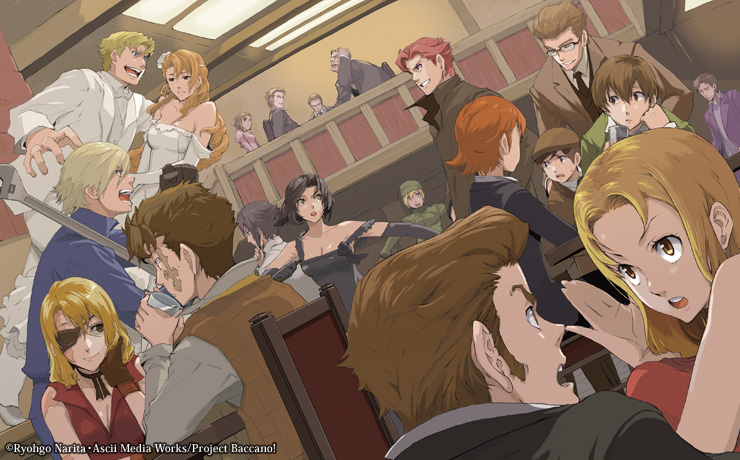
The original Blu-ray case illustration places many characters inside a railway carriage. Benches, the ceiling and carriage windows set up strong diagonals; figures lean across seats and turn toward people at different distances. The foreground pair is especially close to the viewer, while more faces remain visible behind them. Rather than isolating one person in a monumental pose, the image makes relationships and competing directions of attention fill the frame.
Our interpretation is that this composition advertises the pleasure of trying to read a social situation. Some figures look tense, some animated or amused, and others more reserved. Those differences can coexist within the same space. The image is official collection artwork, credited on the product page to Enami; it is not evidence that all these people share a single corresponding scene in the television story. Its visible copyright remains intact.
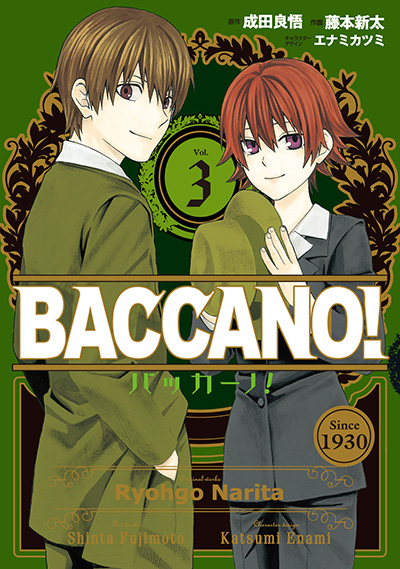
Fujimoto’s third manga cover changes scale and rhythm. Two young figures stand against a green background inside an ornate dark-and-gold frame. A large white BACCANO! title crosses their bodies, with a round volume-three marker above and a Since 1930 emblem below. The restraint of that paired composition contrasts with the carriage’s crowd. The volume label identifies the manga edition; the date emblem does not turn this third manga book into source novel three.
Original visual reference
The ensemble asks you to build connections rather than find one owner of the story
Our reading of the opening premise is that immortality changes the length of a person’s history without eliminating immediate fears, loyalties or desires. Money, recognition and affection can still determine an action even when death operates differently. The supernatural rule therefore interacts with familiar motives instead of replacing them. That gives the crime setting more than a decorative historical costume.
The official setup also introduces several groups heading into overlapping trouble around New York and a transcontinental train. Our analytical question is who can see which part of the event. A suspicious act from one viewpoint can be a practical necessity from another; the first account a viewer receives is not always the fullest account available. Keeping that distinction in mind helps a first viewing feel exploratory rather than like a test of how quickly names can be memorized.
The source novels, anime and manga can emphasize that uncertainty differently. Prose has space to stay with a particular line of explanation. An animated cut can jump between places before the viewer has resolved a connection. A manga page can arrange faces and reactions so that the reader controls the return to an earlier panel. These are comparison tools, not a claim that every adaptation delivers the same incidents or that an unseen cut was mandated by financial pressure.
Recognize the different artists attached to each route
The official anime credits identify Takahiro Omori as director, Noboru Takagi for composition and scripts, Takahiro Kishida for character design and Brain’s Base for animation production. Makoto Yoshimori supplies music, while Miwa Iwanami handles sound direction. Those credits let readers distinguish the source illustrations, screen character models and audiovisual presentation. A memorable character image should not automatically be attributed to the person responsible for every other format.
Shinta Fujimoto draws the three-volume Square Enix manga, with Narita credited for the original story and Enami for the character designs. Yen Press’s first-volume synopsis begins in 1927, following Firo and the Martillo family; the final-volume catalog identifies 1930 and the conclusion of that manga’s ruckus. Read volumes one through three as their own progression. It is not a three-book compression of all twenty-two cataloged prose volumes.
Ginyu Shijin draws a separate Grand Punk Railroad manga. KADOKAWA identifies its second volume as the concluding adaptation of the 1931 Local and Express novels. Its Japanese paper release in 2008 and digital release in 2014 are different editions, not two additional story volumes. Keep it beside Fujimoto’s manga as a parallel option. It is not volumes four and five of Fujimoto’s series, and an English license for one version does not establish an English edition of the other.
A finished anime can leave a reader wanting a much larger source world
The named AniList score here is the 2007 television anime’s 81/100, normalized to 8.1/10 and observed October 3,2026. Its entry covers thirteen television episodes. It does not rate the three supplementary DVD installments, the novels or either manga. This distinction prevents a sixteen-episode collection from inheriting a broader audience-score claim than the record supports.
A selected r/Baccano discussion begins with a viewer surprised by the size of the novel series after finishing the anime. Replies describe the different eras, recommend beginning with the first novel and discuss physical-book availability. The exchange captures a useful practical problem: a screen story can feel substantial without showing the full reach of its source. Individual commenters’ current volume counts and claims about the anime’s commercial performance are not our primary evidence.
Our recommendation is to decide what you want next. Rewatch the anime if you want to trace how its information was arranged; start the novels if you want a larger prose route; choose a named manga if you prefer a limited visual reading project. Confusion in an early episode does not necessarily mean that a missing prequel is required. The work contains disturbing violence alongside its comic energy, so the ensemble’s playfulness should not be mistaken for an all-ages suitability guarantee.
A high-definition package can contain an upconverted older master
The official 2011 Blu-ray announcement specifies sixteen episodes on three discs and states that the HD material was upconverted from an SD master. That matters when assessing a physical release: a resolution label does not by itself promise new animation or a native high-definition restoration. The package also separates Enami’s illustrated outer case, Kishida’s digipack and its booklet as different supplied extras.
For the novels, compare format and language as well as volume number. Yen Press catalogs hardback and digital versions of the first novel, while its audio series credits Michael Butler Murray as reader. An audiobook is another delivery format of the prose, not a new anime season or separate manga chapter. Its release schedule should not be assumed identical to the hardcovers. Check the exact volume and regional purchase page before buying.
Community complaints about scarce early hardcovers may help identify what to check, but they do not demonstrate current global stock, print runs or title profit. No audited production budget or franchise revenue was established in our sources. The original novel’s documented award is a recognition of a work; it does not supply sales results. We avoid using fan speculation about commercial failure or the author’s health as an explanation for an unverified next release date.
Choose a route by medium, then keep its numbering
For the screen route, complete episodes one through thirteen and then fourteen through sixteen. For prose, begin The Rolling Bootlegs and follow the published volume sequence, keeping each date subtitle as a story-setting label. For the Fujimoto manga, read one through three; for Ginyu Shijin’s train adaptation, read one and two separately. These instructions keep narrative order, historical era and physical edition from collapsing into the same kind of number.
The official catalogs are the first stop for a new volume, edition or confirmed installment. Community and wiki pages are useful for discussing eras and character relationships after you have encountered them, but their summaries may expose major outcomes. We do not turn a fan chronology into a mandatory viewing order. Game products remain outside this anime/manga/prose roadmap under the site’s format rule.
Hell Girl provides another directed work by Omori and a very different treatment of moral consequences. Dead Mount Death Play offers another Narita/Fujimoto collaboration for readers curious about the creators’ other work. Those are creator connections, not required chapters of a shared Baccano! continuity. A future update should distinguish a newly published narrative volume from another language edition or a reissued collection so that the relevant branch can change without rewriting every route.
Primary sources and useful navigation
- Official anime ·13 TV and 3 DVD installments
- Official anime ·source and ensemble introduction
- Official anime ·staff credits
- Official Blu-ray ·16 installments, SD upconversion and case art
- KADOKAWA ·first source novel,2003 publication and award
- Official anime ·source novel titles and differing story years
- Yen Press ·first novel, author, illustrator, translator and formats
- Yen Press ·reviewed English novel catalog
- Yen Press ·volume 22 edition
- Yen Press ·Fujimoto first manga and 1927 premise
- Yen Press ·Fujimoto manga catalog and ending volume
- Square Enix ·third manga cover and credits
- KADOKAWA ·separate Grand Punk Railroad manga 2 ending
- Yen Press ·audio formats and named reader
- AniList · named anime audience score
Community and catalog routes
- MyAnimeList · named anime catalog
- Reddit ·selected post-anime source reading discussion
- Baccano Wiki ·light novel navigation; spoilers
- Wikipedia ·version navigation; spoilers
The production and publisher links support project facts. Catalog and community pages are secondary navigation and may reveal later events.
Explore related story guides
Original series imagery is reproduced under permission asserted by the site owner; the source and rights credits are retained. The route diagram is Animeteor’s own explanatory graphic.
Games and live-action adaptations
- DS Dengeki Bunko ADV: Baccano! — Game: Multiple-viewpoint railway adventure