Begin Yamada’s novel, Segawa’s manga volume one or the 2005 anime episode one. These are alternate presentations of the original conflict. Ouka is a later publication branch with different creators; no exact post-anime chapter shortcut is certified.
Reviewed 3 October 2026 · Opening premise and adaptation relationships. Major endings withheld; linked catalog summaries and discussions may contain spoilers. · Licensed access varies by country.
The source and screen branches

Novel, original manga and 2005 anime present the central conflict in different media. Ouka’s scope and creators remain separate; the live-action Shinobi product does not enter this map. No edition-to-edition chapter match is certified.
- READ · source: Original novel · opening → Finish that prose presentation
- READ · adaptation: Masaki Segawa · manga volume 1 → Original manga · volumes 1–5
- WATCH · original: GONZO anime · episode 1 → Original 2005 run · 24 episodes
- OPTIONAL · later branch: After the original route → Ouka · different publication creators
Choose Yamada’s novel, Segawa’s manga or the 2005 anime
Begin The Kouga Ninja Scrolls with Futaro Yamada’s novel, Basilisk with Masaki Segawa’s manga volume one, or the original GONZO anime with episode one. GONZO’s production credits identify both the original novelist and manga artist. Its series record confirms a 24-episode 2005 television production; Kodansha’s English manga catalog identifies a complete five-volume series.
These are three presentations of the central rivalry, not consecutive story blocks to concatenate. Reading the novel and then the manga is a comparison of adaptations. Watching the anime and beginning volume one is likewise a return to the source presentation, not a claim that the first manga volume happens after the screen finale.
Start here for a compact, adult ninja tragedy in which a political contest traps two people who want another future. The manga publisher rates the work 18+. Our selected images are non-explicit official references, and the guide withholds the decisive outcomes. The later Ouka title has a separate creator and continuation scope explained below, rather than replacing the original opening.
Kouga and Ouka have related titles but different creative scopes
The English novel record identifies Yamada’s The Kouga Ninja Scrolls, while GONZO’s anime credits distinguish Yamada’s original work from Segawa’s manga. A prose book, five collected manga volumes and 24 television episodes measure different objects. Their numbering systems cannot be converted by assuming a fixed number of chapters per episode.
Kodansha’s discussion of Ouka names novelist Masaki Yamada and comic artist Tatsuya Shihira. It explicitly frames the comic as a continuation of Segawa’s Basilisk rather than a direct sequel written by Futaro Yamada. That distinction is a useful safeguard against attributing every later installment to the original novelist merely because the family name is shared.
For a first encounter, finish the original chosen route before investigating Ouka’s premise, which can disclose original-story relationships. This page records the later work as optional discovery without an exact cross-edition handoff. A publisher’s new-chapter label describes a later publication; it should not be mistaken for a missing volume of the original five-book English manga.
| Presentation | Named creator / production | Start |
|---|---|---|
| The Kouga Ninja Scrolls · novel | Futaro Yamada | The novel’s opening |
| Basilisk · original manga | Masaki Segawa | Volume 1 → 5 |
| Basilisk · 2005 anime | GONZO; director Fuminori Kizaki | Episode 1 → 24 |
| Ouka · later publication branch | Masaki Yamada / Tatsuya Shihira | After original route; separate title |
The first-episode image makes intimacy visible before the contest
GONZO’s premise places Gennosuke and Oboro’s wish to overcome an inherited rivalry against an externally imposed conflict. Its first-episode reference still below shows the pair close together, with Oboro leaning toward Gennosuke. That composition is directly visible; it does not identify the image as the ending or demonstrate how every subsequent scene frames their relationship.
Our reading begins with the contrast between the closeness of two bodies and the distance created by clan allegiance. The image gives intimacy an immediate form that an abstract description of a feud cannot supply. A viewer can then ask how a public designation changes the meaning of a private attachment without treating the couple as interchangeable symbols.
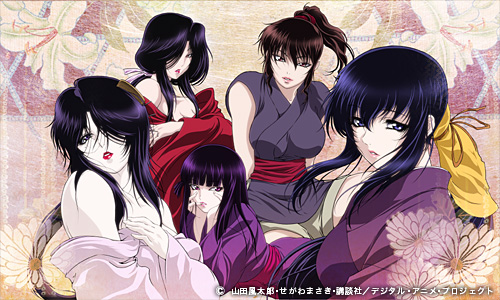
The original gallery illustration above belongs to a September 2005 magazine campaign and carries several character portraits. It is promotional artwork, not an episode screenshot. Keeping it separate from the small first-episode still avoids a false visual comparison. The case examines the confirmed premise and displayed composition while leaving later injuries, deaths and the final decision undisclosed.
Original visual reference

The contest turns people into instruments of succession
The publisher’s premise makes the two clans’ conflict part of a struggle over political succession. Our interpretation asks what happens when a decision made above the participants is transferred into their bodies. The contest can be presented as a rule-bound solution while its costs fall on people whose personal futures are not the decision-makers’ priority.
This produces a sharper question than which side is stronger. Who benefits from treating the rivalry as inevitable? Who can revoke a restraint, and who has to live through the consequences? A battle structure may look symmetrical on a roster while remaining deeply unequal in the authority that determines whether it should happen at all.
The viewer should also resist confusing a fictional political premise with a complete historical account of ninja clans. The official materials present a stylized drama with supernatural techniques. Its usefulness as an ethical story does not certify its events as documentary history; actual historical claims would require separate sources and a different kind of article.
A spectacular ability can also become a person’s assigned value
GONZO’s introductory material foregrounds unusually individualized ninja techniques. Our reading asks how a combat spectacle turns an ability into a social identity. A participant may be recognized mainly for what a body can do, leaving less room for what that person wants or fears outside the contest.
For a close reading, look at what the introduction of a technique allows the audience to understand and what it delays. A surprising ability can reorganize a confrontation, but its emotional force depends on whether the participant exists as more than a mechanism. An elimination structure makes that distinction especially important because narrative time is limited.
The manga can make a still transformation available for prolonged inspection, while animation decides when the viewer sees it and how long a reaction lasts. That is a difference in expressive tools, not evidence that one medium is automatically more disturbing or more humane. Compare a named, legally accessed passage before making a claim about a particular adaptation choice.
The romance is constrained by obligations that do not belong to the couple
The premise gives the couple a desire to end a conflict that preceded their relationship. Our interpretation treats that desire as an attempt to create a future rather than merely escape a dramatic obstacle. The force opposing it comes partly from the expectation that a person should continue what a group already believes about itself.
Watch how private speech and public responsibilities are placed near one another. An expression of affection can be sincere while leaving a practical problem unsolved. Conversely, an action that appears loyal to a clan can make a shared future less possible. A tragedy gains complexity when these pressures are allowed to operate together instead of being reduced to a misunderstanding.
The first-episode still provides an introductory image of closeness, not proof of the final outcome. Readers coming from the novel or manga should keep the anime’s disclosure sequence intact for newcomers. An adaptation comparison can discuss form and emphasis without using an unmarked ending summary as the evidence for every claim about romance.
Source authorship and the anime audience score stay distinct
The publisher’s novel biography identifies Futaro Yamada and the earlier prose work, and GONZO’s staff page identifies Segawa’s manga and director Fuminori Kizaki. The later Ouka publisher article supplies different novel and manga creators. Preserving those names helps a reader follow adaptation history without collapsing a franchise into one imagined authorial voice.
The score above is AniList’s named 24-episode 2005 anime entry, checked on 3 October 2026. It is not a score for Yamada’s novel, Segawa’s manga or the Ouka production. The ten-point display is a scale conversion of an external audience statistic; visitors are not being asked to rate the work on Animeteor.
The linked manga and anime catalog entries and reader community provide discovery routes. Their descriptions can contain major spoilers, especially when discussing later titles. Community comparisons should be read as individual interpretations. Production lineage here rests on the publisher and studio records, while exact scene coverage and a post-anime chapter shortcut remain unverified.
Adaptation history establishes products, not a combined profit total
The English novel catalog, complete manga listing and original anime archive document different published products. The novel publisher’s biography also names the separate 2005 live-action film Shinobi as an adaptation. That screen product belongs outside the core novel–manga–anime map and does not supply a required reading step.
No complete title-level production budget or audited franchise profit was verified. A retailer price, a historical award or the existence of another adaptation would not establish that figure. Commercial comparison needs a defined product, territory and period; otherwise different editions and media can be counted as if they were one consistent sales measurement.
Begin the original novel, the five-volume manga or the 24-episode anime according to your preferred medium. Explore Ouka after the original route with its creator scope visible. Ninja Scroll offers a separate animated ninja film, while Rurouni Kenshin supplies a different period drama and adaptation history. Their links are thematic discoveries, not installments of the Kouga–Iga conflict.
Primary sources and useful navigation
- Penguin Random House / Del Rey · Yamada’s original novel and adaptation biography
- Kodansha · complete five-volume manga and adult rating
- GONZO · original anime, 24 episodes and creator roles
- GONZO · official original-production staff record
- GONZO · original episode reference imagery
- GONZO · magazine campaign image in official gallery
- Kodansha · Ouka creators and continuation scope
- AniList · named anime audience score
Community and catalog routes
- MyAnimeList · named anime catalog
- Wikipedia · secondary original-series navigation
- Reddit · anime reader/viewer community
The production and publisher links support project facts. Catalog and community pages are secondary navigation and may reveal later events.
Explore related story guides
- Ninja Scroll · a distinct original ninja feature
- Rurouni Kenshin · another period-drama adaptation history
Original series imagery is reproduced under permission asserted by the site owner; the source and rights credits are retained. The route diagram is Animeteor’s own explanatory graphic.
Games and live-action adaptations
- SHINOBI: Heart Under Blade — Live action: Film · 2005
A separately licensed slot-machine simulation
Universal Entertainment’s official Android listing identifies SLOT Basilisk: The Kouga Ninja Scrolls — Kizuna as a pachislot simulator app, with rights credited to Futaro Yamada, Masaki Segawa, Kodansha and GONZO. It is a separate licensed software product, rather than an additional television episode or a narrative continuation of the ninja conflict.
The listing distinguishes simulated app values from those of the physical machine. Its reference to the physical machine’s 27 January 2014 introduction is not treated as this app’s verified release date. The store’s promotional montages do not provide the complete original in-app gallery required for a separate game guide.