Start with the 1993 feature. Its 2026 restoration is another presentation of the same film, with U.S./Canada screenings announced for 4, 5 and 7 October. The later Dragon Stone television production remains a separate optional screen block.
Reviewed 3 October 2026 · Opening premise and adaptation relationships. Major endings withheld; linked catalog summaries and discussions may contain spoilers. · Licensed access varies by country.
The source and screen branches

Restoration and disc editions do not add a story installment. The later television production stays outside the feature’s internal chronology. No required source novel or manga is established for this route.
- WATCH · film: Ninja Scroll · 1993 feature · Choose licensed disc / restored edition
- OPTIONAL · later TV: Dragon Stone · television opening → Follow that separate production
Start with the 1993 film, then choose the television production separately
For the original Ninja Scroll experience, start Yoshiaki Kawajiri’s 1993 animated film. Sentai’s theatrical-version product lists a 94-minute feature. A later disc edition or the 2026 4K restoration presents that film again; it is not a new episode to place after the ending or a second installment of the original story.
Ninja Scroll: The Series, also identified by the Dragon Stone title, is a later television production with its own opening. Keep it as a separate screen block after you have chosen whether the film’s style interests you. This guide does not certify a scene-level continuity bridge that would justify inserting television episodes into the feature.
The movie is adult material. Its licensed rating flags violence, language and sexual content; readers should also expect sexual violence. Our images are non-explicit promotional artwork, and this introduction withholds major outcomes. If those subjects are outside your viewing preferences, a route guide is not a reason to continue. No novel or manga is claimed here as required preparation for the film.
The restored feature has dated screenings, not a new story season
AMC Global Media’s 11 June 2026 announcement schedules the 4K restoration for U.S. and Canadian theaters on 4, 5 and 7 October 2026. As of this guide’s 3 October source check, those screenings are upcoming. Participating venues and showtimes should be checked through the event’s official ticket route rather than assumed to cover every city.
The earlier February announcement describes a restoration supervised by Kawajiri and an early-2027 limited-edition Blu-ray SteelBook plan. That is an announced window, not an exact worldwide shipping date. Its 4K scan and repair work concern the presentation of the 1993 feature, so the map keeps restored and older disc editions within the same film route.
Sentai’s January 2025 theatrical Blu-ray is another named product. Its release date, 94-minute running time and language information identify that edition, not the 2003 television series. The film’s translated title can appear on both products, making medium, year and subtitle more useful identifiers than the broad franchise name alone.
| Entry | What it contains | Route status |
|---|---|---|
| Ninja Scroll · 1993 | The original animated feature | Main starting choice |
| 2025 theatrical Blu-ray | A licensed disc edition of the film | Same film route |
| 2026 4K restoration | Restored feature; dated North American screenings | Same film route |
| Dragon Stone television production | Later episodic production | Separate screen block |
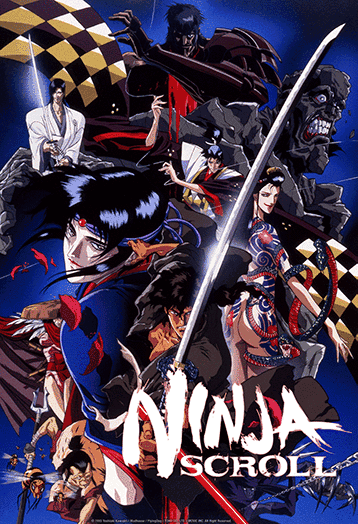
The poster turns a blade into the composition’s dividing line
The official theatrical artwork displayed above places several figures around a long diagonal blade. The licensed Blu-ray cover below reuses that composition within a visible disc case. Those are promotional images for the feature, not stills selected from a specified fight. Their relationship demonstrates an edition’s presentation without proving anything about the film’s individual shot order.
Our reading follows the blade’s diagonal. It draws the eye between foreground figures and a darker upper background, making the ensemble feel assembled around an immediate threat. Different scales and directions create tension before the viewer knows the characters’ relationships. That is a concrete claim about the displayed campaign image, not a reconstruction of its story.
The licensed premise brings Jubei’s intervention into a wider conspiracy. An action taken in one encounter can create an obligation larger than the person initially expects. The guide uses that opening situation as an interpretive starting point and avoids the revealing details in some retailer summaries. Promotional material can itself contain spoilers; its presence does not override the page’s stated boundary.
Original visual reference

Legible danger matters more than the number of attacks
Our action-reading lens asks whether the audience can understand a threat before a character must answer it. Spatial orientation, a pause and a visible limitation can make a confrontation tense. A montage of spectacular movements may communicate intensity while leaving the practical situation much less clear.
For a close viewing, choose one early confrontation and track position, distance and the available escape routes. Notice when a cut adds information and when it withholds a response. These are tools for evaluating choreography, not a claim that the promotional image supplies all the details or that every encounter in the feature uses one fixed formula.
The finite running time matters to this method. A film has to establish its threats within a compact duration, while an episodic production can distribute introductions differently. Comparing the later television title with the feature therefore needs more than a list of recognizable names. Look at how each production allocates time to danger, recovery and the next decision.
An intervention can create responsibility without creating ownership
A rescue premise raises a useful ethical distinction. Helping somebody does not mean acquiring the right to decide everything that happens next. Our reading asks whether a later action respects another person’s choices or reduces that person to a reason for the hero’s next confrontation.
That question is particularly relevant to an adult action film using coercion and sexual violence as part of its danger. A critical discussion can examine how a production frames those subjects without reproducing explicit imagery or treating them as decorative proof that the story is serious. Who receives a point of view remains important alongside who receives a spectacular action sequence.
This introduction does not certify a comprehensive judgment about every scene. It gives a first viewer a way to notice agency, obligation and the difference between vulnerability and characterization. If you compare a later review with the feature, check whether it discusses those choices or merely repeats the escalation described in an advertisement.
Restoration changes access to an image, not the film’s place in the route
The rights holder’s restoration announcement specifies a scan from the original 35mm negative, damage repair and color correction. These are documented restoration steps. They do not establish a new fictional chronology or prove that every older release had the same source material, transfer quality or color decisions.
Our practical advice is to compare edition information before comparing screenshots. A compressed web image is not a controlled test of a disc’s resolution, contrast or grain. The poster on this page is useful for recognition, while a claim about image fidelity needs the actual release, a known display setup and consistent viewing conditions.
For a reader deciding how to begin, the production choice comes first: the feature or the television title. The edition choice follows. Separating those decisions keeps a restoration announcement from becoming a confusing watch-order recommendation and lets a returning viewer revisit the film without being told that new packaging means an unseen sequel has appeared.
Name the film and the television entry when comparing reactions
AMC’s official film announcement identifies Kawajiri as original creator, writer and director, with character design and animation direction by Yutaka Minowa and music by Kaoru Wada. The production-role list distinguishes Animate Film from MADHOUSE’s animation-cooperation credit. A broad studio label should not erase those named roles.
The audience score above is AniList’s 1993 movie record, checked on 3 October 2026. It is not the later television title’s score, a judgment of the new restoration or Animeteor’s own rating. The provider’s hundred-point value is divided by ten for display, with the original record retained for later verification.
The linked Reddit community discussion compares the movie with the television production. Those responses are individual preferences, not evidence that a restoration has changed the story or that one score applies to both entries. A familiar English title can invite that confusion, so the year and medium stay visible alongside the source link.
A revival can be documented without inventing its profitability
The official 2026 press material documents another theatrical release and explains the restoration process. That establishes a new distribution event for an older film. The number of announced screening dates is not a box-office figure, and a distributor’s praise for an earlier revival does not supply an audited profit calculation.
No complete restoration budget or title-level profit statement was verified for this guide. A future SteelBook window also cannot be treated as units sold. Financial analysis would need a named release, territory, period and metric before relating receipts to production and distribution expenses. The guide instead gives the specific dated event and keeps the financial gap explicit.
Choose the original feature in an edition suitable for your region; treat the Dragon Stone television production as a separate later option. Samurai Champloo offers a different episodic use of swordplay and travel. Basilisk follows a distinct novel-to-manga-to-anime relationship. Neither is a prerequisite or continuation simply because an English title refers to ninjas or scrolls.
Primary sources and useful navigation
- Sentai · theatrical-version disc, runtime and mature rating
- AMC / HIDIVE · 2026 screening dates, role credits and original artwork
- AMC / Sentai · restoration method and early-2027 disc announcement
- Hulu Japan · separately named Dragon Stone television production
- AniList · named anime audience score
Community and catalog routes
- MyAnimeList · named anime catalog
- Wikipedia · secondary film navigation
- Reddit · movie and television-production reactions
The production and publisher links support project facts. Catalog and community pages are secondary navigation and may reveal later events.
Explore related story guides
Original series imagery is reproduced under permission asserted by the site owner; the source and rights credits are retained. The route diagram is Animeteor’s own explanatory graphic.