Start Yoshihiro Togashi’s manga at volume one or the 1992 anime at episode one. Follow the 112-episode main television route; choose films and video extras separately. No exact anime-to-manga continuation chapter is certified here.
Reviewed 3 October 2026 · Opening premise and adaptation relationships. Major endings withheld; linked catalog summaries and discussions may contain spoilers. · Licensed access varies by country.

The source and screen branches

These are source and presentation routes, not a panel-to-episode concordance. Publication order and in-story chronology are different. Games and live-action remain outside this map.
- READ · source: VIZ manga · volume 1 → Continue volumes 2–19
- WATCH · main TV: 1992 television · episode 1 → Continue main series · 112 episodes
- OPTIONAL · animation: Named films / video extras · Separate from main TV numbering
Begin with manga volume one or the 112-episode television route
YuYu Hakusho has two straightforward first-time routes: Yoshihiro Togashi’s manga from volume one, or the 1992 television anime from episode one. VIZ’s English catalog lists nineteen manga volumes. Fuji Creative identifies the main screen production as a 112-episode series. Those are different ways to encounter the same central characters, not two halves that must be completed in tandem.
Our recommendation is to choose the manga if you want control over reading pace and the source’s page-to-page delivery, or the television series if sustained performance and audiovisual timing are your priority. Neither choice requires watching a feature film before the opening episode. A long series is easier to approach when its main route stays visible.
After finishing the anime, use the manga as a separate source reading rather than treating the next numbered chapter as an automatic sequel. This guide has not inspected a licensed finale-to-page correspondence. It therefore recommends volume one for a full source comparison and does not invent a chapter that supposedly begins a post-anime continuation.
Nineteen manga volumes are not nineteen anime seasons
VIZ’s product list makes the English single-volume reading route identifiable. Read the volume numbers within that edition. The publication date on an English product records that edition’s release; it does not date the beginning of Togashi’s Japanese serialization or the premiere of the television adaptation.
The Crunchyroll Store anniversary box lists episodes one through 112 and an OVA among its contents. Its package is useful evidence of what that particular edition contains, not a promise that every regional streaming service includes the same extras. A streaming service’s season divisions can be packaging choices rather than new productions.
Pierrot’s archive separately identifies theatrical productions and video material. Keep those named extras outside the main television sequence until you know which item you are selecting. A short feature, a longer film and anniversary animation should not all be labeled season five. Games and live-action products, when covered, belong to separate product guides rather than this manga–anime roadmap.
The rescue challenges the label of delinquent
VIZ’s opening description establishes the central reversal: Yusuke is known as a troublesome teenager, yet dies while saving a child. The afterlife’s response creates the story’s starting problem. Fuji Creative’s screen synopsis also identifies his death, return and spirit-detective role. These sources corroborate the premise without proving that every opening scene appears in identical order.
Our interpretation begins with the gap between a reputation and an action. The rescue matters because it interrupts an easy judgment of Yusuke. An act done without an audience or a guaranteed reward is harder to reduce to performance. The opening asks readers to reconsider a person before presenting the larger supernatural conflicts.
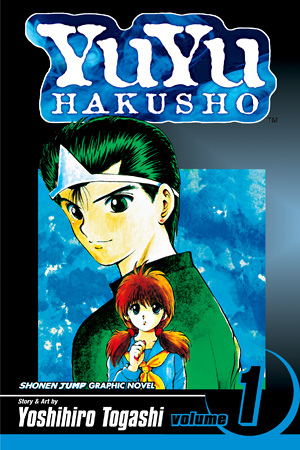
The VIZ banner and volume-one cover shown here are original manga promotional references. Their character presentation connects the source identity to this reading, but a cover is not the rescue scene. We have not reproduced that scene or compared a licensed episode’s individual shots with manga panels; the case’s factual limit is the verified introductory framing.
Original visual reference
A second chance is an obligation, not a clean erasure
Yusuke’s return is an unusually productive starting point because survival does not remove the relationships and judgments that existed before it. Our reading treats the second chance as an obligation to respond to a world that has already formed an opinion of him. A new supernatural role adds responsibility without making him an entirely different person.
The distinction is useful when following his development. Ask whether a decision changes because he has learned something, because another person now matters to him, or because the situation makes his old behavior inadequate. A larger power does not answer those questions by itself. Character growth becomes visible through priorities, not only through the strength of an attack.
The ghost premise also gives the opening a way to approach absence. A person can discover the effects of their life only after being removed from ordinary participation. That is our thematic inference from the introductory situation, not a statement that every adaptation handles mourning identically. Readers can test it against the version they choose.
Four companions make strength a question of trust
Fuji Creative’s screen introduction describes Yusuke working with three companions. Pierrot’s anniversary introduction names Kuwabara, Kurama and Hiei alongside him. This ensemble gives the supernatural premise a social dimension: the protagonist’s capacity to face danger becomes connected to people whose temperaments and histories are not interchangeable.
Our editorial reading focuses on trust rather than ranking the group’s combat abilities. A useful question is who is willing to act before they have certainty about somebody else. Cooperation can be difficult even when several characters want to defeat the same threat. A companion’s independence creates tension that a perfectly obedient supporting cast would not provide.
For newcomers, the group is also a reason to allow the story time to establish its relationships. An early confrontation and a later partnership can carry different emotional weight despite sharing action imagery. That observation does not require revealing who wins a major fight. It suggests what to watch for while keeping discovery order intact.
Spirit detective work asks who defines a threat
The official premise gives Yusuke an investigative role alongside his fighting role. That combination makes the title more interesting than a sequence of strength tests alone. An investigation requires a judgment about what has happened and who needs protection; a battle determines whether the characters can act on that judgment.
Our interpretation asks what changes when an opponent is understood as a person with a motive rather than a category of monster. Sympathy need not excuse harm, and a sympathetic explanation need not eliminate the need to intervene. Holding both possibilities open lets readers examine the ethical decision instead of treating the supernatural label as the whole answer.
A detailed adaptation comparison could inspect how dialogue, reaction time and framing communicate those judgments. The manga reader controls a pause between panels; a television performance supplies its own duration and sound. These are different tools. This guide proposes that comparison without claiming to have established a universal winner across all 112 episodes.
Keep creator credit and audience preference attached to a version
VIZ identifies Yoshihiro Togashi as the manga’s creator and links his career to other works, including Hunter x Hunter and Level E. Fuji Creative credits the original comics and the Pierrot/Shueisha television production separately. Those records distinguish source authorship from animation production rather than assigning both to one studio.
The external score displayed above is AniList’s named 1992 television entry, checked on 3 October 2026. Its 100-point audience value is shown on a ten-point scale. It does not rate the manga, a movie, the OVA extras or the live-action adaptation. The score is a limited indicator of that platform’s audience reception, not an objective measure of fidelity.
The linked Reddit volume-one discussion illustrates a practical reader concern: encountering a series when the opening volume is missing. Its question is a reason to provide clear edition navigation, not evidence that all fans recommend one format. Community routes below are optional, may contain spoilers and remain separate from the publisher and production evidence.
Anniversary availability is evidence of an edition, not a profit statement
An anniversary home-video set and a maintained English manga catalog show that there are identifiable ways to revisit the series. They do not establish a current global audience count, a complete production budget or franchise profit. A retailer’s price belongs to one product and territory and may change independently of the story’s popularity.
Pierrot’s anniversary campaign is also a dated historical reference. Its celebration of the television production should not be mistaken for a newly announced full remake. When future news is added, the update needs the named project, announcement date and relationship to the existing route. Older promotional material must keep its historical context.
Choose the nineteen-volume source route for the manga’s own delivery or the 112-episode series for the television ensemble. Explore specifically named extras afterward according to interest. A different supernatural-action guide offers another discovery route, but its world and chronology should not be joined to Yusuke’s.
Primary sources and useful navigation
- VIZ · manga premise, creator and English editions
- VIZ · nineteen-volume catalog
- Fuji Creative · 1992 production, 112 episodes and rights credits
- Pierrot · historical 25th-anniversary introduction
- Pierrot · theatrical production archive
- Crunchyroll Store · anniversary box contents
- AniList · named anime audience score
Community and catalog routes
- MyAnimeList · named anime catalog
- Reddit · missing volume-one reader question
- Wikipedia · secondary franchise navigation
The production and publisher links support project facts. Catalog and community pages are secondary navigation and may reveal later events.
Explore related story guides
Original series imagery is reproduced under permission asserted by the site owner; the source and rights credits are retained. The route diagram is Animeteor’s own explanatory graphic.
Games and live-action adaptations
- Yu Yu Hakusho (2023) — Live action: Series · 2023
Production and edition updates
Yu Yu Hakusho: Makyo Toitsusen — Mega Drive edition
Sega’s official archive dates the original Japanese Mega Drive fighting game to 30 September 1994 and credits Sega as publisher. It identifies eleven playable characters and one-to-four-player battles, with a separate hub needed for the original four-player setup. The game is also listed in the Japanese Mega Drive Mini catalog.