Watch Kon’s single animated feature or read Takeuchi’s Complete Metamorphosis. Awaken from a Dream has a separate plot; the 4K remaster is an edition, not a sequel.
Reviewed 2 October 2026 · Opening premise and format relationships; major ending revelations withheld. Linked publisher summaries and discussions may reveal later events. · Licensed access varies by country.
The source and screen branches

One film adapts the source novel. The other book has a separate plot; edition and restoration dates do not create additional story installments. No source manga is invented.
- READ · source: Complete Metamorphosis → English edition · 2018
- WATCH · adaptation: Satoshi Kon animated feature → 1998 Japanese theatrical catalog
- READ · optional separate plot: Awaken from a Dream → Not film continuation
- WATCH · edition choice: Existing film · 4K remaster → Check extras and territory
One film and a source novel do not form a numbered television route
Perfect Blue is a single animated feature directed by Satoshi Kon. It draws on Yoshikazu Takeuchi’s novel, available in English as Complete Metamorphosis. Begin either at its opening. The prose and screen versions are separate treatments, so reading the novel is an opportunity for comparison rather than a prerequisite for understanding a missing first episode.
GKIDS identifies the film’s Japanese theatrical release in 1998, while its copyright carries 1997. A festival or production date and a domestic theatrical date can legitimately differ. This guide labels the animated feature by its 1998 catalog entry and does not turn those dates into two distinct films or a prequel-sequel relationship.
Awaken from a Dream is another Takeuchi book with a separate plot, not a chapter following the film’s ending. No source manga was verified for this route. Restored screenings, discs and digital editions present the existing animated work; games and live action, if separately covered, remain outside the novel-to-animation map.
| Route | Entry point | Relationship |
|---|---|---|
| Animated feature | 1998 cataloged film | Kon’s screen interpretation |
| Source prose | Complete Metamorphosis | Takeuchi novel; begin at opening |
| Other prose | Awaken from a Dream | Separate plot, optional |
| 4K edition | Existing animated feature | Restoration and distribution, not sequel |
English book dates and a restored film serve different purposes
The English Complete Metamorphosis paperback is dated 6 February 2018, ISBN 9781626926455, with 232 pages in the distributor’s product record. That is the English edition’s publication date, not the origin of Kon’s earlier film. A later translation can make a source newly accessible without reversing the adaptation relationship.
Seven Seas dates Awaken from a Dream to 24 April 2018, ISBN 9781626927414, and explicitly distinguishes its plot from Complete Metamorphosis. The shared Perfect Blue series label is useful catalog navigation. It should not be read as confirmation that the second English product continues Mima’s film story in a mandatory chronological sequence.
GKIDS now advertises a 4K remaster with digital, collector and steelbook editions. Its collector package includes a booklet, art cards and a poster; its bonus listings identify subtitled Kon lectures. Those are documented edition features. The displayed remaster poster’s October screening text is campaign artwork, not an automatically recurring annual release date.
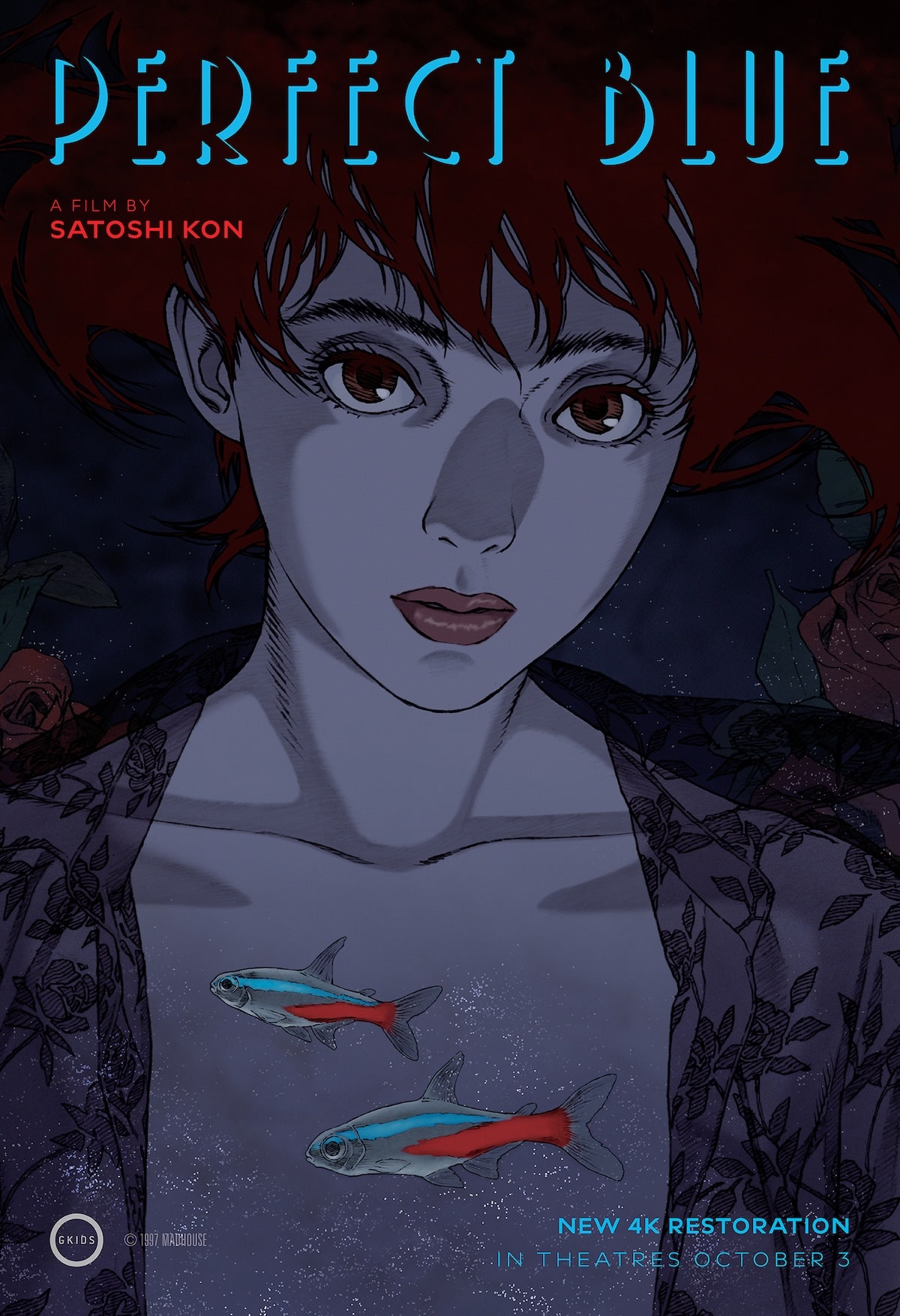
A publicity image makes a face appear beneath another surface
The selected original GKIDS remaster poster shows Mima’s face in a predominantly dark blue and red composition. Small blue-and-red fish appear below it, with the film title and restoration campaign text printed around the image. This is authorized-distributor promotional artwork, not a newly generated portrait or a claim that the poster depicts one literal event.
Our visual reading notices the tension between direct facial attention and a surrounding surface that seems to contain other imagery. The face is recognizable, but the composition makes its setting uncertain. That is a useful introduction to the film’s concern with a person’s image, without disclosing the resolution of its reality puzzles.
A poster remains an editorially arranged advertisement. It can suggest themes without proving a character’s diagnosis, identity or final action. The guide therefore separates visible design from story explanation. Visitors who compare the source and film should examine named licensed passages and scenes, rather than use promotional symbolism as a shortcut to a definitive interpretation.
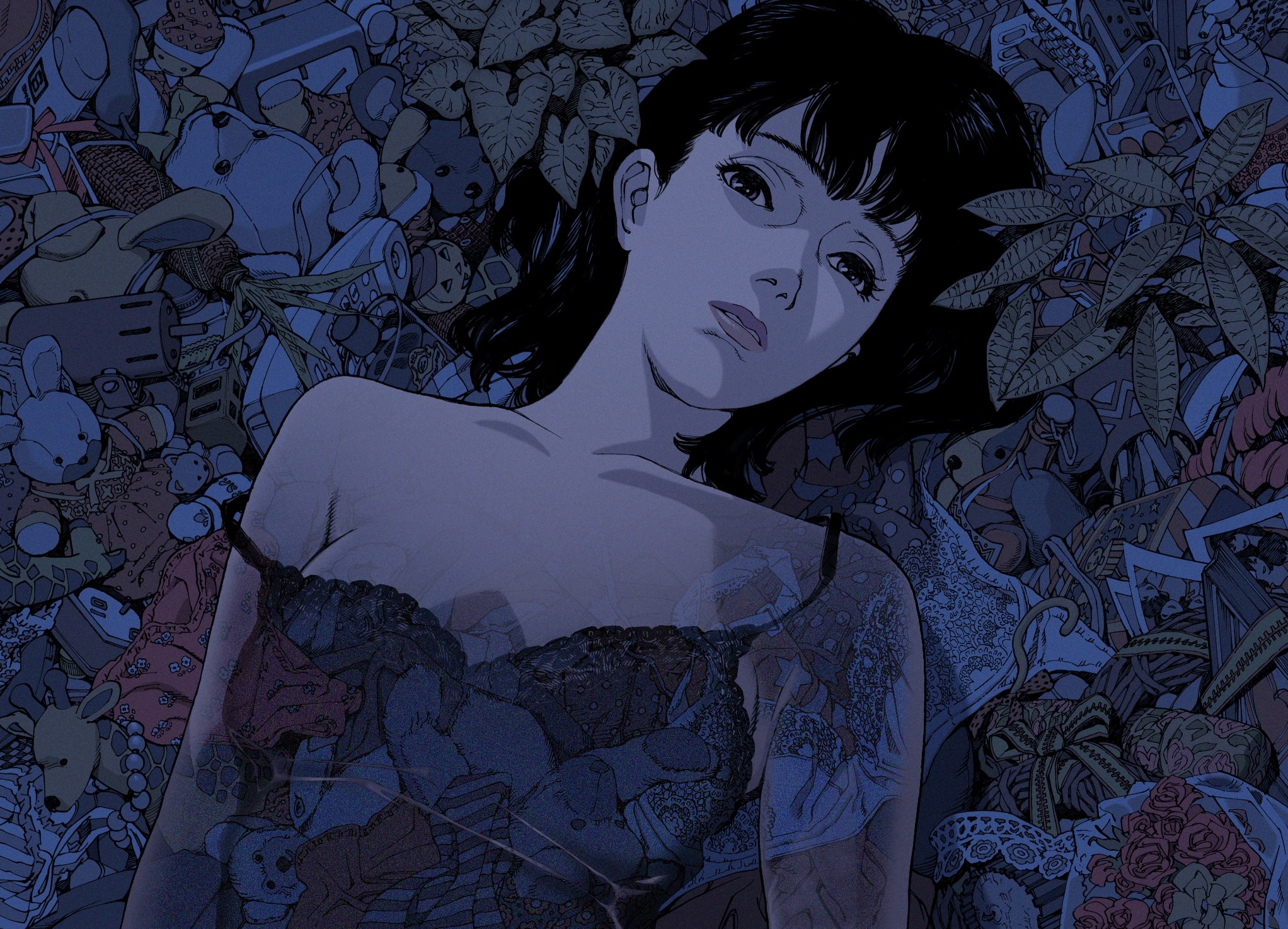
Original visual reference
A public image can become a demand against the person it represents
Our central reading starts with Mima’s move from pop performance toward acting. A public image is useful while it connects a performer with an audience, but it becomes coercive when other people treat it as an obligation that the performer must obey. The story’s premise places that tension within an increasingly threatening environment.
A close reading can distinguish affection for a performance from a claim of ownership over its creator. Who is permitted to change, and who assumes the right to veto that change? A familiar persona can become a source of control when its consistency is valued more highly than the actual person’s decisions and safety.
This interpretation does not require treating every admirer as dangerous or diagnosing the performer from a brief summary. The relevant question is how a particular relationship converts an image into authority. Specifying an action, scene or passage helps keep that criticism grounded rather than reducing the work to a broad condemnation of fandom.
A career decision may be voluntary while its conditions remain unequal
The licensed premise describes a difficult change in Mima’s career and provocative professional demands. Our analysis asks how the work environment distributes power over a performer’s body and image. Agreement to pursue a role does not by itself explain whether every surrounding decision was freely chosen or whether refusal carried a meaningful cost.
A close reading should distinguish the character’s ambitions, the manager’s expectations, the production’s demands and the audience’s reactions. Those positions can overlap without being identical. Tracking who proposes an action and who bears its consequences makes the career change more legible than simply describing it as a fall from one public identity into another.
The film includes sexual violence and disturbing material. This guide discusses those themes without reproducing explicit scenes or using them as decorative attraction. Its purpose is to examine how professional opportunity and vulnerability interact, while withholding major revelations and avoiding claims about a real performer based on this fictional character’s circumstances.
Uncertainty asks viewers to inspect transitions, not only collect clues
GKIDS describes fiction, performance, dreams and mediated information intersecting within the feature. Our reading asks how a viewer is positioned between those layers. An abrupt transition can briefly make an image seem continuous with the preceding situation, creating uncertainty that concerns the act of watching as well as the plot’s events.
A close reading can identify the exact point at which an assumed context changes. What established the location, whose perception was available and which evidence remained offscreen? This approach keeps uncertainty specific instead of declaring every confusing moment arbitrary. It also allows competing interpretations to be compared through shared observations.
The prose source requires its own examination of viewpoint and language. We do not claim it reproduces every film transition or provides a universal answer key to Kon’s editing. An adaptation comparison becomes stronger when it names an actual passage and screen sequence, then explains what each medium makes available to its audience.
Creator connections are useful without manufacturing a shared universe
Takeuchi is credited on the source books, while Kon directed the animated feature. GKIDS identifies Millennium Actress, Tokyo Godfathers and Paprika among Kon’s other works. These are useful creator connections for further viewing; they do not establish that those films are chronological installments of Mima’s story or require a shared-universe roadmap.
The current distributor’s supplemental listings offer interviews and lengthy subtitled Kon lectures for edition-specific research. A future analysis should identify the particular lecture or interview before attributing a statement to the director. General internet anecdotes about artistic intention or another filmmaker’s legal rights are not substituted for a verified first-person record.
The displayed AniList 8.5 out of 10 concerns only the animated movie cataloged in 1998. Neither book inherits that rating, and the remaster is not given an invented separate audience score. Reddit and secondary navigation offer discussion with spoilers possible; they are not evidence that an unannounced sequel or source manga exists.
Restoration adds access and supplemental context to an existing work
A restored edition can change how viewers encounter a film through presentation, subtitles, packaging and access. GKIDS’s current remaster listing documents that activity. It does not establish a new animated installment, and a collector product’s extras should not be assumed to appear on every digital service or in every territory.
No audited Perfect Blue net profit or complete original production budget was verified. A collector package price, historical theatrical receipt and distributor-wide revenue measure different things. Comparing commercial performance would require dates, territory and reporting definitions, rather than projecting a result from a cult reputation or an audience score.
Begin the feature or Complete Metamorphosis, then compare their treatments if desired. Choose Awaken from a Dream for a separate prose story. Future maintenance should check remaster access and edition specifications, preserving the distinction between the original work’s history and a new distribution campaign rather than presenting a refreshed poster as a new film announcement.
Primary sources and useful navigation
- GKIDS · original film and current remaster editions
- Seven Seas · source and separate-plot prose
- English distributor · Complete Metamorphosis edition
- English distributor · Awaken from a Dream edition
- AniList · named adaptation audience score
Community and catalog routes
- MyAnimeList · named adaptation catalog
- Reddit · film discussion, spoilers possible
- Wikipedia · secondary production navigation
The production and publisher links support project facts. Catalog and community pages are secondary navigation and may reveal later events.
Find this work in our thematic collections
Original series imagery is reproduced under permission asserted by the site owner; the source and rights credits are retained. The route diagram is Animeteor’s own explanatory graphic.
Games and live-action adaptations
- Perfect Blue: Yume Nara Samete… (2002) — Live action: Film · 2002
Production and edition updates
- Perfect Blue 4 K — Shinjuku screening from 2 October 2026
- Perfect Blue × WIND AND SEA — Tokyo Issue 2026 collection
These separate records distinguish source editions, planned productions and dated exhibition or collaboration windows. Historical notices are not presented as new announcements; game and performed routes remain outside the core reading and viewing diagram.