Animation is the source: earlier Ayakashi Bakeneko, the twelve-episode 2007 series and a separately numbered film trilogy. Ninagawa’s case comics and Niki’s historical novels are reading branches; film three’s September 2026 streaming date is already past.
Reviewed 2 October 2026 · Opening premise and format relationships; major ending revelations withheld. Linked publisher summaries and discussions may reveal later events. · Licensed access varies by country.

The source and screen branches

Animation is the root. The film trilogy is a named route, not a fourth TV season; comics and prose branch outward. This is not Princess Mononoke or a certified case-by-case historical chronology.
- WATCH · earlier / TV: Ayakashi · Bakeneko case → 2007 Mononoke · twelve episodes
- WATCH · film trilogy: Karakasa → Hinezumi → Hebigami · third chapter
- READ · case comics: Ninagawa · named animated case → Choose actual title and edition
- READ · historical prose: Niki · Shuu → Oni → Mou → Optional spin-offs · not anime source
Animation is the root, with comic and prose adaptations branching outward
Mononoke is an anime-origin property. The Medicine Seller’s earlier Bakeneko appearance belongs to the Ayakashi anthology; the 2007 Mononoke television series then presents twelve episodes. The full Ayakashi anthology is not treated as a season of Mononoke, and this property is distinct from Studio Ghibli’s Princess Mononoke.
For a straightforward entry, watch the earlier Bakeneko story if available, then the 2007 series. The newer film trilogy is its own numbered screen route: Karakasa, Hinezumi and Hebigami. Those titles identify the three chapters more reliably than an assumed season number. This guide does not certify an exact historical placement for each case across all formats.
Yaeko Ninagawa’s comics adapt named animated cases. Hideyuki Niki’s prose books are spin-off historical fiction, and separate film novelizations also exist. Neither branch should be placed above the original animation as its source. Choose the actual case or book title and edition rather than looking for one universal manga number after episode twelve.
| Medium | Starting point | Relationship |
|---|---|---|
| Earlier animation | Ayakashi · Bakeneko case | Medicine Seller’s earlier screen appearance |
| Television | 2007 Mononoke, episode 1 | Twelve episodes |
| Film | Karakasa → Hinezumi → Hebigami | Three numbered chapters |
| Manga | Named Ninagawa case adaptation | Comic version of animated material |
| Prose | Niki’s Shuu, then related books | Optional historical spin-off |
The third film’s release is already past at this review
The current official film site identifies Karakasa as chapter one, Hinezumi as chapter two and Hebigami as chapter three. The third chapter’s Japanese theatrical date is 29 May 2026. Its official announcement schedules worldwide Netflix distribution from 29 September 2026. Both dates are past at this guide’s 2 October review; no still-upcoming third-film countdown is presented.
KADOKAWA identifies Niki’s Mou as the third historical spin-off prose book, released on 24 April 2026, following Shuu and Oni. These are named companion stories. Their position in a prose product series does not turn Mou into animated film three or establish that its events follow the final television episode.
Coamix’s publication notices credit Ninagawa for comics adapted from specific animated cases, including Zashiki Warashi and Bakeneko. Preserve those case labels. A comic prequel product and a television case with the same supernatural term may require their own edition comparison; the guide does not infer page identity from a similar title.
A request for shelter turns an ordinary room into a question
Toei’s first-episode synopsis describes a pregnant woman seeking shelter at an established inn on a rainy night. The proprietor hesitates before allowing her into a room not normally assigned to guests, where strange events occur. This case stays with the opening situation and does not disclose the explanation behind the room.
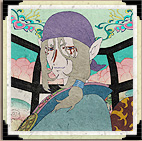
The selected original episode-one reference shows an older-looking figure in a purple head covering and teal clothing against ornate interior patterns. The image is small in the official archive and remains at a modest displayed size. It is not enlarged into an invented high-resolution screenshot or confused with the newer films’ promotional art.
Our reading connects the ordinary need for shelter with the information withheld about a place. Permission to enter does not necessarily mean understanding what the room contains or represents. The frame offers visual context; its pattern and expression alone cannot establish guilt, identify every unseen person or prove the eventual supernatural explanation.
Original visual reference
Knowing what happened can be part of confronting the supernatural
Our central interpretation treats the Medicine Seller’s investigation as a demand for explanation before action. The official character record describes the need to obtain form, truth and reason before the sword can be released. The dramatic obstacle is therefore not simply finding a stronger weapon; it is uncovering a relationship among appearance, event and motive.
A close reading can distinguish what the audience sees from what a witness admits. A visible disturbance may establish that something is wrong without explaining why. The sequence can make a remembered event return in fragments, requiring the viewer to revise an earlier account instead of receiving all relevant information in the first conversation.
This structure gives supernatural-work an investigative dimension. The task involves listening, challenging and interpreting as well as confronting a threat. The guide does not make the three fictional categories into a universal account of Japanese religion; it describes the production’s own stated dramatic mechanism.
Several accounts can protect the same silence for different reasons
Our analysis asks what a witness gains by describing an event in a particular way. Fear, shame, status and loyalty can all affect an account, but they are not interchangeable motives. A useful review identifies what the named character knows and what the conversation actually establishes before announcing that every hesitant person is lying.
The horror can arise from the distance between an accepted public explanation and a person’s private experience. When a room, household or institution keeps a story settled, questioning that story can threaten more than one individual. The narrative tension then concerns who is permitted to speak as much as what creature is present.
This reading preserves uncertainty without reducing the cases to arbitrary puzzles. A revelation matters when it changes the meaning of an earlier gesture or response. Detailed case solutions belong behind spoiler labels; a first-entry guide can explain the investigative appeal while leaving the actual answer for the licensed episode.
Decorative surfaces can make orientation part of the viewing experience
Mononoke’s visual presentation makes patterned surfaces and stylized compositions conspicuous. Our interpretation asks how those surfaces affect the viewer’s confidence about space. A richly decorated room can appear legible as a beautiful image while remaining difficult to understand as a safe, ordinary location.
A scene analysis should separate texture, color, framing and movement rather than calling the entire effect strange and stopping there. Does a pattern continue across a boundary? Does a cut clarify where somebody stands or leave a new uncertainty? Those questions provide specific ways to discuss visual storytelling without inventing production intentions.
The television series, newer films and comic adaptations have their own presentations. The shared Medicine Seller premise does not prove identical art direction or scene structure. A full comparison should inspect a named case and adaptation; this guide’s selected television reference is not evidence that every film image uses the same technique.
Case adaptation and spin-off prose are different creative contributions
Toei supplies the original television production record and its episode archive. Coamix’s notices identify Ninagawa’s case-based comic work, while KADOKAWA identifies Niki’s historical prose. The official film character page supplies the later screen project’s stated sword mechanism. These records preserve what each source actually credits or describes.
The first-reading map consequently branches outward from animation. A prose spin-off can introduce new situations using the Medicine Seller without becoming the source of the earlier television cases. A film novelization is likewise a named adaptation product, which should receive its own author and edition record if expanded in a later comparison.
The displayed AniList 8.2 out of 10 concerns the twelve-episode 2007 television entry. It does not score the Ayakashi anthology, every comic or all three newer films. Community and secondary catalog destinations provide navigation with spoilers possible; they do not establish a new chapter’s release without the relevant production notice.
A trilogy and related books extend access without disclosing net profit
The completed three-film route, documented Netflix release and related publishing show activity in several media. Those are identifiable releases and distribution announcements. They do not reveal the licensing fee, theatrical profit after costs or the income received by individual artists and writers.
No audited title-level net-profit figure or complete production budget was verified for this guide. Retail book prices, ticket receipts and a worldwide platform notice measure different things. A later commercial analysis should identify the actual reporting source and period before comparing figures or claiming that one medium funded another.
Begin with the earlier Bakeneko case or the 2007 series, then choose the numbered film route and named reading companions deliberately. Future updates can revise regional availability and edition records while preserving the anime-origin root. No invented post-anime chapter shortcut or compulsory placement of games and live action is added to the roadmap.
Primary sources and useful navigation
- Toei · original television production
- Toei · twelve-episode archive
- Toei · opening case and selected visual
- Toei · earlier Ayakashi character context
- Official film trilogy and current release notices
- Official film character mechanism
- KADOKAWA · first Niki historical prose spin-off
- KADOKAWA · third historical prose book, April 2026
- Coamix · Ninagawa case-adaptation credit
- Coamix · Bakeneko comic and prequel products
- AniList · named adaptation audience score
Community and catalog routes
- MyAnimeList · named adaptation catalog
- Reddit · discussion search, case spoilers possible
- Wikipedia · secondary format navigation
The production and publisher links support project facts. Catalog and community pages are secondary navigation and may reveal later events.
Find this work in our thematic collections
Original series imagery is reproduced under permission asserted by the site owner; the source and rights credits are retained. The route diagram is Animeteor’s own explanatory graphic.
Production and edition updates
Mononoke Hebigami Blu-ray/DVD — Japan, 21 October 2026
The film portal dates the third chapter Hebigami’s Japanese Blu-ray and DVD to 21 October 2026. It lists an 87-minute main feature, Blu-ray VPXV-72179 and DVD VPBV-14830, with Japanese and English subtitles. The date describes physical home video, separate from the film’s theatrical opening and September Netflix distribution.
See the separate production record →
Mononoke Futakubi Onna stage prequel — Tokyo, May 2026
The official Mononoke movie-prequel stage site identifies 劇場版モノノ怪 前日譚~二首女~ at Tokyo’s Shinagawa Prince Hotel Stella Ball from 14–17 May 2026. These are past stage-performance dates at the present review.