Read the main English two-in-one manga or watch TV seasons 1–3, then Last Game. Replace is optional companion prose; the movie adds Fujimaki-written material to Extra Game. Edition numbers are not interchangeable.
Reviewed 2 October 2026 · Opening premise and format relationships; major ending revelations withheld. Linked publisher summaries and discussions may reveal later events. · Licensed access varies by country.

The source and screen branches

The main manga is the root. Replace is optional prose; Last Game follows the main animated route. Game adaptations stay outside this map.
- READ · main comic: English collected manga · 1–15 → Keep one edition’s numbering
- WATCH · main adaptation: TV season 1 → 2 → 3 → Last Game · sequel film
- READ · prose companions: Replace · volume 1 → Optional character stories
- COMPARE · documented difference: Extra Game → Last Game → New film material · no chapter shortcut
Start with the main comic or the first television season
Kuroko’s Basketball begins with Tadatoshi Fujimaki’s manga. For animation, follow the three numbered television seasons in order before Last Game. The film adapts the separate Extra Game sequel and includes material Fujimaki wrote for the screen. It should not replace the first season or be treated as a fourth television season.
For English reading, VIZ collects the main story into fifteen two-in-one books. The final English volume is therefore numbered fifteen rather than thirty. Follow the numbering printed on your chosen edition throughout; switching between Japanese standard volumes and English collected volumes can make a reading log appear to skip or repeat material.
Replace is a companion prose series, with Fujimaki credited for original work and Sawako Hirabayashi as writer. It explores additional character situations, including earlier school experiences. Read the main introduction first, then choose the companion books for their own stories. Their existence does not make the original property novel-based.
| Format | Starting point | Next step |
|---|---|---|
| Manga | VIZ two-in-one volume 1 | Main numbered series through 15 |
| Anime | Television season 1 | Season 2 → season 3 → Last Game |
| Novel | Replace volume 1 | Optional prose companions |
| Film | Last Game | After the main TV route |
| Exact handoff | Read the source from its beginning | No certified chapter conversion here |
The last collected book and the first prose book have different jobs
VIZ’s volume-fifteen record identifies the English paperback with ISBN 9781421596150 and a 4 December 2018 release. Its final-volume position belongs to the main English collected series. It is not an instruction to put Replace or the later film inside that book’s chapter sequence.
Shueisha records the first Replace print edition on 4 March 2011, ISBN 9784087032406, and its digital version on 24 February 2015. The later digital date is a product-format distinction rather than a new chapter of the main basketball tournament. The publisher’s prose-series list supplies the individual companion titles and order.
Production I.G explicitly describes Last Game as an adaptation of Extra Game with new episodes written by Fujimaki for the movie. This is a documented adaptation difference. This guide keeps its details spoiler-light and does not invent a panel-by-panel account of the changed ending without a separately inspected licensed comparison.
The official ensemble visual gives different kinds of presence a place
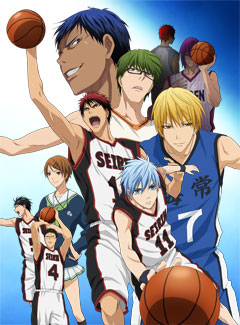
The selected original Production I.G illustration places blue-haired Kuroko toward the front with a basketball, surrounded by players posed at different scales and angles. Uniform colors distinguish groups, while the layered arrangement makes several bodies share a relatively small image. This is promotional artwork, not a screenshot of one match.
Our reading of that composition is about attention. A sports ensemble can ask the viewer to recognize both the prominent figure and the person whose contribution is less immediately conspicuous. An illustration can arrange those differences at once; a moving scene has to decide whose movement or reaction receives time on screen.
The image cannot prove who is strongest, who wins a particular contest or whether a depicted move obeys real basketball rules. It supplies a useful visual introduction to the cast. The larger argument about Kuroko’s contribution comes from the property’s premise and requires the actual story, rather than treating the size of a drawn face as a statistical ranking.
Original visual reference
A player can change the game by changing what others notice
Our central interpretation is that Kuroko makes attention part of the contest. The ordinary question of who controls the ball becomes connected to who is perceived as a threat, who is expected to act and what another player overlooks. That lets an apparently modest presence matter without simply becoming the loudest personality on the court.
A close reading can follow the recipient of a pass as carefully as the passer. The dramatic effect is not contained in one person’s cleverness: someone else must occupy a useful position, recognize the possibility and act. Cooperation becomes a relationship among expectations, rather than a slogan pasted onto an individual highlight.
This differs from interpreting every special technique as a literal coaching lesson. The series uses exaggerated abilities to organize dramatic encounters. Ask what a technique changes about a relationship or a reader’s understanding of the court before claiming that the fictional mechanism is a reproducible athletic skill.
Exceptional ability can make collaboration a harder choice
The premise places players with extraordinary reputations in different competitive settings. Our analysis asks what happens when a person’s established excellence supplies an argument against depending on others. A team can offer belonging, but it also imposes the uncomfortable fact that someone else’s decision can affect your result.
That tension gives rivalry more than a ladder of stronger opponents. A confrontation can test a character’s definition of what makes a victory worth having. Does winning demonstrate private superiority, vindicate a school’s preparation or show that a relationship among players has become reliable under pressure? These meanings can conflict even when the scoreboard is unambiguous.
Avoid reducing the cast to a permanent numerical power list. Match context, available teammates and narrative emphasis matter. A useful discussion identifies the scene and conditions behind a claim, distinguishing admiration for a spectacular performance from a prediction about every possible game.
The viewer needs both a moving body and an intelligible court
Our adaptation question concerns the balance between excitement and orientation. A close-up can make effort or confidence vivid, while a wider view lets the audience understand spacing. Neither automatically explains the play by itself. The sequence has to connect the emotional detail to the action that changes possession or opportunity.
Comic panels and animation solve that connection differently. A reader can pause on a diagram-like arrangement or return to an earlier panel; animation controls the duration of the reveal and can use sound to mark a pass, footfall or interruption. Comparison should name the specific chapter and episode being inspected.
This guide does not certify an exact post-season chapter bridge. For a complete source comparison, start the chosen manga edition at book one. That recommendation gives the reader a consistent text, while optional scene-focused research can later document a narrower seam with actual chapter evidence.
Fujimaki’s manga and the screen production have separate credited roles
Production I.G’s first-series record credits Fujimaki for the original manga, Shunsuke Tada as director, Noboru Takagi for series composition and Yoko Kikuchi for character design. Those roles identify different decisions: source creation, overall screen direction, episode organization and the design used to draw the animated cast.
Hirabayashi’s prose companion credit belongs to Replace. It should not be folded into a claim that she wrote the entire original comic, nor should the studio be presented as the manga publisher. Keeping creator and edition records separate makes future related-work links more useful than a single undifferentiated list of names.
The linked Reddit search, MyAnimeList entry and secondary encyclopedia provide discussion and navigation. Audience comparisons may reveal later outcomes. The displayed AniList observation is scoped to the twenty-five-episode 2012 first television entry; it is not an average score for all three seasons, the prose books or Last Game.
A sequel film is a distinct release, not proof of every edition’s performance
The verified publishing and production records establish a main comic, companion prose and several screen releases. They demonstrate different ways the property has been packaged and extended. That product history is useful commercial context, but the number of editions does not disclose how much any individual contributor earned.
This guide does not invent an audited title-level profit figure or complete television budget. Box-office gross, book circulation and publisher-wide revenue would measure different things even if all were available. A future numerical update must identify the reporting organization, period, territory and whether the figure refers to shipments, sales or receipts.
Choose the main manga or first television season as your entry, then add the appropriate companions deliberately. Later news can update this stable guide without turning an anniversary illustration into a new season or putting game material inside the reading map. Games and live action, when covered separately, remain outside this novel–comic–anime route.
Primary sources and useful navigation
- VIZ · main manga catalog
- VIZ · final English collected volume
- Shueisha · first Replace prose edition
- Shueisha · companion prose-series list
- Production I.G · first television credits and selected artwork
- Production I.G · Last Game and original screen additions
- AniList · named adaptation audience score
Community and catalog routes
- MyAnimeList · named adaptation catalog
- Reddit · discussion search, spoilers possible
- Wikipedia · secondary format navigation
The production and publisher links support project facts. Catalog and community pages are secondary navigation and may reveal later events.
Find this work in our thematic collections
Original series imagery is reproduced under permission asserted by the site owner; the source and rights credits are retained. The route diagram is Animeteor’s own explanatory graphic.
Distinct licensed game products
The official Street Rivals product portal identifies a 3D basketball game for iOS and Android, with a Japanese service launch dated 16 November 2023. This is separate from Aquria’s 2014 Nintendo 3DS product Shōri e no Kiseki and the publisher’s separately titled 3DS Mirai e no Kizuna. A historical launch or trailer does not certify current service or store access; none of these games extends the numbered anime route.
Street Rivals — exact product, platforms and historical launch · Aquria — separate 2014 3DS product · Bandai Namco — separately named Mirai e no Kizuna