Read Shion Miura’s source novel or watch the twenty-three-episode 2018 anime. Sorata Unno’s manga is a separate adaptation, not the original source. The live-action film stays outside this map, and no post-anime page or chapter shortcut is certified.
Reviewed 2 October 2026 · Opening premise and format relationships; major ending revelations withheld. Linked publisher summaries and discussions may reveal later events. · Licensed access varies by country.

The source and screen branches

The prose novel is the root, with manga and anime as separate adaptation routes. The live-action film is excluded. A later print or digital-edition date does not establish a source sequel.
- READ · original source: Run with the Wind · novel → Check translation, format and edition
- READ · comic adaptation: Sorata Unno’s manga · first book → Independent comic numbering
- WATCH · anime adaptation: 2018 television production → Twenty-three episodes
- COMPARE · source and screen: Named passage / licensed episode → Exact continuation shortcut not certified
A prose novel comes before the separate comic and screen adaptations
Choose Shion Miura’s Run with the Wind novel for the original source, or watch the twenty-three-episode animated production that began in 2018. The screen story follows university students pursuing a long-distance relay goal. It is not an adaptation whose original reading route begins with manga volume 1.
Sorata Unno’s manga is a separate adaptation of Miura’s novel, verified by Shueisha’s publication record. Read its own first book if that visual source presentation interests you. Comic chapter numbers and prose page numbers are independent, and neither should be substituted for an animated episode number when discussing progress.
The 2009 live-action film is another adaptation, handled outside Animeteor’s novel–manga–anime roadmap. The animated series does not require that film first, and the film is not labeled as the next episode after the animated conclusion. No second animated season or source sequel is added without a production or publisher record that actually establishes it.
| Route | Begin here | Relationship |
|---|---|---|
| Original prose | Miura’s Run with the Wind | Source novel |
| Anime | 2018 production · twenty-three episodes | Screen adaptation |
| Manga | Unno’s first adaptation book | Separate comic route |
| Live action | Separate adaptation coverage | Excluded from the main roadmap |
| After animation | Read the source for comparison | No certified page or chapter shortcut |
Paperback and digital dates identify products, not new events
Shinchosha’s original-book record gives 22 September 2006 for the Japanese novel, while its paperback has a separate catalog entry. These are different book presentations of the source. A later binding or reprint should not be reported as a newly written continuation simply because the publication date is newer.
The English source is listed by HarperCollins under Run with the Wind: A Novel, and an institutional library record credits Yui Kajita as translator. Check the actual format and regional product record when buying or borrowing; this guide does not transfer a paperback date to an ebook or promise current stock from an archived catalog.
Shueisha’s inspected fifth comic volume credits Miura for original work and Sorata Unno for manga. Its record distinguishes the 2009 paper edition from the 2021 digital remaster. Those dates demonstrate why an edition-aware reading log matters: a new digital product can preserve an older story installment rather than extend it.
The opening encounter introduces another person’s question about running
The official first-episode synopsis describes Kakeru running through the city at night, Haiji following by bicycle and asking whether he likes running. Haiji leads him to the student residence, where the other occupants and an ambitious plan become part of the introduction. This case stays within those opening events rather than disclosing the eventual relay outcome.
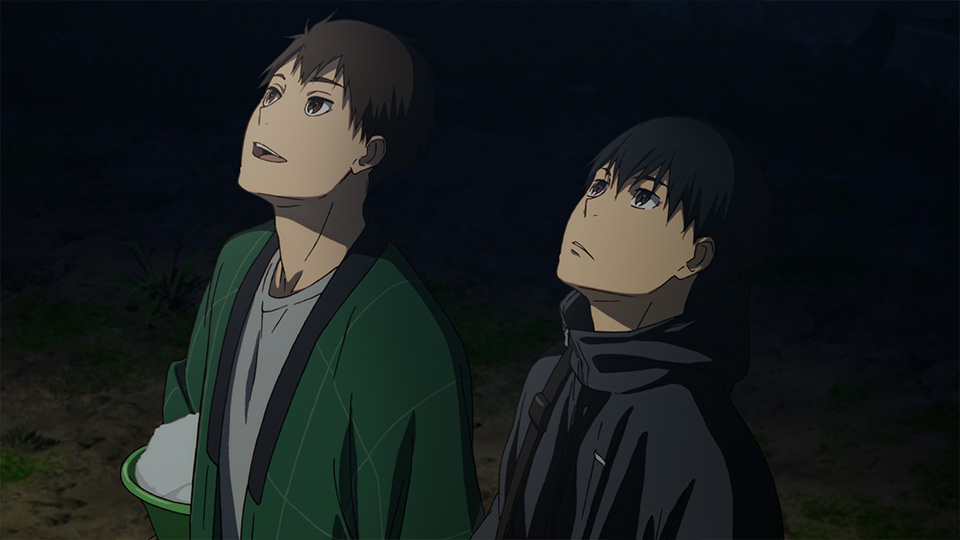
The selected official episode-one image shows Haiji in green and Kakeru in a dark top standing outdoors at night, both looking upward. The frame supplies a shared setting and different expressions. It does not prove consent to every later training decision, identify the unseen object of their gaze or establish a runner’s physical condition.
Our interpretation is that the opening question shifts running from something a person visibly does to something whose meaning can be disputed. Skill, habit, enjoyment and obligation are not the same answer. That difference gives the story a useful starting point for asking why somebody might agree to pursue a demanding goal with other people.
Original visual reference
An individual performance can carry a collective responsibility
Our analysis treats the relay as a structure that preserves individual differences while connecting their consequences. One runner occupies a section of the route at a time, yet the meaning of that section depends on what came before and what can be handed forward. The group cannot replace that relationship with a single talented person’s complete race.
That makes the slower or less experienced member analytically important. A shared goal has to accommodate people who begin from different capacities and expectations. A close reading can ask whether improvement means catching up to the best runner or becoming reliable in a specific role within the group’s plan.
This is a useful contrast with Haikyu!!, where coordination often occurs among several players within one exchange. Run with the Wind can make connection visible across separate efforts and time. Neither structure is inherently more emotional; each gives the audience a different way to understand what someone contributes and what someone receives.
A compelling plan still needs other people’s participation
Haiji’s opening proposal gives the group an organizing ambition. Our reading distinguishes the power of such a proposal from the question of who agreed to it. Confidence can make a difficult goal imaginable while also making disagreement harder to express, particularly when one person controls the explanation of what the group is supposed to become.
A careful analysis should therefore ask what each member knows and wants before treating the shared residence as a ready-made team. People can live close together without sharing an athletic commitment. The practical and ethical work of recruitment is more interesting when reluctance remains a meaningful response rather than a temporary joke before inevitable agreement.
This does not require declaring a fictional leader wholly right or wholly wrong. A dramatic plan can produce opportunities and pressure at the same time. Track how the story makes those effects visible, and distinguish a person’s intention to help from another person’s actual experience of the help.
The body gives ambition a pace it cannot simply announce
Long-distance running makes progress a repeated physical activity. Our interpretation is that this limits the usefulness of a sudden motivational declaration: a person still has to cover ground, recover and return. The story can consequently make commitment observable through repetition rather than only through words about wanting to win.
A close reading can compare how different characters experience the same session. The distance may be identical while effort, anxiety or confidence varies. That variation makes training an encounter with other people’s circumstances, not just a neutral ladder whose rungs everyone climbs at the same speed.
The fictional schedule should not be used as a personal training prescription. The analysis concerns how the narrative presents bodily limits and shared ambition; it does not certify that a viewer can safely reproduce the characters’ workload. Real sports practice and medical questions require evidence beyond a dramatized university team.
Miura’s source and the animated team have their own credits
Production I.G’s official staff record names Shion Miura’s Shinchosha novel as source, Kazuya Nomura as director, Kohei Kiyasu for series composition and scripts, Takahiro Chiba for character design and Yuki Hayashi for music. Production I.G supplies animation. Unno’s comic and Kajita’s English translation remain distinct contributions to other editions.
Our adaptation question is how private sensations become visible or audible. Prose can narrate an experience of effort; animation can use breathing, footfalls, movement and the duration of a shot. A complete comparison must inspect the named licensed passage and scene, so the opening case here does not claim to list every adaptation change.
The linked community and general catalog destinations support further discussion, with ending spoilers possible. They are not primary evidence for an invented sequel or a new source volume. The displayed AniList score concerns the twenty-three-episode 2018 animated entry only, excluding the novel, manga, translated editions and separate live-action film.
Adaptation longevity is different from a title-level profit statement
The prose, comic and screen presentations establish a property that has reached readers and viewers through several formats. Their edition dates and credited contributors are verifiable product facts. They do not disclose the total revenue earned by the author, studio or publishers, or how licensing fees and production costs were divided.
No audited title-level net-profit or complete animation-budget figure was verified for this guide. A publisher’s general business results cannot be silently assigned to one work, and a book’s retail price is not its creator’s income. A future commercial update should state the real reporting source, period, territory and definition of any monetary figure.
Begin the original novel for Miura’s source voice or episode 1 for the animated introduction, and choose Unno’s manga as its own adaptation route. Keep edition identifiers and languages explicit. Future publication or adaptation notices can update the existing guide without inventing an exact post-anime page bridge or turning an old digital remaster into a new story sequel.
Primary sources and useful navigation
- Shinchosha · original novel
- Shinchosha · separate paperback record
- HarperCollins · English source product
- Institutional library · English translator and edition
- Shueisha · comic adaptation and digital-edition distinction
- Official animated production
- Official episode archive
- First episode · synopsis and selected image
- Production I.G · screen credits
- AniList · named adaptation audience score
Community and catalog routes
- MyAnimeList · named adaptation catalog
- Reddit · anime discussion; search Run with the Wind, spoilers possible
- Wikipedia · secondary edition and adaptation navigation
The production and publisher links support project facts. Catalog and community pages are secondary navigation and may reveal later events.
Find this work in our thematic collections
Original series imagery is reproduced under permission asserted by the site owner; the source and rights credits are retained. The route diagram is Animeteor’s own explanatory graphic.
Games and live-action adaptations
- Run with the Wind (2009) — Live action: Film · 2009
Production and edition updates
Run with the Wind — January 2023 stage production
The official 2023 stage site lists 18–22 January 2023 at Tokyo’s Theatre 1010, with Ryoichi Tsukada as Haiji and Masaki Yabe as Kakeru. It identifies Shion Miura’s novel and describes this production as a recast restaging of the 2021 ILLUMINUS adaptation. Those performance dates have passed.