Start the 2014 twelve-episode island-life anime or Yoshino’s manga at volume 1. English 18+1 is a bonus comic-and-art book, not Japanese volume 19 Hibi. Handa-kun is an optional earlier-school spinoff rather than a required beginning.
Reviewed 2 October 2026 · Opening premise and format relationships; major ending revelations withheld. Linked publisher summaries and discussions may reveal later events. · Licensed access varies by country.

The source and screen branches

Original conclusion, English bonus book and later Japanese return are distinct. The earlier-school spinoff is optional; no exact manga handoff is certified.
- READ · main manga: Manga volume 1 → Original conclusion · volume 18
- READ · separately identified extras: English 18+1 · bonus edition Different books; not equivalent editions Japanese 19 Hibi · later return
- WATCH · island-life route: 2014 TV episode 1 → 2014 TV episode 12
- OPTIONAL · earlier-school spinoff: Handa-kun → Separate source / screen route
The island story begins with Barakamon, not its school spinoff
Start Barakamon with the twelve-episode 2014 television series or Satsuki Yoshino’s manga at volume 1. The opening sends calligrapher Seishu Handa from his metropolitan professional life to an island community. It is a story of creative adjustment and unexpected company, rather than a fantasy-world relocation.
Handa-kun is a separate spinoff concerning Handa’s earlier school life. Earlier fictional time does not make it compulsory viewing before the island story. A newcomer can understand Barakamon’s premise directly, then choose the spinoff if the character’s younger circumstances are of interest.
Source-book numbering needs particular care. The original manga concluded with volume 18, but an English book labeled 18+1 and a later Japanese volume 19 are different publications. Keep the main reading route and those extras distinct rather than using a publisher’s catalog item count to declare that every English and Japanese book is equivalent.
| Item | Begin or placement | Edition distinction |
|---|---|---|
| Main manga | Volume 1 → original volume 18 | Original concluded run |
| English 18+1 | Bonus after the main run | New short material and art collection |
| Japanese volume 19 Hibi | Later return · 12 July 2023 | Not the English 18+1 book |
| 2014 TV | Episodes 1–12 | Island-story screen entry |
| Handa-kun | Optional separate spinoff | Earlier school setting; not mandatory episode zero |
Why 18+1 cannot simply be relabeled volume 19
Yen Press lists Barakamon volume 18+1 for 28 July 2020, ISBN 9781975313470, with 200 pages. Its description combines additional comic material and a substantial color-art section. It is a bonus publication with a specific title and composition, not a normal numbered volume silently carrying the same contents as a later Japanese book.
Square Enix lists Japanese volume 19, subtitled Hibi, for 12 July 2023, ISBN 9784757586611. The publisher describes a return after the original conclusion. Its separate date, identifier and title make the distinction visible even before comparing individual pages.
Yen Press’s series catalog counts the bonus book among its available entries. A nineteen-item catalog can therefore exist without proving that Japanese volume 19 has a matching English edition there. Before buying or recommending a continuation, match the printed title and ISBN rather than relying on the size of the product list.
Return to the source through an identified edition
The supported manga beginning is volume 1. This guide does not certify an exact chapter to start after television episode 12, because that requires a scene comparison against the licensed collected edition and an explanation of material the adaptation rearranges or omits.
A beginning-to-end manga route lets the professional and community relationships accumulate in their original page order. If you choose a shorter continuation later, record which television endpoint you used and what earlier source material should be revisited. Familiarity with the island premise is not proof that every early chapter was adapted.
For additional reading after the original run, use 18+1 as the labeled bonus edition and check the Japanese volume 19 record separately. The roadmap does not include live-action versions or possible game material in its anime–manga relationship. Those formats need their own adaptation pages and should not become invented steps in a reading sequence.
The selected scene belongs to Handa’s professional opening
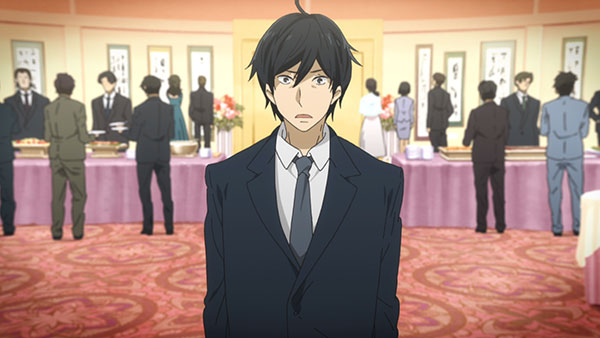
The original episode-one frame shows a suited Handa at an exhibition-like gathering, with other attendees behind him. It is an urban professional opening image, not an island landscape. Keeping that distinction makes the later move meaningful instead of using the picture as generic evidence of relaxed rural life.
The official opening synopsis says Handa leaves after an incident in Tokyo and looks for quiet on the island, where Naru already treats his new rental home as a familiar gathering place. Those facts establish the contrast between a professional setback and a living arrangement that refuses to provide complete solitude.
Our interpretation is that the frame introduces somebody whose sense of self is tied to being seen in a particular professional setting. The island premise then changes who gets to look at him and what they expect. The still cannot prove the final quality of his calligraphy or the outcome of his later career.
Original visual reference
A new environment changes the audience for creative work
Handa’s calligraphy gives the rural-life theme a specific professional focus. Our reading is that a change of environment matters because it changes the feedback available to the artist. The people around him need not understand a formal exhibition’s standards to challenge the habits he brings from that world.
That creates a productive distinction between technical ability and creative responsiveness. Somebody can have discipline and still struggle to hear criticism, improvise or decide what a piece should express. A story about craft becomes richer when growth concerns the relationship to making work rather than a sudden magical increase in skill.
Watch how interruptions affect that relationship. An interruption can be genuinely inconvenient and still expose an assumption about what working conditions must look like. The analytical question is not whether all distraction is beneficial, but whether Handa learns to recognize a useful encounter without dismissing it because it arrived outside his preferred routine.
A borrowed home has boundaries other people already know
The rental-house premise reverses the newcomer’s expectation that a private space will arrive empty of social history. Our interpretation is that Handa enters a place others already use and understand. Learning to live there involves negotiating existing connections, rather than designing a community from nothing.
Naru’s presence makes that conflict concrete. A child can treat a room as ordinary shared territory while an adult sees it as a necessary workshop. The contrast provides comedy, but it also asks whose understanding of the space will be acknowledged when routines collide.
This is why Barakamon fits everyday wonder more precisely than a general list of pleasant countryside scenery. Its interest lies in the friction between work, hospitality and familiarity. A warmer community does not automatically eliminate embarrassment or inconvenience; it changes whether those experiences can become part of a relationship instead of evidence that the move failed.
The artwork and the calligraphy have credited makers
The official anime staff record names director Masaki Tachibana, series composition and scripts by Pierre Sugiura, character design by Majiro, music by Kenji Kawai and animation by Kinema Citrus. It also specifically credits Ungai Hara for the calligraphy. That last role matters when reviewing a work whose central craft must be represented visually.
Yoshino remains the source manga creator; the animation studio is not the author of every related publication. Likewise, the English bonus-book catalog’s translation and lettering credits belong to that edition. Production, original authorship and localization describe different contributions and should not be merged into one creator line.
The linked episode-one rewatch discussion is a place to compare how individuals respond to Handa’s initial behavior and the island’s welcome. It is not a source for final-volume numbering or production finances. The displayed AniList score concerns only the 2014 twelve-episode anime, with its observation date retained beside the metric.
A later book is a new product record, not a revised ending date
The bonus art collection, later Japanese return and separate spinoff demonstrate several publishing choices around the property. Those records document editions and opportunities to revisit the setting. They do not establish an audited budget, creator earnings or net profit for the television production.
A reader comparing costs should distinguish a comic continuation from a book partly devoted to illustrations. They serve different interests even when a store places both in one manga category. Archived television disc listings also describe physical releases rather than proof of a new season currently entering production.
Begin the island story in the format you prefer, then identify optional books by their full titles. Future updates should check whether the later Japanese return receives a verified English edition, while preserving the existing 18+1 record. That is a useful maintenance change; replacing the bonus book’s name with a guessed volume number would make the guide less accurate.
Primary sources and useful navigation
- Official 2014 anime
- Official episode 1 · opening premise and frame
- Official anime staff and cast
- Square Enix · anime and source relationship
- Square Enix · Japanese volume 19 Hibi
- Yen Press · English series and editions
- Yen Press · English 18+1 bonus edition
- AniList · named TV audience score
Community and catalog routes
- MyAnimeList · named television catalog
- Reddit · episode-one rewatch; spoilers
- Wikipedia · secondary catalog and spinoff navigation
The production and publisher links support project facts. Catalog and community pages are secondary navigation and may reveal later events.
Find this work in our thematic collections
Original series imagery is reproduced under permission asserted by the site owner; the source and rights credits are retained. The route diagram is Animeteor’s own explanatory graphic.
Games and live-action adaptations
- Barakamon — Live action: Series · 2023