Watch the twelve numbered 2023 TV episodes in order. The IM recap after episode 8 is optional, not a thirteenth main episode. The official project is original animation; no speculative source manga or novel route is added.
Reviewed 2 October 2026 · Opening premise and format relationships; major ending revelations withheld. Linked publisher summaries and discussions may reveal later events. · Licensed access varies by country.
The source and screen branches

Original-animation route. No assumed manga or novel branch. Home-video booklets, soundtrack and expired event offers remain outside the story chronology.
- WATCH · original 2023 television: Episodes 1–8 · begin with Piece of Cake → IM recap · optional review, not episode 13 → Episodes 9–12 · complete the main TV route
An original anime, without an invented source reading lane
Buddy Daddies is presented by its official project as original animation. Its primary route is the 2023 television series, not a manga or novel that must be read first. The twelve numbered main episodes form the screen sequence. The official story navigation also lists an IM recap separately between episodes 8 and 9.
Watch episodes 1–12 in number order. The recap is an optional review of earlier material, not a thirteenth main episode or a separate season. No independently verified source manga or novel is established in the primary records inspected for this guide, so the roadmap uses one supported screen lane.
This distinction matters when a visitor arrives from a reading list. A title with an original story credit still has writers and character designers; it does not become a source novel merely because those roles exist. Likewise, a home-video booklet or soundtrack is supplementary material rather than evidence of a prose adaptation.
| Item | Order or role | Status |
|---|---|---|
| Main TV series | Episode 1 → 12 | 2023 original animation |
| IM recap | Optional after episode 8 | Review installment; not main episode 13 |
| Source manga / novel | No verified edition in this review | No assumed reading route |
| Blu-ray / DVD extras | Optional product supplements | Outside story chronology |
Two adults with dangerous work meet everyday responsibility
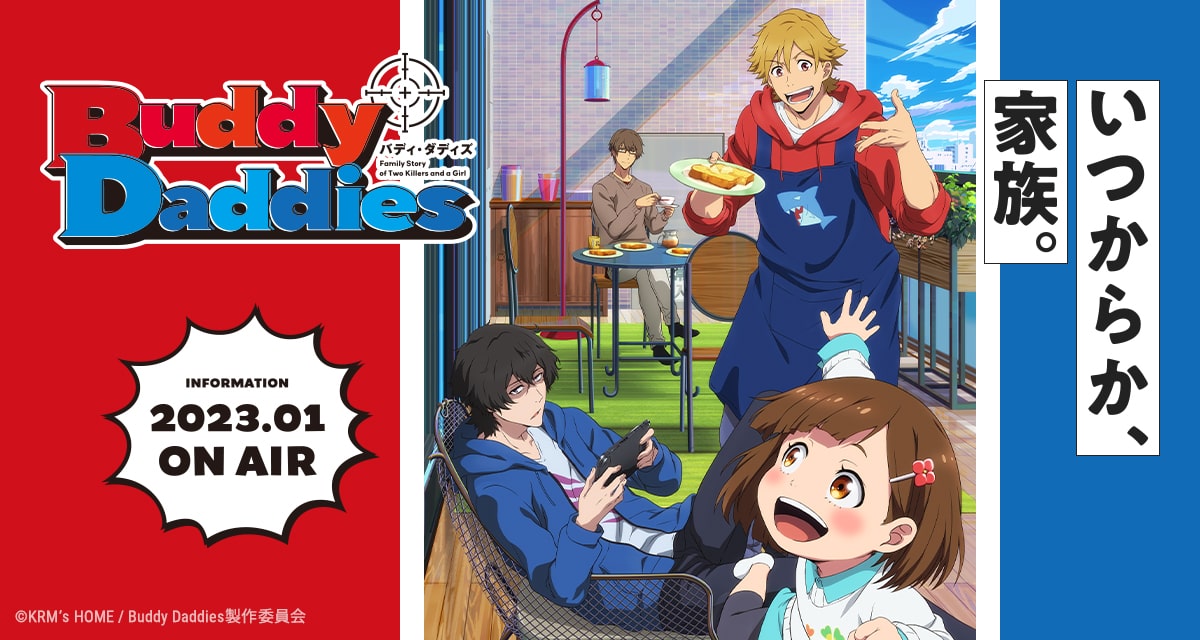
The opening premise introduces Kazuki Kurusu and Rei Suwa, whose work involves violence, and four-year-old Miri. The official introduction contrasts their professional abilities with the unfamiliar demands of caring for a child. That contrast supplies the guide’s entry point without revealing later family outcomes.
Our reading is that competence changes meaning when the task changes. A person who can plan a dangerous operation may still need to learn what a child expects from an ordinary day. The interesting connection is how responsibility interrupts established habits, rather than whether parenting can be reduced to another mission.
An introductory image showing the three together should not be mistaken for a complete suitability assessment. The premise also involves weapons and dangerous employment. A visitor choosing family-centered animation should inspect the actual opening and relevant local content guidance rather than infer a gentle preschool story from a small child in the artwork.
A first-episode frame before the family arrangement settles
The selected original image comes from the official episode-one page, Piece of Cake. It shows the two adult leads indoors: Kazuki in a suit, Rei in a blue zip-front jacket, both looking alert. The full 1200-by-675 frame preserves their relationship within the setting instead of reducing the work to a single face.
The opening synopsis connects their Christmas-period job with Miri’s search for her father. Our interpretation of the selected still is that the adults’ guarded expressions belong to a world organized around preparation and risk. That provides a visual starting point for the later contrast with the attention a child requires.
The frame does not demonstrate how the entire encounter concludes or which adult will adapt more successfully to parenting. Those would need the sequence itself. We use the official synopsis for the opening circumstances and the actual image for positioning and expression, keeping the analysis within the evidence shown.
Original visual reference

Daily repetition gives care a visible cost
Our interpretation of the premise is that a family relationship becomes convincing through time spent, not just the moment an adult agrees to help. Meals, supervision and explaining a rule impose repeated demands. They can reveal whether a person remains present when there is no dramatic reward for doing so.
This offers a useful viewing question: which routines change after Miri enters the adults’ lives? A change in timing or attention can matter more than a speech about becoming responsible. Comedy can expose the gap between how capable a character believes himself to be and how much he has to learn.
The comparison should not imply that dangerous professional skills make a person a good parent. They can explain an ability to notice threats while leaving emotional communication unresolved. A scene is richer when it lets a skill help in one respect and become an obstacle in another.
A partnership has to make room for a third person
Kazuki and Rei begin as adults with an existing relationship and way of working together. Our reading is that introducing a child changes the partnership’s audience and priorities. Decisions that once affected only the pair now have consequences for somebody unable to share their understanding of the risks.
That can make coordination more revealing than individual strength. If one adult assumes the other has understood a need, a small misunderstanding can become a practical failure. Care requires information to be shared at the right time, including information that seems obvious to the person who noticed it.
The family-and-care collection uses this property to compare chosen responsibility with other forms of companionship. The comparison does not require treating every household story as equivalent. Here, the adults’ dangerous work creates a particular conflict between secrecy, their established routine and the child’s need to understand what is happening.
Story, design and animation have separate credits
The official credits identify KRM’s HOME as the original project, Vio Shimokura of Nitroplus for the original story, and Yuko Kakihara with Shimokura for series composition. Yoshiyuki Asai directs the anime. These records explain who develops the screen narrative without inventing an underlying comic author.
Katsumi Enami is credited for original character design, while Katsutoshi Sako handles character design and chief animation direction. Katsutoshi Kitagawa of ROUND TABLE supplies the music, and P.A.Works handles animation production. Distinguishing the design roles helps a reader understand why a promotional drawing and an animated scene can share recognizable characters while differing in execution.
Our interpretation is that the production has to balance action readiness with readable domestic reactions. The first-episode still supplies an example of the guarded adult side; the premise supplies the contrasting care demands. The credits identify responsibilities, but do not themselves prove that every tonal transition succeeds.
A useful comparison can attract disagreement
In the linked premiere discussion, Reddit user Depressed_student_20 responds positively to Miri and revises an earlier concern that the project would simply resemble Spy × Family. Another participant, BTS_lovemyself, finds the child’s voice grating. These individual reactions illustrate different responses to the same family-centered entry point.
Neither comment establishes a community-wide verdict, a ranking against another franchise or a production fact. The comparison is useful as a question about expectations: does the visitor want an action premise with a child, or specifically the rhythms of this household? Those are not necessarily the same preference.
The attributed AniList score is scoped to the 2023 twelve-episode TV entry. It does not rate a nonexistent source manga, merge other family anime into an average or represent a score awarded by Animeteor readers. The observation date is displayed because an audience metric can change after this review.
Disc extras and expired events are separate from the story route
The official first Blu-ray and DVD volume is dated 22 March 2023 and contains two main episodes. Its listed supplements include a booklet and original soundtrack volume 1. The archived Japanese tax-inclusive prices are ¥7,150 for Blu-ray and ¥6,050 for DVD; these historical package prices are not current international purchase quotations.
That product page also records a June 2023 event and an application window ending in April 2023. The window has expired. An old entry still visible in a product archive is not a current invitation, and neither an event nor a later correction to an event notice constitutes a newly announced anime season.
The disc catalog establishes an additional distribution product, not a title-level budget or profit total. Begin with the numbered television episodes, use the recap if a refresher helps, and treat soundtrack and booklet material as optional supplements. A future guide update can add a genuinely confirmed new format or season without inserting merchandise into the core watch chronology.
Primary sources and useful navigation
- Official project · original-animation premise and current archive
- Official story navigation · twelve numbered episodes and IM recap
- Official first episode · Piece of Cake and original frame
- Official production and cast credits
- Official first Blu-ray / DVD · dated editions, extras and expired event
- AniList · named TV audience score
Community and catalog routes
- MyAnimeList · named television catalog
- Reddit · named premiere reactions, with possible spoilers
- Reddit · series discussion community
- Wikipedia · secondary production navigation
The production and publisher links support project facts. Catalog and community pages are secondary navigation and may reveal later events.
Find this work in our thematic collections
Original series imagery is reproduced under permission asserted by the site owner; the source and rights credits are retained. The route diagram is Animeteor’s own explanatory graphic.