Watch the 2022 TV episodes 1–12, or begin Liz Takayama’s prose or Sei Takano’s manga at volume 1. English manga is licensed by One Peace Books. Web EP4 completion is not completion of every print edition; no exact anime-to-book handoff is certified.
Reviewed 1 October 2026 · Opening premise and format relationships; major ending revelations withheld. Linked publisher summaries and discussions may reveal later events. · Licensed access varies by country.

The source and screen branches

MF Books displays prose volumes and Japanese manga volumes separately; English release numbering is another schedule. A web completion notice is version-specific. Games and live action are excluded.
- READ · source prose: Choose web or MF Books edition → Begin at its first installment
- READ · manga adaptation: Sei Takano · volume 1 → Follow the chosen language edition
- WATCH · 2022 television: Episode 1 → Continue through episode 12
A pharmacy is an institution as well as a place to help
Parallel World Pharmacy follows a modern pharmacological researcher who awakens as Farma de Medicis, the son of a court pharmacist in another world. Begin with the twelve-episode 2022 anime, Liz Takayama’s prose, or Sei Takano’s manga adaptation as separate routes. The modern knowledge is part of the premise, but supernatural abilities also matter, so the story is not a straightforward documentary about medicine.
The source has a web version and published MF Books editions with keepout’s original character designs. One Peace Books licenses the manga in English. Those product identities are useful before choosing where to start: an English manga volume is not the corresponding numbered Japanese prose book, and a completed web arc does not automatically certify every print adaptation as complete.
Choose this if you enjoy a competence fantasy that also asks who can obtain help and how a service reaches them. The opening’s overwork, family loss and reincarnation give its knowledge premise an emotional context. Illness and dramatic treatment appear throughout; our analysis addresses storytelling and access, without converting a fictional treatment into practical medical instructions.
One television run, several independently numbered reading routes
Watch the 2022 television episodes 1–12 in order. The official first episode introduces the previous researcher and Farma’s unfamiliar family position; the episode archive follows that screen sequence. No earlier novel chapter needs to be inserted as a mandatory prerequisite to understand the anime’s opening.
For prose, begin the source’s first book or first web installment, identifying the version you are using. For manga, begin Takano’s volume 1. The MF Books portal and the anime’s book page describe different catalog snapshots. A promotional page that displayed eight volumes when the show began should not be treated as a permanent endpoint for the series.
At this review, the MF Books portal lists ten prose volumes and twelve manga volumes, while One Peace Books has its own English manga catalog. We report the displayed catalog scope rather than declaring either print route complete without an explicit final-volume record. No unverified anime continuation date is added.
| Route | Start | Important distinction |
|---|---|---|
| 2022 TV | Episode 1 → 12 | Released screen run |
| MF Books prose | Novel volume 1 | Ten volumes displayed by the checked portal |
| Japanese manga | Takano’s volume 1 | Twelve volumes displayed by the checked portal |
| English manga | One Peace Books volume 1 | Separate translation publication schedule |
| Web prose | Original web entry | EP4 completion notice is version-specific |
English manga credits keep the source and artist visible
One Peace Books credits Sei Takano for manga, Liz Takayama for original story and keepout for character design. Its English volume-1 record identifies ISBN 9781642732443, 176 pages and publication in 2023. The publisher also lists a volume 7 with ISBN 9781642734904 and a 2025 publication label; those are English edition details, not Japanese source release dates.
The MF Books portal records prose volume 1 on 25 January 2016 and volume 10 on 25 January 2024. It separately labels the comic section. A volume number that appears next to the manga does not extend the prose’s displayed count, and vice versa. Keep the medium attached to a citation when saving publication information for a future update.
The author’s July 2022 activity report announces completion of the web version’s EP4. That is a primary, version-specific statement. It should not be rewritten as all formats ended in July 2022, especially when the official book catalogs show later print publication. Web serialization, edited prose and manga adaptation can advance through different release structures.
A full source entry avoids an uninspected seam
After the twelve television episodes, the safest verified entry into source reading is volume 1 of the chosen prose edition or volume 1 of the manga. We have not inspected the complete licensed episode-12 ending against a named book to certify an exact continuation chapter. The map records the relationship between formats, not a numerical conversion formula.
A medicine-focused adaptation may compress an explanation while preserving the broad result of an event. That can make an apparently familiar chapter contain context a viewer has not received. A useful comparison would identify the question raised, the explanation offered and the response of other characters in both versions before recommending anything be skipped.
For a later maintenance pass, source publication and English release availability should be checked separately. A Japanese volume’s existence does not guarantee an English release, while a translator’s later schedule does not mean the original author has stopped. Keeping those distinctions allows the same guide to remain useful as one route grows ahead of another.
Episode one: Farma looks at his own hand
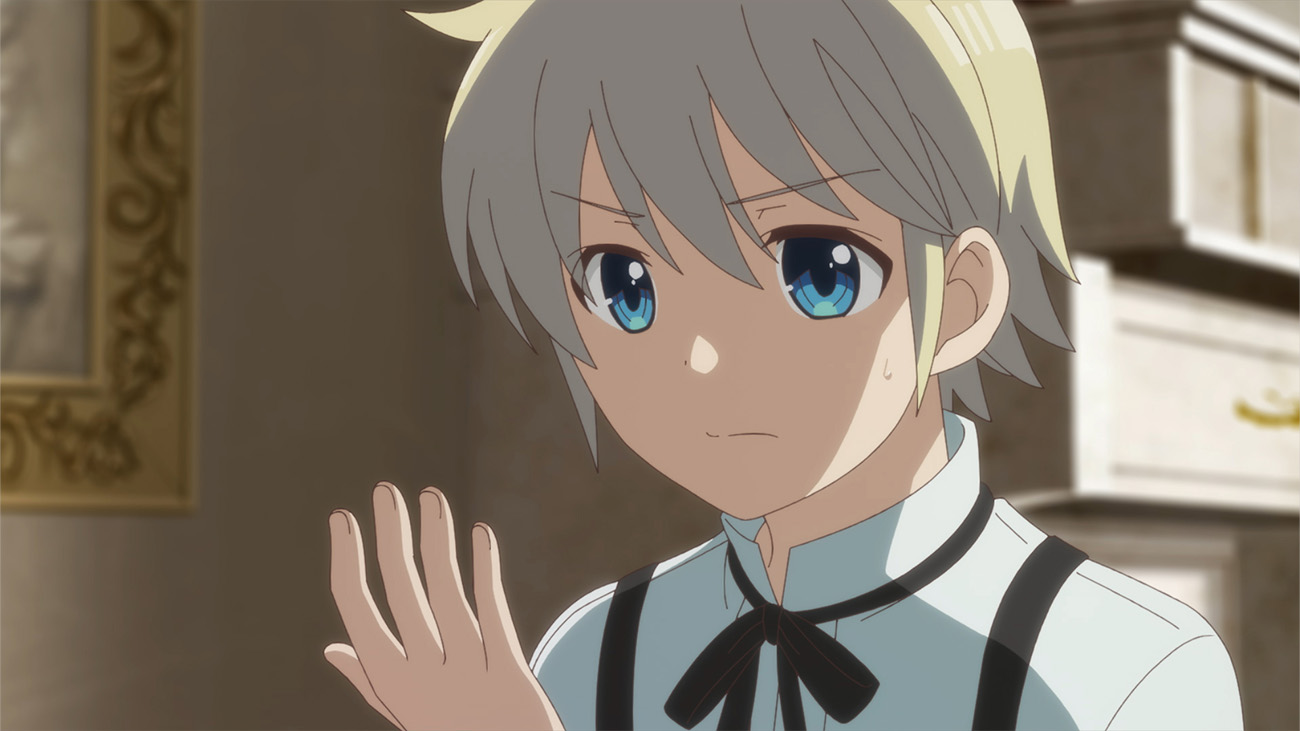
The official first-episode image shows a pale-haired Farma raising a hand in front of himself, his blue eyes directed toward it. The full 1300-by-731 frame includes the interior behind him. It is distinct from the lead ensemble illustration, where the pharmacy setting is presented as promotional artwork.
Our reading is that this gesture makes unfamiliar embodiment visible. Looking at a hand is a simple way to suggest that a person is checking what the body can do and whether it feels like their own. The medical knowledge premise becomes more interesting when it begins with uncertainty rather than an immediate display of mastery over every problem.
The official opening synopsis confirms the researcher’s new identity in Farma’s family and his exposure to the setting’s supernatural practice. The still supports expression, gaze and gesture analysis; it does not prove a particular medical action, a surrounding line of dialogue or a matching manga panel. We retain that boundary rather than treating an attractive character image as evidence for an uninspected procedure.
Original visual reference
A useful discovery still has to reach somebody
The pharmacy premise creates a question beyond whether Farma knows a solution. Our interpretation is that a service has to connect expertise to access: somebody must trust the person offering it, reach the place where it is supplied and be permitted to use it. That makes a shop or institution narratively meaningful rather than just a backdrop for demonstrations of knowledge.
The official character descriptions give different people practical roles around the pharmacy. Ellen teaches and supports Farma, while Lotte helps with its administrative work. Such roles make cooperation visible. A protagonist’s special ability does not remove every ordinary task involved in keeping a place open or making help understandable to the person who needs it.
When watching early episodes, distinguish the supernatural advantage from the work needed to make it useful. The first can create spectacular results; the second creates a social arrangement. That distinction offers a richer way to discuss a competence fantasy than judging it only by how rapidly the lead solves the next illness.
Expertise changes its meaning in another social setting
Farma’s modern knowledge reaches a world whose institutions have their own traditions and authority. Our reading is that the tension comes from explaining an unfamiliar idea to people who have reasons to trust something else. A correct answer in the protagonist’s memory is not automatically a persuasive public argument inside the new setting.
The court-pharmacist family position gives him access, but also expectations. A child who appears unusually capable can become surprising or frightening to someone who understands the world differently. The raised-hand opening image provides an individual version of that question: before persuading others, he has to understand his own changed situation.
The fictional setting combines real medical vocabulary with divine and supernatural powers. We do not assess a depicted medicine as a real prescription or assume that a narrative recovery validates a treatment. The critical interest is how the series frames care, evidence, trust and distribution. Those themes can be discussed clearly without implying a clinical authority the story does not possess.
The adaptation has identifiable creative roles
The official staff page credits Keizo Kusakawa as director, Wataru Watari for series composition, Mayuko Matsumoto for character design and Diomedea for animation. It also names Tatsuya Kato and Satoshi Hono for music. Takayama and keepout remain credited for the source and original character concepts, while Takano is the manga artist rather than the television director.
Those distinctions offer useful creator routes for further exploration. Someone drawn to the animation can follow the director or studio; someone interested in the explanation-heavy premise can follow the source prose. Similar subject matter in another contributor’s work would be a comparison opportunity, not proof that the stories share a canon.
Our Reddit and reference links provide places to discuss the opening, the access theme and preferences between prose and manga. They are not evidence that a treatment is medically correct or a platform chapter equals an anime episode. The displayed AniList score belongs solely to the 2022 twelve-episode TV entry, with no rating transferred to the source books or English manga.
Catalog growth can be documented without inventing sales
The checked Japanese prose and comic portal, English manga licensing and television production document several commercial routes for this property. Their counts describe cataloged products, not the number of books purchased. The linked records do not disclose audited title-level profit or a production budget, so neither is estimated from the audience score.
One Peace Books’ historical publication labels also should not be read as a guarantee of current stock in every region. Check the individual edition and retailer before buying. The same caution applies to the original web version: a completion notice belongs to a specific serial stage and does not establish translation availability elsewhere.
Begin with the anime if you want a compact introduction, or with the prose or licensed manga if you prefer to explore the source in a reading format. The medicine-and-care collection below offers comparisons with different professional fantasies. Future updates can add an inspected chapter seam or new dated release while preserving the existing source, adaptation and edition distinctions.
Primary sources and useful navigation
- Official anime project
- Official opening episode and original image
- Official anime staff roles
- Anime-era book catalog · historical snapshot
- MF Books · separately labeled prose and manga catalogs
- One Peace Books · licensed English manga editions
- Author · web EP4 completion notice
- KADOKAWA · Japanese manga volume 11 record
- AniList · named TV audience score
Community and catalog routes
- MyAnimeList · named television catalog
- Reddit · opening episode discussion
- Novel Updates · source navigation
- Wikipedia · adaptation overview; spoilers
The production and publisher links support project facts. Catalog and community pages are secondary navigation and may reveal later events.
Find this work in our thematic collections
Original series imagery is reproduced under permission asserted by the site owner; the source and rights credits are retained. The route diagram is Animeteor’s own explanatory graphic.