Watch the twelve main 2013 TV episodes, or start Mamare Touno’s five-book source prose route. Several different manga adaptations exist: choose one by artist and begin its own volume 1. Episode 0/1/2 prose books and the screen recap are separately labeled extras.
Reviewed 1 October 2026 · Opening premise and format relationships; major ending revelations withheld. Linked publisher summaries and discussions may reveal later events. · Licensed access varies by country.
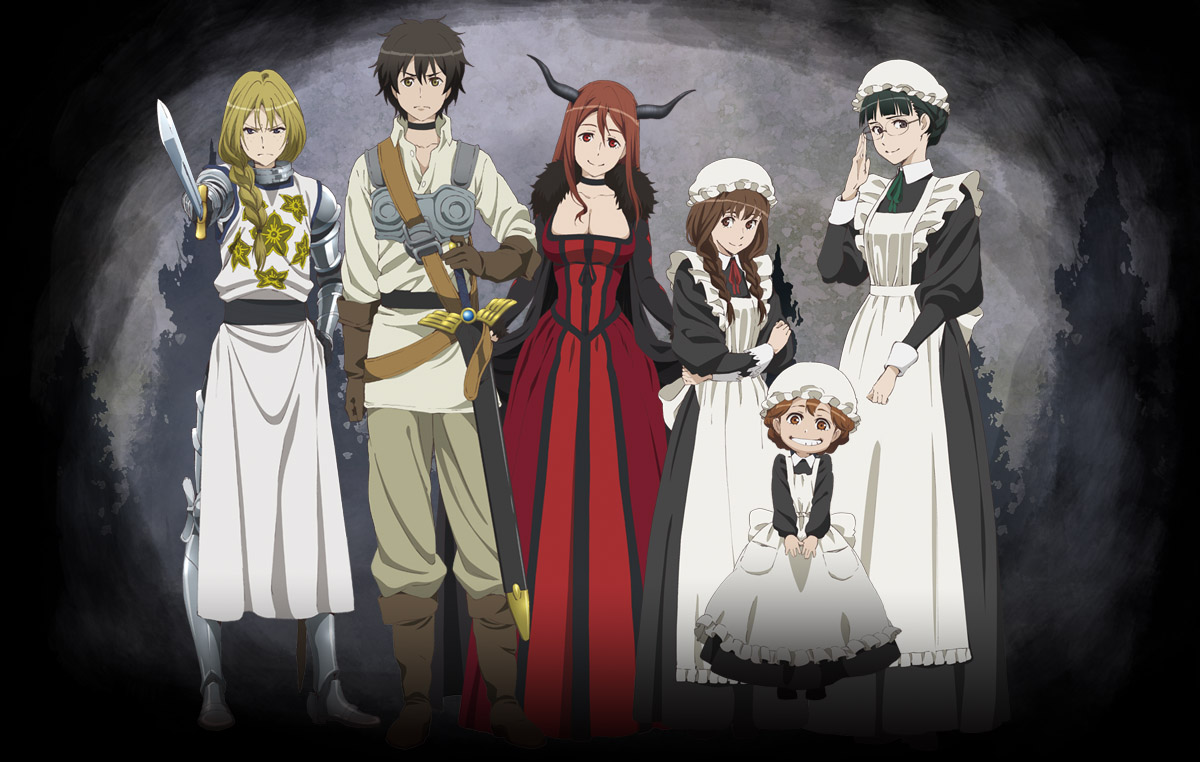
The source and screen branches

Episode 0/1/2 books are supplementary products, not a verified insertion timeline. Different manga versions do not share chapter numbering; no exact TV handoff is certified.
- READ · original prose: Main book 1 → Continue through main book 5
- READ · choose a manga version: Identify the adaptation artist → Start that version at volume 1
- WATCH · 2013 television: Main episode 1 → Continue through main episode 12
The Hero arrives for a fight and receives a proposal
Maoyu: Archenemy & Hero begins at the point where a conventional fantasy might end: the Hero reaches the Demon King. Instead of treating a victory in single combat as the solution, the premise asks what would happen to societies that depend on the war. Mamare Touno’s prose is the source; the 2013 anime and several different manga adaptations present that premise in their own forms.
For the screen entry, begin the twelve main television episodes in order. For the source, begin the five main prose books. The author’s catalog separates those from the Episode 0, Episode 1 and Episode 2 supplementary books. Their numbers are product labels, not proof that they must interrupt specific television episodes or be read as a prequel trilogy before the main story.
This is a useful choice for someone who enjoys agricultural change, institutions and arguments about the consequences of peace. It combines economic fantasy with romance and sexualized humor, so its tone is not uniformly a serious political lecture. The attraction is the change of question: after asking who wins a conflict, it asks what arrangements allow people to live afterwards.
A short television route does not cover every source branch
Watch the 2013 television episodes 1–12 as the principal screen sequence. A special recap belongs to an optional summary category rather than being added as a thirteenth main story episode. The release sequence is the clearest first-viewing route, retaining the point at which the series explains the Hero and Demon King’s unexpected cooperation.
The first episode’s official page describes their encounter and her argument that simply ending the war would create further problems. That establishes the project’s opening question. It does not establish that twelve television episodes reproduce every scene across the five source books, or that the television ending can be used to skip a fixed number of books without comparison.
When choosing a reading route, identify which artist’s manga you have selected before using a volume number. The official book page lists several comic versions. Treating them as one sequence would mix different retellings and editions, making a seemingly simple instruction such as start at volume six unreliable.
| Branch | Entry | Scope |
|---|---|---|
| TV anime | Main episode 1 | Twelve main episodes |
| Source prose | Main book 1 | Five main books |
| Supplementary prose | Episode 0 / 1 / 2 | Additional books; separate labels |
| Manga | Chosen artist’s volume 1 | Multiple different adaptations |
Several comic adaptations share a premise, not numbering
Touno’s official page identifies the five main prose volumes and the related Episode books. Its introductory premise centers on escaping a war-supported system rather than defeating one ruler. The source route is therefore a way to follow the original construction of that argument, while supplementary material needs to be identified by its individual title and contents.
The official anime book page lists Akira Ishida’s comic version alongside other adaptations, including Hiro Toge’s Oka no Mukou e and You Asami’s work. These are different artists’ treatments, not interchangeable reprints of one comic. The title, creator and publisher should travel together when you save a reference or buy a volume.
A comic adaptation can make a long explanation easier to visualize, but that does not prove it preserves every source passage. The reverse is also true: a prose edition’s fuller explanation does not automatically make its pacing more enjoyable for every reader. Choose according to the presentation you want, and use a publisher’s preview to test the style rather than relying only on the familiar character names.
A safe source entry is better than mixing adaptation boundaries
After the television run, begin the main prose at book 1 if you want the source’s complete route. An independently chosen manga should likewise begin with that adaptation’s first volume. We have not inspected the licensed TV ending against a specific prose book or comic edition to certify an exact continuation chapter.
The limitation is especially relevant here because the different manga versions can expand, compress or emphasize the same premise differently. Even a chapter number that works for one version may be wrong for another. Our diagram branches from Touno’s source into separate media rather than drawing a false chain from anime to any conveniently numbered comic.
For a later comparison, record the problem being discussed, the proposed change and whose viewpoint makes the explanation persuasive. That approach treats adaptation as a choice about emphasis. It is more informative than a list of isolated omissions, and it can remain spoiler-aware without disclosing the outcome of the Hero and Demon King’s broader plan.
Episode one: the Hero’s armor meets an unfamiliar argument
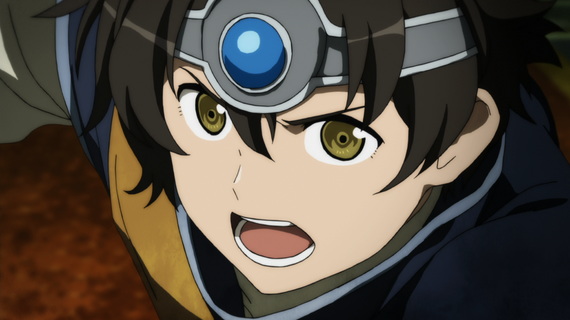
The official first-episode image shows the Hero in a close horizontal frame, wearing armor with a circular blue ornament above his forehead. His open mouth and wide eyes create a startled expression. The complete 570-by-320 composition is retained; the lead illustration separately shows the ensemble rather than pretending all its characters appear together in this opening shot.
Our reading is that the armor makes his role immediately clear while the expression makes his certainty less secure. The equipment suggests somebody prepared for a confrontation, but the premise puts him in a conversation for which defeating an opponent is not enough. The tension comes from the gap between a familiar role and an unfamiliar problem.
The episode’s official synopsis supports the encounter and the Demon King’s counterproposal. The still supports observations about expression and design, not the exact line spoken at that instant or a corresponding source page. The case check is therefore bounded to an opening scene reference. A full adaptation study would need the named prose or comic edition inspected alongside the episode.
Original visual reference
Peace is presented as a system change
The central idea is stronger when treated as a question about arrangements rather than as a slogan that war is bad. Our interpretation is that the premise asks which institutions, incomes and expectations a conflict has created. Ending the visible confrontation can leave those dependencies in place, so a solution must consider people who never stand on the battlefield.
That changes what the Hero’s strength can accomplish. An individual achievement is easy to recognize; a reliable food supply or a new agreement is less spectacular but may affect more lives. The story invites attention to the ordinary mechanisms that support grand fantasy conflicts. Watch for who gains from stability and who experiences a proposed change as a threat.
The Demon King’s opening argument is a character’s proposal inside a fictional world, not a universal economic theorem. It can be persuasive dramatically while leaving room for objections about assumptions and consequences. Evaluating those assumptions makes for a better discussion than treating the character’s confidence as proof that every policy would work in a real society.
The material world gives a speech something to test
A fantasy explanation becomes more interesting when it connects to food, work and a household’s ability to survive. Our reading is that Maoyu’s emphasis on agriculture lets an abstract peace project encounter practical constraints. People need a way to live through change; the fact that a plan is morally attractive does not make its transition effortless.
This also changes the scale of heroism. Technical knowledge, teaching and cooperation can become meaningful actions alongside combat. The relevant question is who can put a proposal into practice and who is asked to bear its costs. A viewer can track those relationships without requiring this guide to reveal later negotiations or political outcomes.
Romance and humor can make the central partnership easier to follow, but they can also distract a viewer who wants sustained policy drama. That is a legitimate taste distinction. The opening episode is a practical test of whether the production’s balance works for you, while the source books offer another presentation of the same foundational problem.
A shared director is a useful comparison route
The official staff page credits Takeo Takahashi as director, Toshihisa Arakawa for series composition, Masashi Kudo and Hiroaki Karasu for character design, and Arms for animation. Hijiri Sanpei is listed as assistant director. Those credits offer a real connection to creative work elsewhere without implying that the fictional settings share a universe.
The newer Spice and Wolf production also lists Takahashi and Sanpei. A viewer interested in how conversation can drive fantasy tension can compare the two works through that staff connection and through their different economic premises. That is an editorial comparison, not proof that a similar visual or dialogue choice was made for the same production reason.
The linked r/anime discussion provides a place to compare reactions to Maoyu’s fantasy and romance balance. We do not turn its recommendation into an audience-wide consensus. The score above is AniList’s audience average for the twelve-episode 2013 television entry only; a reader’s preference for one of the manga versions is a separate judgment.
An old circulation milestone needs its original date
Touno’s official catalog describes 600,000 main-book copies and 2.2 million copies including comics as of January 2013. Those are historical circulation figures, not current 2026 sales, and the combined figure must not be presented as sales of a single manga adaptation. A circulation milestone is also different from audited production profit.
Multiple prose and comic products demonstrate that this premise reached readers through several commercial forms. The linked records do not disclose a title-level animation budget or profit calculation. The existence of several adaptations supports a discussion of format choices, while a claim that every one succeeded financially would need evidence beyond a book list.
For your next step, select the anime’s opening episode or main prose book 1, then use the fantasy-economics collection to compare approaches to trade, food and institutions. A later guide revision can add an inspected source handoff or a separately verified English license. It should retain the artist-specific manga labels, source direction and dated circulation scope already established here.
Primary sources and useful navigation
- Author · source books, premise and dated circulation
- Official anime project
- Official first-episode record and image
- Official staff credits
- Official book catalog · multiple adaptations
- KADOKAWA ComicWalker · Ishida adaptation record
- AniList · named TV audience score
Community and catalog routes
- MyAnimeList · named television catalog
- Reddit · fantasy and romance discussion
- Wikipedia · version navigation; spoilers
- Maoyu Wiki · reference navigation; spoilers
The production and publisher links support project facts. Catalog and community pages are secondary navigation and may reveal later events.
Find this work in our thematic collections
Original series imagery is reproduced under permission asserted by the site owner; the source and rights credits are retained. The route diagram is Animeteor’s own explanatory graphic.
A historical GREE game and performed reading
The official archive identifies Maoyu’s separate GREE social game, launched on 25 December 2012. It used character cards and cooperative boss battles on smartphones and feature phones, with Shoji Masuda supervising. The same archive explicitly states that service ended on 28 June 2013 at 16:00. This is a discontinued game, not a current playable extension or anime sequel.
Official exact game and service-end archive
The separately documented 2013 Human Declaration reading performance and its DVD are performed interpretation, not a live-action television or film adaptation.