Watch Planetes episodes 1–26 in order, or read the complete manga: Japanese volumes 1–4, English Omnibus 1–2, or English Deluxe books 1–2. Choose one collected edition; the Deluxe books are not a sequel.
Reviewed 1 October 2026 · Opening workplace premise, early character Nono and production context; later outcomes withheld. Official galleries and final-book descriptions contain spoilers. · Licensed access varies by country.

The source and screen branches

English collected books use different numbering from the Japanese volumes. Start the manga at its beginning after the anime for comparison; no unchecked chapter continuation is supplied.
- READ · original Japanese edition: Kodansha volumes 1–4 Follow volume numbering Source manga complete
- READ · English collected edition: Omnibus 1–2 OR Deluxe 1–2 Alternative bindings Choose one complete edition
- WATCH · Sunrise TV adaptation: TV episodes 1–26 Presentation order Complete television route
Space exploration begins with someone doing the maintenance
Planetes gives space travel an unusually practical point of entry: Hachimaki and his colleagues collect orbital debris. Other people may imagine exploration as a glorious departure, but these workers have to make the environment usable for the next traveler. The premise puts a dangerous, necessary job at the center of a human drama.
Choose Makoto Yukimura’s manga if you want to control the pace of a character’s reflections and examine the drawing before moving on. Choose Sunrise’s twenty-six-episode anime if the workplace ensemble, recorded performance and music are your preferred entry. Both routes introduce this setting; the television production is an adaptation of the manga, not a prequel that must be watched before reading it.
The opening brings a new employee into a department with an established culture. That makes the anime approachable even if orbital mechanics is unfamiliar. Expect practical work, ambitions and friction between colleagues alongside the space setting. A viewer seeking continuous combat or an immediate voyage to a distant planet should assess the first episode’s workplace emphasis before committing to the whole series.
Watch the original TV series from episode 1 to 26
Sunrise’s English project catalog identifies twenty-six episodes, while Sunrise World dates the Japanese run from 4 October 2003 to 17 April 2004. Begin with the first episode, Outside the Atmosphere, and follow the numbered television sequence. The official episode archive supplies a corresponding list through episode twenty-six.
This route does not require a recap film, an earlier anime or a fan chronological edit. The characters’ ambitions and relationships develop through the presentation order. A later explanation of somebody’s history is not a reason to relocate the explanation ahead of the episode that introduces it.
The historical official site uses an in-universe company layout and older frames-based navigation. Its standalone episode-one page is the simplest original reference for the opening. Later pages contain plot outcomes, so use them as return-viewing resources. An older broadcaster link or a historical streaming button is not proof that the same service and territory still carry the program today.
Four Japanese books, or one complete English two-book edition
Kodansha’s Japanese title catalog lists the four numbered manga books and marks the series complete. Dark Horse’s English collections organize the source into two larger books. Do not interpret the smaller English book count as half of the story: collected-edition numbering is not the same thing as the original volume numbering.
For the English paperback route, read Planetes Omnibus volumes one and two. The distributor’s first-book record is dated 22 December 2015, ISBN 9781616559212; the concluding second omnibus is dated 10 May 2016, ISBN 9781616559229. The second is explicitly described as the concluding collection. Read within that edition rather than pairing an omnibus number with a differently organized older paperback.
The two Deluxe hardcovers are another complete English collection route, rather than a continuation beyond the omnibus. Book one is dated 29 July 2025, ISBN 9781506750149, and book two 2 December 2025, ISBN 9781506750156. Pick one edition according to availability, size and binding preferences. Reading both sets is optional comparison, not a requirement to obtain the full source narrative.
| Edition | Sequence | Identifiers |
|---|---|---|
| Kodansha Japanese manga | Original volumes 1–4 | Use the numbered Kodansha catalog |
| Dark Horse English omnibus | Omnibus 1–2 | 9781616559212 / 9781616559229 |
| Dark Horse English Deluxe | Deluxe books 1–2 | 9781506750149 / 9781506750156 |
After the anime, begin the manga again for a different presentation
Our recommendation after episode twenty-six is to start the manga at its beginning. The official production materials identify the source, but they do not supply a verified chapter-to-episode concordance or authorize treating a television episode number as a manga chapter number. A guide should not turn those missing details into a confident shortcut.
Yukimura’s message on the original project site welcomes the move to animation and specifically notes his interest in what music could add to scenes. He describes the new medium as an opportunity to build and supplement the work. That is useful primary context for comparison: the author was responding to possibilities of adaptation, not claiming that every panel would be transferred without a change.
Compare a specific exchange or a character’s introduction after experiencing both versions. Look at where a page turn places emphasis and where a screen reply is timed. This creates a manageable observation about presentation. It is more revealing than asking only whether one version contains the same ending, and it avoids pretending the anime leaves a simple unpublished chapter waiting afterward.
A low-status department can perform indispensable work
The official first-episode synopsis introduces Tanabe as a new employee assigned to the debris section, a department others disparage as Half Section. Our interpretation is that this contrast between institutional status and practical necessity gives the opening its tension. The task can be important even when the workplace offers its staff little prestige.
That is a productive lens for the crew’s disagreements. An experienced worker may understand practical risk while speaking dismissively to a newcomer. A newcomer can ask a worthwhile question while lacking the knowledge to act safely. You do not have to decide that either experience or idealism automatically wins every argument.
As you watch, distinguish a complaint about the job from a refusal to care about its consequences. People can resent working conditions while still taking the work seriously. A space setting lets the drama make those consequences unusually visible, but the underlying question is recognizable: who receives credit when ordinary maintenance prevents an extraordinary failure?
Wanting a future can strain the relationships that make it possible
The original series introduction gives Hachimaki a concrete aspiration: obtaining his own spacecraft. That changes the debris job from a neutral background into something he measures against the future he imagines. Our reading is that the conflict is not merely whether a dream is admirable, but what happens when the present is treated mainly as an obstacle to it.
Consider how an ambition changes the value a character assigns to advice, friendship and routine work. The same task can look like useful training, an unwanted delay or a responsibility to colleagues, depending on what that person is trying to achieve. The audience need not share the dream to understand the pressure it creates.
This makes Planetes a possible choice for readers interested in adult working life as well as space. Progress is not simply a larger distance traveled. It can involve deciding which relationships remain meaningful when a person’s goals change. We leave the later outcomes unspoiled and recommend following how those choices are prepared in smaller interactions.
Nono on the lunar surface: a change in what counts as home
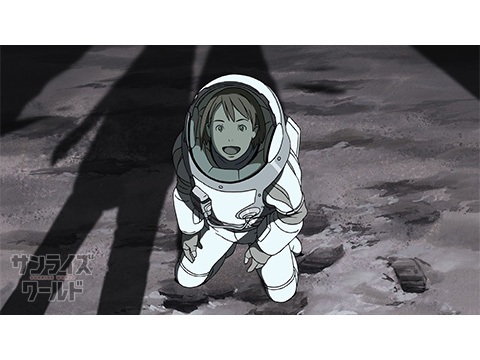
Sunrise World supplies the original image below and identifies Nono as a twelve-year-old raised on the Moon who has not experienced Earth directly. The inspected image looks down toward her suited figure on a gray surface. Long shadows, a nearby footprint and her upward-facing expression make a simple encounter visually specific.
Our interpretation is that the image invites a reversal of the usual explorer’s perspective. For someone born on Earth, the Moon is an unfamiliar destination; for this character, it is the place from which another world is imagined. The same setting can therefore represent an extraordinary visit for one person and ordinary surroundings for another.
The still establishes framing, expression and visible surface detail. It does not establish the entire conversation, the exact timing of the shot or a later outcome. The reproduction preserves the supplied white margins and Sunrise World watermark. Keeping those elements intact makes its origin visible and avoids presenting an editorial crop as if it were the original composition.
Original visual reference
A real debris problem gives the fictional job weight
ESA’s Space Debris Office defines debris as non-functional artificial objects and fragments in orbit or reentering the atmosphere. Its FAQ explains why collisions can damage spacecraft and generate additional fragments. Those facts supply real context for the premise; a piece of material need not be large or visually spectacular to matter.
The same FAQ describes the cascading-collision concern associated with the Kessler syndrome and discusses mitigation, shielding and avoidance. We use it to explain the general problem, without recycling its older numerical counts as a live 2026 census. A changing debris population requires a dated current report if exact totals are needed.
The narrative inference is that debris collection makes the consequences of exploration visible: launching something creates obligations beyond the launch itself. That does not mean the series is an engineering manual or that a fictional human-operated recovery vessel is ESA’s recommended solution. Enjoy the practical premise while separating real orbital hazards from the specific technology and institutions of the story.
Sunrise’s adaptation adds timed voices and music
The official credits identify Gorō Taniguchi as director, Ichirō Ōkouchi for the script, Yuriko Chiba for character design and Kōtarō Nakagawa for music. Makoto Yukimura remains the credited original creator. These roles describe a collaboration, rather than a reason to assign every striking element to one familiar name.
Yukimura’s original message is especially useful beside those credits because he explicitly welcomes music joining the drawn material. Our interpretation is that this points to a basic adaptation opportunity: a printed expression can be held for as long as the reader chooses, while a voice, pause and musical cue establish a shared pace for the screen audience.
For a return comparison, choose one early conversation and pay attention to when you stop reading versus when the anime moves to the next response. There is no need to rate every production department to notice that difference. A small concrete comparison can reveal what the adaptation adds to your experience without declaring that one medium is inherently better.
A fictional department’s deficit is not the production’s profit
Sunrise World describes the debris section as an unprofitable department within the fictional company. That is setting information. It must not be converted into a claim that the Planetes anime itself lost money. Fictional corporate accounts and real production finance are entirely different evidence.
The documented English omnibus and 2025 Deluxe editions show continuing publication in distinct formats. The distributor lists the Deluxe books as 528-page hardcovers, and the direct publisher store describes binding and color-art features. Those records help identify a product; they do not reveal units sold or the margin retained by the publisher.
Sunrise World also records the anime’s 2005 Seiun Award in the media category. Recognition and a continuing edition history are meaningful commercial context, but the sources used here do not disclose an audited title-level budget, total license revenue or net profit. We do not convert an audience score or a cover price into an invented return-on-investment figure.
| Record | Scope | Limit |
|---|---|---|
| Half Section described as unprofitable | Fictional workplace setting | Not anime financial performance |
| English omnibus and Deluxe catalogs | Real identified publication products | Not audited sales or profit |
| 2005 Seiun media award | Documented recognition for the anime | Not a universal audience score |
The workplace comedy is part of the choice a viewer makes
In the first-episode Reddit rewatch, user fieew praises the designs and music but finds the characters and office behavior unappealing. BottiBott welcomes the prospect of a space-industry story focused on ordinary work. These individual responses show why the premise alone does not predict whether the opening will suit someone.
The practical question is whether the everyday interactions deepen the setting for you or delay the sort of space story you wanted. Our recommendation is to give the first episode’s blend of danger and workplace friction a fair hearing. Appreciating a believable task does not require liking every member of the crew immediately.
The displayed score is AniList’s directly observed weighted average for the twenty-six-episode 2003 TV entry: 80/100, normalized to 8.0/10 on 1 October 2026. It does not rate the manga or blend editions into a franchise score. Named community comments remain opinion, and later rewatch threads should be opened only after the corresponding episode.
Use the creator and theme links for different next steps
If you want another Yukimura manga, the English edition identifies him as the creator of Vinland Saga. That is a creator connection, not a shared timeline or a required prelude. Following the author can be useful when character motives and the cost of ambition are what interested you most.
If you want another crew story, our thematic comparison page offers a different discovery route. Astra’s displaced students and Planetes’ working adults begin with different needs, even though both depend on a group sharing limited space. Choose by the kind of relationship and practical problem you want to follow, rather than assuming every space title makes the same promise.
Future edition and release updates can be added to this guide while retaining its verified routes. Games and live-action adaptations, if later confirmed, belong in Animeteor’s supplementary sections and will not become steps in the anime-and-manga map. The verified core remains the source manga in your chosen complete edition and the twenty-six-episode television adaptation.
Primary sources and useful navigation
- Sunrise · official English TV count and original creator
- Sunrise World · credits, award, Nono scene and original art, later spoilers
- Original project · first-episode synopsis and dated staff
- Original project · standalone episode directory
- Yukimura’s original adaptation message · Japanese legacy page
- Kodansha · completed Japanese manga catalog
- PRH distributor · English omnibus one identifier
- PRH distributor · concluding English omnibus two
- PRH distributor · Deluxe book one (2025)
- PRH distributor · Deluxe book two (2025), later manga spoilers
- Dark Horse Direct · Deluxe product and binding details
- ESA Space Debris Office · scientific context, FAQ dated April2021
Community and catalog routes
- AniList · matched original TV score entry
- MyAnimeList · anime catalog navigation
- Wikipedia · references and edition overview, spoilers
- Reddit · named first-episode workplace reactions
The production and publisher links support project facts. Catalog and community pages are secondary navigation and may reveal later events.
Find this work in our thematic collections
Original series imagery is reproduced under permission asserted by the site owner; the source and rights credits are retained. The route diagram is Animeteor’s own explanatory graphic.