Watch Ergo Proxy episodes 1–23 in presentation order. Centzon Hitchers & Undertaker volumes 1–2 form an optional separate manga story; they are not a chapter continuation from the TV finale.
Reviewed 1 October 2026 · Opening premise and visual interpretation only; late identities and ending explanations withheld. Community reviews and later catalog summaries may contain spoilers. · Licensed access varies by country.
The source and screen branches

The manga is an optional companion branch, not a later anime season. Reading it after the TV series is our recommendation, not a claim about its exact in-world chronology. No verified prose edition is supplied here.
- WATCH · original TV narrative: TV episodes 1–23 Keep presentation order Complete numbered screen route
- READ · optional companion manga: Centzon Hitchers & Undertaker 1–2 Finish at volume two Separate original travel story
Start with the city, then follow the questions outside it
Ergo Proxy begins with a practical contradiction: Romdo presents itself as an orderly protected city, yet its human residents and their AutoReiv companions face a disturbance the established system cannot neatly contain. Re-L investigates, while immigrant Vincent Law occupies a much less secure social position. The opening makes a mystery out of both the disturbance and the city’s confidence in its own explanation.
Start with the original television anime. Its twenty-three numbered episodes form the verified screen route, and the related manga is a separate companion story. This is a good choice if you enjoy an uneasy setting, questions about identity and an investigation that asks you to hold incomplete information in mind. If immediate explanations and a consistently brisk pace are your priorities, begin with one or two episodes before committing to a complete set.
You do not need a philosophy course or an unofficial ending explanation before episode one. A more useful habit is to ask who is speaking, what they actually know and what their place in Romdo allows them to assume. The story’s difficulty becomes more manageable when a statement by a character is treated as a claim to examine, rather than automatically accepted as the world’s final truth.
The viewing route is episodes 1–23 in presentation order
Use the television episode numbering from one through twenty-three. The complete-series licensed Blu-ray record explicitly includes that range, and AniList identifies the 2006 TV production as twenty-three episodes. A player’s division into a season menu or language tracks does not create additional narrative seasons. Match the series title and episode rather than building a route around an interface label alone.
Our recommendation is to retain every episode on a first viewing. Changes in style or pace are not sufficient reasons to declare an episode disposable. A mystery can use a pause, a different presentation or a return to an earlier question to alter how you understand its characters. We do not offer a skip list that removes such material without a verified account of the consequences.
Follow the order in which the series gives you information. Reorganizing scenes around when recalled events supposedly occurred can reveal explanations earlier than the screen narrative intends. Complete the twenty-three episodes before opening detailed ending discussions. Afterward, revisit the beginning if you want to compare your first assumptions with what you now understand; this is a second viewing choice, not an extra required season.
Centzon Hitchers & Undertaker is a companion, not a chapter jump
The archived official project announcement identifies Centzon Hitchers & Undertaker II as the final book of a two-volume comic. It credits Manglobe and Yumiko Harao, describes an original story from Dai Satō and the anime writing team, and names Dorothy, Leono and Hart as its travelers. That primary description matters: the book is not simply the television script printed as manga.
For a straightforward route, finish the anime and then read the comic volumes one and two as an optional return to its world. This is our spoiler-conscious reading recommendation, not a claim that the manga’s events occur after the TV finale. We have not established a precise episode interval for inserting the comic, so the visual map shows a companion branch instead of a fabricated chronological junction.
The National Diet Library catalogs the Japanese second volume under Sunday GX Comics, ISBN 978-4-09-157084-0. Its bibliographic publication field reads March 2007; the historical official promotion gives a 19 February on-sale notice. Those fields serve different purposes. Preserve the distinction when identifying an edition, rather than silently replacing one date with the other or treating a library’s month as an exact shop release day.
| Format | Entry route | Relationship |
|---|---|---|
| Original TV anime | Episodes 1–23 | Primary screen narrative |
| Companion manga | Centzon Hitchers & Undertaker 1–2 | Separate original travel story; optional after watching |
| Prose novel | No verified edition supplied here | No novel lane or invented reading prerequisite |
Citizenship is part of the mystery’s pressure
The opening setup places Re-L and Vincent at different distances from institutional authority. One investigates within the city’s system; the other seeks a secure place in it. Our interpretation is that this difference makes belonging a dramatic question before any late revelation arrives. Who gets to ask a question, and who is expected to prove that they deserve to remain?
Think about the difference between safety and acceptance. A protected environment can offer shelter while also making membership conditional. An immigrant character’s uncertainty allows that condition to become visible, because fitting in is a task rather than a background assumption. You can follow this tension without reducing every resident to an emblem of a political theory.
On a first viewing, notice when a character describes what a good citizen should do. Ask whether the instruction explains the situation or merely defines behavior the city finds convenient. The answer may change with context. Keeping that question open is more revealing than deciding at the outset that every authority figure is wrong or every official procedure is meaningless.
What changes when a companion stops being only a function?
The official premise associates the Cogito virus with changes in AutoReivs. That turns an apparent technical problem into a question about how the human community interprets machine behavior. Is a change in an assigned role necessarily a malfunction, or can the language of malfunction prevent someone from recognizing a different kind of experience? This is an interpretive question prompted by the setup, not a medical or engineering claim.
A useful way to approach the human-machine relationship is to distinguish usefulness from recognition. A companion can be valued for doing a job while still being denied a say in what that job means. If the companion behaves unexpectedly, the response tells us something about the person’s expectations as well as the machine. The premise invites attention to both sides of the relationship.
Avoid making the word consciousness a shortcut that solves every scene. Watch how recognition is expressed through responses, requests and refusals. A character’s ability to make a claim about themselves and another character’s willingness to hear it are different events. That distinction gives the philosophical vocabulary a human dramatic stake, even when the setting is populated by artificial beings.
First-episode image study: Re-L seen at close range
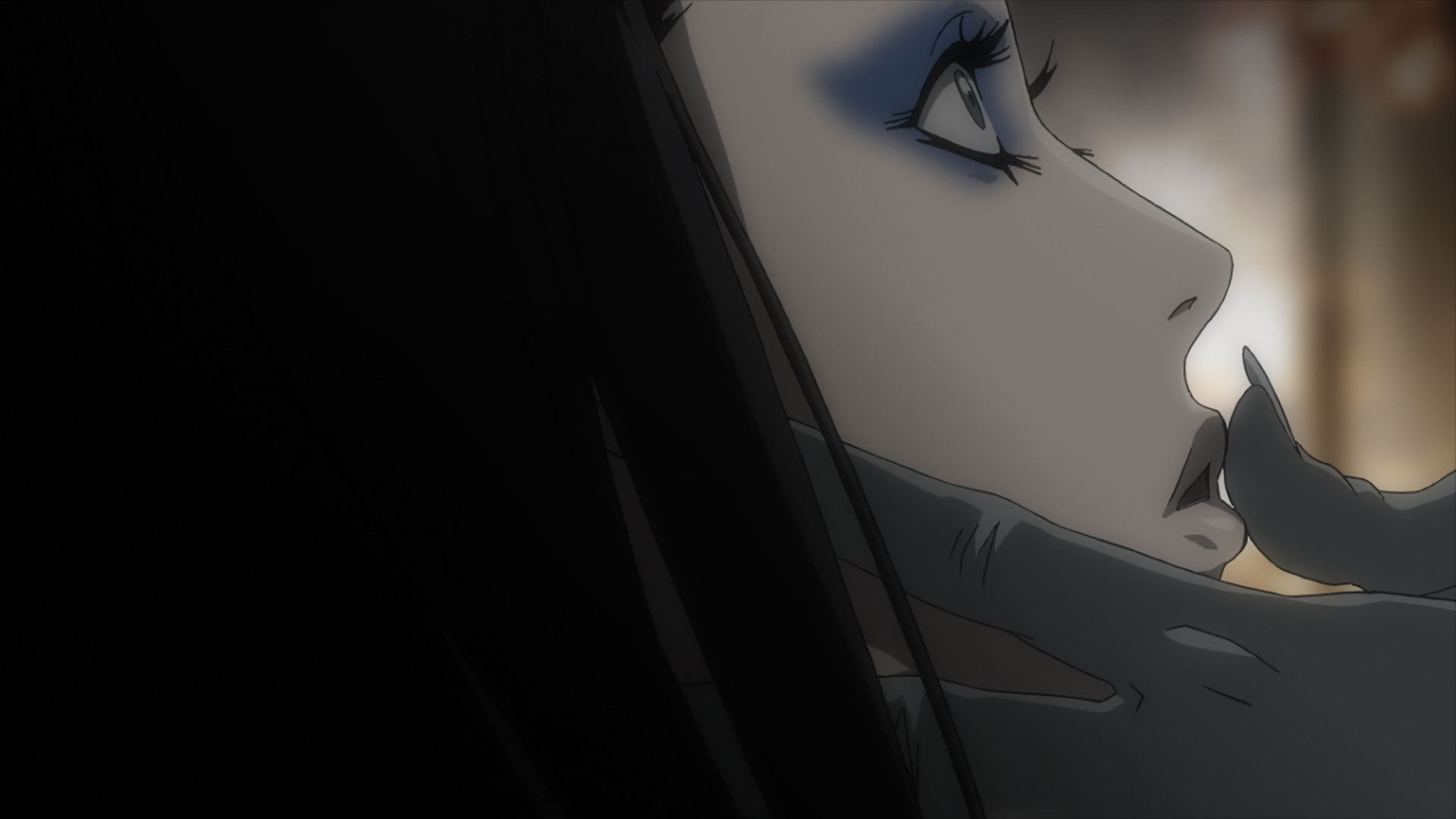
Bandai Channel’s first-episode page supplies the original image below. Re-L’s face occupies the right half, while dark hair and shadow fill much of the left. Her eye is directed upward, and a gray hand is visible close to her lower face. The frame offers little environmental information: face, gesture and a blurred background carry the immediate visual attention.
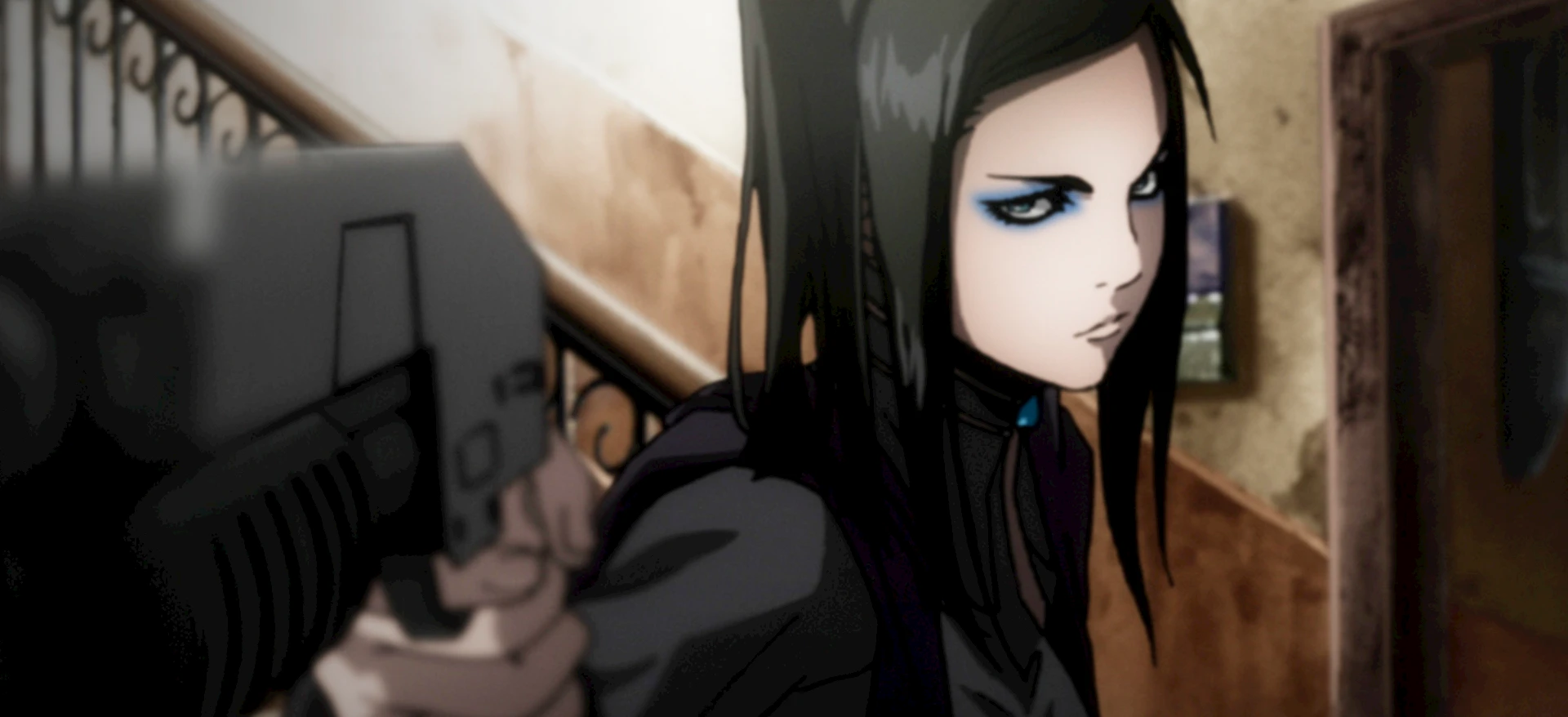
Our interpretation is that the close framing makes her exposed expression more prominent than her institutional role. In the collection’s lead image she is presented with a weapon; here, the visible eye and nearby hand create a different balance of confidence and uncertainty. Comparing those two supplied images is a concrete way to think about how a character can be introduced as capable while also being placed under pressure.
The episode synopsis describes her encountering a mysterious escaped creature during an investigation. The still does not prove the identity of the hand, the exact dialogue or the length and order of adjoining shots. We keep the visual reading within what can be seen and what the licensed synopsis establishes. The image is reproduced intact rather than cropped to manufacture a different expression.
Original visual reference
Darkness can direct attention as well as establish atmosphere
The two original images on this page offer a small but useful visual comparison. Both make dark hair and clothing prominent, while the face remains a clear point of attention. The lead image includes architectural detail and a strongly foreshortened weapon; the episode image reduces the surrounding space. The difference changes what you are invited to inspect before you know anything about an ending.
In our reading, a restricted palette can create uncertainty by leaving parts of the environment less explicit. It can also make a small movement of an eye or hand unusually noticeable. Those are possible effects of the inspected images, not a claim that every scene uses the same lighting or that a publicity still proves an entire production technique.
When watching, give a dark scene enough attention to distinguish deliberate low contrast from a poor playback setup. Check your device’s brightness and use a licensed source before attributing unreadability to the artwork. A visual style built around shadow is easier to appreciate when the image is displayed faithfully; increasing saturation or stretching a promotional crop is not a substitute for that experience.
Director, writer, designer and composer are different contributions
The licensed Japanese credits name Shūkō Murase as director, Dai Satō as chief writer, Naoyuki Onda for character design and Yoshihiro Ike for music, with Manglobe credited as the original project. Those roles answer different questions. A striking character drawing, a narrative idea and a musical decision should not all be casually assigned to whichever creator’s name a viewer recognizes first.
For further exploration, begin with the particular contribution that interests you. If the character presentation caught your attention, follow the design credit. If the structure of the questions interests you, follow the writing credit. Connections through a creator are useful discovery routes, but they do not establish a shared fictional universe or require another title to be inserted before Ergo Proxy.
Likewise, separate a distribution brand from an animation credit. The North American Blu-ray store lists FUNimation in its product fields; that identifies the licensed edition’s commercial context. It does not replace Manglobe with FUNimation as the original animation studio. Edition information and production authorship belong alongside each other, with their purposes kept clear.
Choose a licensed edition by language and region
The Crunchyroll Store’s indexed complete-series Blu-ray record, UPC 704400078750, specifies episodes 1–23, English and Japanese language tracks, English subtitles and a 1 November 2016 release date. Its listed Blu-ray region is A. These are details of that North American product, not a promise that a disc bought elsewhere has the same compatibility or that all streaming territories currently carry it.
That product also advertises keyword, behind-the-scenes and English staff interview featurettes. They can be useful return-viewing material if included in the edition you obtain. Check the actual listing rather than assuming every complete collection reproduces the same extras. A special feature is an optional production resource; it does not become an additional story episode merely because it is on the disc.
NBCUniversal’s Japanese streaming directory provides another official discovery route, including a link to Bandai Channel. Streaming licenses and older directory entries can change. Use the link to check the service’s current territory, language and availability before paying. We do not equate an accessible catalog description with a guarantee that a visitor anywhere in the world can press play.
A later complete-set release is evidence of distribution, not profit
A documented licensed Blu-ray edition released a decade after the 2006 television production shows that the work received another home-video product release. That is a concrete commercial fact. It does not tell us how many copies sold, how much of the retail receipt reached the original production, or whether the series recouped its costs.
The two-volume companion manga also shows a publishing branch associated with the project. Its existence and final-volume announcement establish a finished product sequence, not a blockbuster claim. Historical cover prices, used-copy asking prices and a modern audience score answer different questions; none supplies an audited title-level profit figure.
The sources used here do not provide a verified numeric production budget, total licensed revenue or net profit statement. Our commercial conclusion is therefore limited to identified products and distribution history. The long life of a catalog entry may make a title worth discovering, but longevity alone does not justify inventing a financial success story.
| Record | Useful conclusion | Missing evidence |
|---|---|---|
| Licensed 2016 Blu-ray product | A complete TV edition was issued | Units sold, receipts and profit |
| Final companion manga volume | A two-book publishing branch exists | Audited sales and royalty income |
| Audience score | An entry-specific reception measure | Production cost or financial return |
Some viewers value the uncertainty; others question the length
The licensed Bandai page also hosts reader reviews, which are community opinion rather than production statements. In March 2018, user アトリ describes understanding and enjoying the series more when returning twelve years later. In October 2014, niwawa questions whether the narrative needed its length while praising the setting, imagery and music. These individual responses illustrate a disagreement; they are not an audience survey.
For a prospective viewer, the useful question is whether the mood and unanswered questions themselves hold your attention. A mystery can be enjoyable before its explanation, but that experience will not be equally satisfying for everyone. Our recommendation is to assess your response to the opening atmosphere rather than treating difficulty as automatic proof of quality or a reason to abandon the title immediately.
The score shown above is AniList’s directly observed weighted average for the 2006 twenty-three-episode TV entry: 76/100, normalized to 7.6/10 on 1 October 2026. It is not a score for the companion manga, an average across formats or a vote collected by Animeteor. The linked Reddit manga question is useful for understanding a common format confusion, not for confirming licensed English availability.
Return to the opening with better questions
After the finale, consider a focused return to the first episodes before reading an exhaustive explanation. Write down one assumption you made about the city, one about Vincent and one about the AutoReivs, then compare them with what the screen actually presented. The exercise can reveal the difference between information withheld by the story and information you supplied from genre expectations.
For further reading, use the two-book companion branch and the linked catalog records to identify an authorized edition. The historical official announcement supports its separate original-story identity; it does not establish a currently available English release. Keep an unofficial translation or a community timeline clearly separate from publisher evidence.
Ergo Proxy belongs in our machines-and-identity collection because its opening gives artificial beings and social membership a shared dramatic problem. That is a thematic connection with other titles, not a shared canon. Games and live-action material, if verified in future, belong in Animeteor’s separate supplementary system and will not be inserted into this anime-and-manga route.
Primary sources and useful navigation
- Bandai Channel · licensed project credits and reader reviews
- Bandai Channel · first episode, original frame and opening synopsis
- Archived official project · final companion manga volume and original-story credit
- National Diet Library · Japanese volume 2 edition record
- Crunchyroll Store · complete-series Blu-ray product identity (indexed record)
- NBCUniversal Japan · official streaming discovery directory
- Crunchyroll · licensed series navigation, territorial availability varies
Community and catalog routes
- AniList · matched TV entry and audience score
- MyAnimeList · anime catalog navigation
- Wikipedia · project references and archived official book links, spoilers
- Manga-news · French companion edition catalog, secondary evidence
- Reddit · viewer question about the manga relationship
The production and publisher links support project facts. Catalog and community pages are secondary navigation and may reveal later events.
Find this work in our thematic collections
Original series imagery is reproduced under permission asserted by the site owner; the source and rights credits are retained. The route diagram is Animeteor’s own explanatory graphic.