Watch PLUTO episodes 1–8 in order, or read Pluto: Urasawa x Tezuka volumes 1–8. Astro Boy’s The Greatest Robot on Earth is optional source comparison, not a prerequisite or season zero. Start the manga at volume one after the anime to compare its presentation.
Reviewed 1 October 2026 · Opening investigation, source relationship and production analysis; perpetrators and late outcomes withheld. Publisher final-volume descriptions and episode discussion pages contain spoilers. · Licensed access varies by country.
The source and screen branches

The Astro Boy story supplies creative lineage; it is optional reading. PLUTO’s manga and anime are alternate entry routes, not successive seasons. Eight books and eight episodes do not prove every chapter-to-scene boundary.
- READ · Urasawa × Tezuka retelling: PLUTO manga volumes 1–8 Finish at volume eight Manga publication complete
- WATCH · manga screen adaptation: PLUTO episodes 1–8 Follow numbered order Eight long installments
A robot detective story that makes the victim matter
PLUTO is a useful starting point for readers who want science fiction organized around an investigation. Gesicht is a robot detective examining attacks on advanced robots and people connected with robot law. The premise makes him both investigator and potential target. That gives the case an immediate personal stake without requiring familiarity with the wider Astro Boy catalog.
Choose the eight-volume manga if you want to control the pace of discovery, pause over a face or return to a clue before turning a page. Choose the eight-part anime if recorded voices, music and a sustained dramatic performance are what draws you in. Both are entry routes into this particular retelling. You do not have to complete every earlier Astro Boy television series first.
Our recommendation is to give the first installment time to establish its different kinds of attention: evidence gathering, ordinary life and the question of how a society recognizes a robot as someone worth caring about. If you mainly want short, rapidly resolved action episodes, the long screen installments may be a less convenient fit. The opening involves murder and destruction; the presence of familiar Tezuka characters does not promise an uncomplicated family adventure.
Watch the eight numbered installments; plan for long sessions
The official anime story directory lists episodes one through eight. Netflix’s own Anime Expo announcement dates the premiere to 26 October 2023. Use the numbered sequence rather than rearranging it around events recalled by the characters. The presentation is an investigation: learning what happened and choosing when to reveal it are part of the experience.
The producers describe the format as eight roughly hour-long installments. That is a production description, not a claim that every player displays precisely sixty minutes. Allocate a substantial session for each episode and check the runtime on your actual licensed service. Eight episodes here should not be compared with eight standard twenty-minute television installments when estimating the commitment.
There is no required recap film in our entry route. Complete episodes one to eight, then choose whether to revisit the manga or its Tezuka source story. This guide does not insert a hypothetical second season or a fan chronological edit. The eight-part adaptation is the verified screen route under discussion; any future separate announcement would need its own official evidence.
Read Pluto: Urasawa x Tezuka volumes 1–8
VIZ publishes the English manga as Pluto: Urasawa x Tezuka under VIZ Signature. Its eighth book is explicitly marked as the final volume. Read the numbered books from one to eight. The title is an important edition identifier: a search for Pluto can also produce unrelated works or the similarly named streaming service.
The English first paperback is dated 17 February 2009, ISBN 978-1-4215-1918-0. The eighth paperback is dated 6 April 2010, ISBN 978-1-4215-3343-8. Its digital product record has a different date, 26 September 2023, and eISBN 978-1-9747-4552-4. A digital catalog date does not replace the earlier paperback’s publication history. Keep format and identifier together when checking a shop or library.
After the anime, return to volume one if your purpose is to compare narrative pacing and drawing. We do not recommend an invented ninth volume or a chapter beyond the finale as the place where an unfinished adaptation resumes. The production interviews describe a deliberate decision to preserve the source’s broad volume rather than compress it radically. They do not provide a checked scene-by-scene chapter concordance, so equal episode and book counts are not used as a license to skip individual chapters.
| Edition | Publication record | Identifier |
|---|---|---|
| Volume 1 paperback | 17 February 2009 | 978-1-4215-1918-0 |
| Volume 8 paperback · final | 6 April 2010 | 978-1-4215-3343-8 |
| Volume 8 digital · final | 26 September 2023 | 978-1-9747-4552-4 |
The Greatest Robot on Earth is the source story, not PLUTO season zero
The official project introduction identifies PLUTO as a reworking of Osamu Tezuka’s Astro Boy story The Greatest Robot on Earth. Its source-history page distinguishes that manga story from later Astro Boy screen presentations. The relationship is creative lineage: the earlier work supplies characters and a dramatic foundation that Urasawa and Nagasaki revisit through this manga.
For a first encounter, starting with PLUTO is sensible. For a comparative reading, seek an authorized Astro Boy edition containing the named story, then compare it with the PLUTO manga. Do not assume that one volume number applies to every language, omnibus or collected edition of Astro Boy. We name the story rather than giving an unchecked English volume shortcut.
The presence of Gesicht, Atom and other familiar names does not turn the two tellings into one consecutive timeline. Reading the earlier story can also disclose important ingredients of the retelling. That is a reason to make the choice deliberate, rather than to present source reading as a spoiler-free prerequisite. Other Astro Boy adaptations are optional comparisons, not episodes to insert into PLUTO’s eight-part watch order.
Who investigates, who is protected, and who counts as a victim?
The opening’s combination of destroyed robots and murdered humans makes the category of victim central. A case can look like damaged machinery from one perspective and a lost life from another. Our interpretation is that the detective framework asks the audience to examine that distinction, instead of resolving it simply by putting a human-looking face on a machine.
Gesicht’s position makes the question particularly productive. He is entrusted with finding an explanation while belonging to the group threatened by the attacks. That does not reveal the perpetrator; it tells us why an apparently objective investigation has personal pressure built into it. As you follow the case, pay attention to when official procedure helps understanding and when the information supplied to the investigator remains incomplete.
A useful first-viewing habit is to separate what a character observes, what they infer and what another person tells them. A confident explanation inside a mystery is not automatically the final explanation. This is a way to engage with the form rather than a list of clues that gives the answers away. The official story archive contains later-episode summaries with substantial revelations, so it is better suited to a return visit.
A change of viewpoint can change the weight of a familiar story
In his official interview, Takashi Nagasaki attributes the choice of Gesicht as protagonist and the title PLUTO to Urasawa; he describes proposing a robot serial-murder psychological-suspense approach. That is concrete evidence for the retelling’s organizing decision. It is more useful than describing the work only as an older story made darker.
Our reading of that decision is that an investigation changes the audience’s relationship to the characters. Instead of meeting a powerful robot only as the next combatant, the detective form can make that robot’s social position and ordinary relationships part of what a death means. The questions become who is being targeted, what the targets have in common, and what the explanation might omit.
Urasawa’s own official account recalls the unsettled sadness he felt reading Tezuka’s story as a child, rather than uncomplicated delight at victory. That context helps explain why comparison should include emotional consequence as well as design changes. A remake can preserve a difficult question while reorganizing how an audience reaches it. Recognizing that possibility does not require exposing either version’s ending.
Episode-one frame study: North No. 2 and Duncan
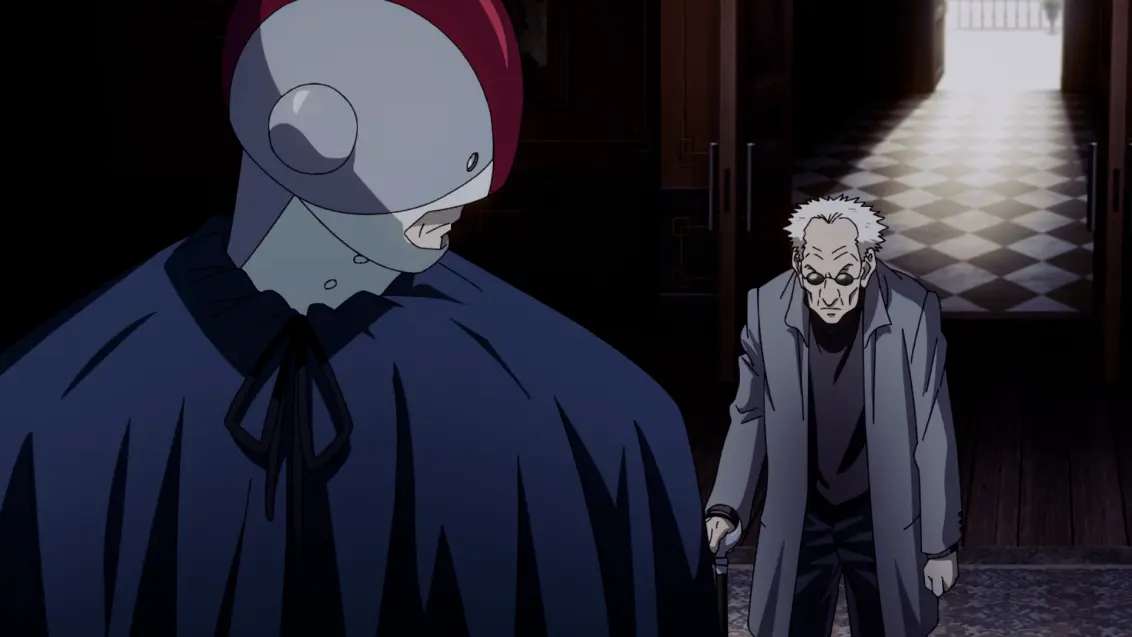
The official first-episode synopsis places North No. 2 as a butler working for the blind musician Paul Duncan. The inspected gallery frame below shows the large armored figure close to the left edge and Duncan farther back at right, beside a doorway and a receding checkerboard floor. The scale difference and the cool shadowed interior are visible properties of this single image.
Our interpretation of the composition is that it turns a relationship into the immediate point of attention. A body associated with physical power occupies the foreground, while the smaller person is neither erased nor made visually irrelevant. Looking from one figure to the other invites a question about what service, dependence and recognition might mean between them. It does not establish the full conversation or its outcome.
That makes this a useful original visual beside the detective discussion. The official premise includes a mystery, but the first installment also introduces a domestic relationship. Give both kinds of material attention. A still can suggest proximity and distance; the episode’s voices, movement and music determine how those possibilities unfold. We have not treated a publicity gallery as proof of an unseen shot-by-shot sequence.
Original visual reference
Why Studio M2’s role needs to be named precisely
The official credits identify Toshio Kawaguchi as director, Shigeru Fujita as character designer, Yugo Kanno for music, Studio M2 for animation production and GENCO as producer. Masao Maruyama’s career connection with MAPPA does not make MAPPA the credited animation studio for PLUTO. A founder’s biography and a project’s production credit answer different questions.
In the first official producer interview, Taro Maki dates Studio M2’s establishment to January 2016 and completion of the pilot to November 2017. Maruyama describes the difficulty of reducing the manga’s material substantially and the eventual decision to maintain its volume. The follow-up interview describes M2 coordinating six production studios and maintaining consistency across the long installments.
That account suggests a useful way to appreciate the screen adaptation: coordination is part of the achievement, alongside a single attractive drawing. A long mystery needs its characters to remain recognizable across scenes and episodes. The interview gives a production account of that goal; it does not authorize attributing every frame to one individual or assuming all participating teams had identical responsibilities.
Follow the particular credit that interests you
VIZ’s product credit names Naoki Urasawa and Osamu Tezuka, co-authorship with Takashi Nagasaki and cooperation with Tezuka Productions. The official anime materials additionally identify Macoto Tezka’s supervisory role. Preserving those distinctions avoids reducing an unusually collaborative retelling to a single convenient author label.
For someone interested in Urasawa’s suspense, his other books are possible comparisons rather than mandatory shared-universe entries. For someone interested in Tezuka, the named Astro Boy source story is the most direct next reading choice. A shared creator is a catalog relationship; it does not prove that separate fictional events occupy the same chronology.
The anime’s Japanese cast includes Shinshu Fuji as Gesicht, Yoko Hikasa as Atom and Koichi Yamadera as North No. 2 in Netflix’s credited project announcement. A vocal performance belongs to this adaptation and language track. Check the cast for your chosen version instead of transferring a performer from a different Astro Boy production merely because the character’s name is familiar.
Ten million copies in circulation is not anime profit
The official project introduction reports worldwide cumulative manga circulation exceeding ten million copies. We attribute that statement to the project’s promotional record. It is a cumulative circulation claim about the books, not verified retail sell-through, a current-year total or a count of Netflix viewers. The wording and scope matter as much as the impressive number.
The producer interviews discuss the scale and difficulty of animation production, but the sources used here do not disclose a numeric audited title-level budget or a profit statement. We do not convert a long production history into an invented per-episode spending estimate. Contract receipts, marketing expenditure and the division of rights would all be needed to make a meaningful profitability calculation.
The commercial evidence supports a modest conclusion: this adaptation developed around an established publishing property and a demanding production format. That is useful context for its market position. It does not establish that the screen release earned a particular return or that an audience score measures financial success.
| Evidence | Scope | Cannot establish |
|---|---|---|
| Over 10 million copies | Official promotional claim · worldwide cumulative manga circulation | Actual retail sell-through or anime profit |
| Long pilot and series development | Named producers’ retrospective interviews | Audited budget or a fixed per-episode cost |
| VIZ print and digital catalog | Identified English editions | Current stock in every territory |
A divided response to pacing is more useful than a popularity slogan
In r/anime’s first-episode discussion, actionfirst1 praises the North No. 2 and Duncan story for drawing attention away from the central investigation, while te4rdr0p finds the opening slow and is unconvinced by that extended character focus. These are named individual reactions, not evidence that every viewer shares one response. The linked thread discusses the episode’s ending and later material, so it is spoiler-heavy.
The disagreement gives prospective viewers a practical question: do you want an investigation that spends substantial time establishing a character relationship, or do you prefer the case to advance more continuously? Appreciating the side story does not make impatience illegitimate, and finding it slow does not settle its artistic value. The long format creates room for this choice to matter.
The upper score is AniList’s directly observed weighted average for its 2023 eight-episode ONA entry: 84/100, normalized to 8.4/10 and dated 1 October 2026. It is not a rating for Tezuka’s manga, the PLUTO comic or an entire franchise. We publish one verified provider here, without blending different formats or presenting a local Animeteor vote.
After episode eight: compare the drawing, then the source
For a return visit, read the manga from volume one and compare how page turns distribute uncertainty with how a screen scene controls timing. Then, if the retelling interests you, read the named Astro Boy story in an authorized edition. Neither step is a missing sequel; both can reveal what changes when familiar material is approached through another form.
Keep later plot questions in a separate spoiler-aware discussion. This introductory guide gives you a complete entry route, edition identities, original imagery and a few concrete ways to think about the adaptation. It does not replace reading or watching the work with an ending summary. Games and live-action adaptations are excluded from the core map, in keeping with Animeteor’s separate supplementary-format system.
Primary sources and useful navigation
- Official PLUTO story and eight-episode gallery · later spoilers
- Official introduction · source relationship and reported manga circulation
- Official explanation of The Greatest Robot on Earth · source-story spoilers
- VIZ · English PLUTO series
- VIZ · volume 1 paperback identity
- VIZ · final volume 8 paperback identity · ending spoilers
- VIZ · final volume 8 digital edition identity
- Official producer interview · development and pilot
- Official producer interview · long format and participating studios
- Urasawa interview · childhood source-story response
- Urasawa interview · animation and return to the source manga
- Nagasaki interview · protagonist and suspense approach
- Netflix · dated 2023 premiere announcement
- Netflix · official project credits and synopsis
Community and catalog routes
- AniList · 2023 anime catalog and audience score
- MyAnimeList · anime entry navigation
- Wikipedia · PLUTO manga reference and citations, spoilers
- Reddit · named first-episode responses, major spoilers
The production and publisher links support project facts. Catalog and community pages are secondary navigation and may reveal later events.
Find this work in our thematic collections
Original series imagery is reproduced under permission asserted by the site owner; the source and rights credits are retained. The route diagram is Animeteor’s own explanatory graphic.
A separate historical stage interpretation
Bunkamura’s production archive identifies PLUTO’s 2015 stage adaptation and a reworked 2018 production directed and choreographed by Sidi Larbi Cherkaoui. The Tokyo 2018 engagement ran 6–28 January, with Mirai Moriyama and Tao Tsuchiya among the performers. This is performed theatre, not a newly announced live-action film or an additional Netflix season; it stays outside the manga–anime sequence.